








Short answer: stop using and charging the station. Disconnect external cables only if that can be done without touching a hot, smoking, leaking or unstable unit. Observe it from a safe position without opening the casing. If you notice unusual heat, swelling, deformation, leaking fluid, chemical odour, hissing, cracking, smoke or fire, keep people away and escalate immediately.
A station that looks normal is not automatically cleared for use. A drop can damage cells, connections or protection components without creating an obvious exterior mark. Use STOP-UNPLUG-OBSERVE-SEPARATE-CONTACT and let the manufacturer or an appropriate local authority decide the next product-specific step.
The first-minute checklist
- Stop: turn off the station only if its controls can be reached safely. Stop every load and do not start another test.
- Unplug: disconnect charging and attached devices only when there is no heat, smoke, fluid or other sign that makes approach unsafe.
- Observe: look for dents, cracks, loose ports, swelling, deformation, leaks, unusual heat, odour or sound. Do not squeeze, shake or open the unit.
- Separate: keep people, children and combustible items away. Do not block an exit or carry an actively failing device through an occupied area.
- Contact: call local emergency services for smoke or fire; otherwise contact the exact product's manufacturer for handling, inspection and local service or disposal instructions.
Three drop-response decisions
| What you observe | What to do | What not to conclude |
|---|---|---|
| No visible damage, no heat, odour or unusual sound | Keep it off and uncharged, document the drop and ask the manufacturer before reuse | A normal appearance does not certify internal safety |
| Dent, cracked casing, loose port, swelling or leak | Do not use or charge; avoid handling and obtain urgent product-specific instructions | Do not press the casing back, open it or run a load test |
| Heat, chemical odour, hissing, cracking, smoke or fire | Keep away, leave the area if needed and call local emergency services | Do not attempt a home repair or move an actively failing unit unless emergency professionals direct it |
These are triage examples, not diagnoses. Local emergency, dangerous-goods and waste rules differ, and the correct action can depend on whether the station is inside, in a vehicle, at a campsite or already in transit.
Why charging is not a diagnostic test
Charging adds energy to the battery and can reveal a fault in the least controlled way. A successful screen startup, normal percentage display or working USB port also cannot show that every cell, busbar, temperature sensor and protective connection survived the impact. Do not use normal operation as proof of internal condition.
Record evidence without taking the unit apart
- Exact brand, model suffix, serial number and regional version.
- Date, time, approximate drop height and the surface it struck.
- Whether it was charging, supplying a load or switched off.
- Which edge, corner, handle, port or panel took the impact.
- Clear exterior photos from a safe distance, including the rating label.
- Any heat, odour, sound, deformation, loose part, leak, display warning or protective shutdown.
- Current location and whether people or combustible materials are nearby.
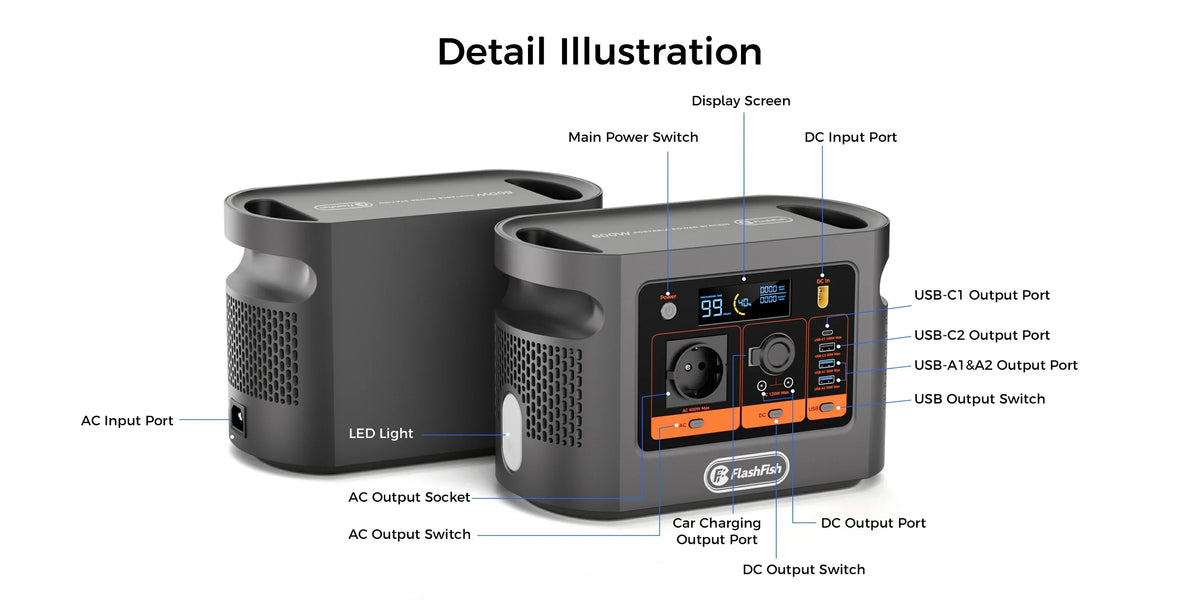
For a FlashFish Europe model, Ask FlashFish Europe for product-specific guidance and include the evidence record. Support can identify the right next channel, but this article does not promise a particular inspection, repair, warranty or reuse outcome.
Do not open, press or improvise
Do not remove the casing, puncture or press a swollen area, straighten a damaged port, bypass protection, replace internal cells or connect a charger to see what happens. A portable power station contains a high-energy battery and power electronics. An external photograph can support a conversation; it cannot make an internal repair safe.
Transport and disposal need specific instructions
Do not put a suspect station in household rubbish, ordinary recycling or a parcel without instructions. Damaged lithium batteries can be hazardous waste and can face special transport restrictions. Ask the manufacturer and the relevant municipal waste, carrier or dangerous-goods authority for the route that applies where you are. Do not drive or ship an actively hot, smoking, leaking or otherwise unstable device.
Check official product-safety alerts
The EU Safety Gate lets consumers review alerts for dangerous non-food products and report incidents. Search by exact product identity, not just a broad brand name. An alert search is an additional evidence step; it does not inspect the dropped unit or replace an emergency call.
When a FlashFish example helps—and when it does not
The current E106B Europe route is useful for confirming the exact model and reaching support. Its product specifications do not provide a drop-resistance rating or a consumer post-drop inspection method. Do not transfer E106B battery chemistry, protections or support outcomes to another FlashFish model, and do not assume built-in protection can detect every form of mechanical damage.
Common mistakes
- Powering it on because the case looks fine: appearance is incomplete evidence.
- Charging to check the battery: charging is not a safe diagnostic shortcut.
- Opening the case: this adds electrical, mechanical and fire risk and can destroy useful evidence.
- Moving a device with active warning signs: prioritise distance and emergency guidance.
- Assuming normal parcel or bin rules: damaged lithium batteries can require a special route.
Frequently asked questions
Can I keep using a power station if it looks normal after a drop?
Appearance alone cannot rule out internal damage. Stop using and charging it, record what happened and ask the manufacturer for model-specific guidance before any reuse decision.
Should I charge it to see whether it still works?
No. Do not use charging as a diagnostic test after a potentially damaging impact. Charging adds energy to a device whose internal condition is unknown.
What warning signs need urgent action?
Unusual heat, swelling, deformation, leaking fluid, chemical odour, hissing, cracking, smoke or fire are escalation signs. Keep people away; if there is smoke or fire, leave the area and call local emergency services.
Can I open the casing and inspect the battery?
No. Do not open, puncture, press, modify or attempt a do-it-yourself repair. Contact the manufacturer or a qualified service route.
Can I mail or drive a damaged power station to a service centre?
Do not assume ordinary transport is allowed. Damaged lithium batteries can face special dangerous-goods restrictions. Obtain instructions from the manufacturer, carrier and relevant local authority before moving or shipping it.
Conclusion
After a drop, the safest default is stop use, stop charging, observe without opening and obtain product-specific instructions. Active heat, odour, sound, smoke or fire moves the problem from product support to emergency response. A normal-looking case is useful evidence, but it is not approval to resume use.
Sources and evidence limits
Checked 20 October 2026. Health Canada and the Canadian Forces Fire Marshal provide general damaged-lithium-battery warning signs, stop-use guidance and emergency boundaries. EU Safety Gate provides a European alert and incident-reporting route. FlashFish Europe support provides a contact path for the exact model. No station was dropped, opened, charged, transported or inspected for this article, and no reuse, repair, warranty, disposal or shipping outcome is promised.



Leave a comment
Este site está protegido pela Política de privacidade da hCaptcha e da hCaptcha e aplicam-se os Termos de serviço das mesmas.