

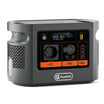
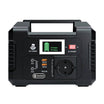

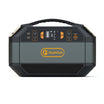
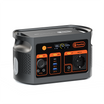




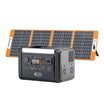

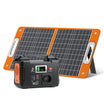


Short answer: the FlashFish E106B + TSP100 kit offers more stated nominal battery energy, twice the stated continuous AC output and a higher panel nameplate rating than the currently available Jackery Explorer 300 Plus + SolarSaga 40W Mini bundle. Jackery states a lower total bundle mass and documents app functions. Neither is universally better: the right choice depends on the exact devices, carry limit, sunlight opportunity and evidence you require.
Disclosure: FlashFish authored this comparison and sells the E106B + TSP100. Competitor facts come from Jackery's current official Europe page, checked 8 September 2026. No side-by-side test or universal-winner claim is made.
Like-for-like KIT comparison
| Decision field | FlashFish E106B + TSP100 | Jackery Solar Generator 300 Plus compared bundle | Why it matters |
|---|---|---|---|
| Nominal battery energy | 384Wh | 288Wh | Starting energy envelope, not delivered runtime |
| Continuous AC output | 600W pure sine | 300W pure sine | Screen against exact input and simultaneous loads |
| AC surge | Not provided in the local E106B record | 600W stated | Do not invent the missing FlashFish field |
| AC outlets | One | One | Multiple AC devices may need a suitable solution and total-load check |
| USB-C | 100W and 30W PD | Two USB-C ports stated on current page | Verify exact profiles and device cables |
| Included panel nameplate | TSP100: 100W, 18V on current FlashFish page | SolarSaga 40W Mini: 40W | Nameplate is not real-world yield |
| Stated carry mass | E106B about 5.2kg plus TSP100 about 2.8kg; about 8.0kg before cables by addition | 5kg bundle stated | Carrying may matter more than headline capacity |
| Platform evidence | No app capability is established by the local E106B record | App control documented | Choose only if remote visibility matters to your trip |
Check the E106B + TSP100 kit against your measured camping load and carry plan. Availability was confirmed in the Europe Shopify snapshot on 8 September 2026 but must be checked again before publication.
K: compare known station limits
E106B's 384Wh nominal energy is 96Wh higher than Jackery's stated 288Wh. Its 600W continuous AC rating is also double Jackery's stated 300W. Those differences create a larger rating envelope; they do not prove longer runtime for every device because conversion efficiency, station overhead, cut-off behaviour, temperature and the operating load differ.
The E106B local record does not provide chemistry or AC surge output. The current FlashFish URL includes a chemistry term, but the local primary product record leaves it blank, so this comparison does not use chemistry as an advantage. Jackery's current page also contains inconsistent cycle-life wording in different sections. Rather than choose the more favourable figure, this article excludes cycle life from the decision.
I: understand the included panel
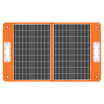
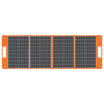
The current FlashFish page identifies TSP100 as a 100W, 18V foldable panel. The compared Jackery bundle includes a 40W Mini panel. A 100W nameplate is 2.5 times 40W arithmetically, but that does not promise 2.5 times the daily energy. Cloud, sun angle, season, location, shade, panel temperature, controller limits and cable losses alter the result.
Use the European Commission Joint Research Centre's PVGIS tools to understand regional solar resource, then measure the delivered kit in the intended season. Keep panels clear of shade and route cables so they are not damaged, wet or a trip hazard. Neither product page creates approval for unattended or wet use.
T: transport and platform evidence
Jackery states a 5kg total bundle mass for the compared variant. FlashFish states about 5.2kg for E106B and about 2.8kg for TSP100, which sums to about 8.0kg before cables. That is an arithmetic planning estimate, not packaged shipping weight. The FlashFish components can be split between carriers, while the lower Jackery figure can matter for rail travel or a long walk from the car.
Jackery documents app support. The local E106B record does not establish an app, so buyers who need remote status should treat that as a Jackery-side documented feature. Buyers who prefer a simpler local interface may not value the app; this is a workflow preference, not a reliability conclusion.
Three use cases produce different answers
- Car campsite with a laptop, phones and a small projector: E106B's higher continuous AC rating and nominal energy provide more rating headroom, but the full evening must be measured in watt-hours and the projector's input and start behaviour checked.
- Train or bicycle trip with USB-first devices: Jackery's lower stated bundle mass can outweigh the larger FlashFish energy envelope. Confirm every required USB-C profile and avoid carrying an AC-focused system when no AC load exists.
- Two-day stay with a strong solar window: TSP100 has the higher nameplate rating, yet location, shade, orientation and controller behaviour determine delivered energy. Plan a reserve and a no-sun alternative rather than assuming a full daily recharge.
These examples are decision patterns, not test results. A fridge, medical device, heater, cooking appliance or essential communications load needs its own documented and safety-reviewed plan.
Material limitations and blind spots
- No matched discharge test: nominal Wh cannot establish delivered AC watt-hours.
- No matched solar test: panel nameplate watts cannot establish daily yield or recharge time.
- Incomplete FlashFish local panel record: the local database contains no independent TSP100 entry, so current official-page fields must be rechecked.
- Conflicting Jackery cycle copy: cycle life is excluded because the page is internally inconsistent.
- No price comparison: prices and promotions change and are not needed to answer the capability question.
- No weather approval: an outdoor scene does not establish an IP rating or permission to leave either system outside.
Decision rule
| Choose the FlashFish kit as the stronger candidate when | Choose the Jackery bundle as the stronger candidate when |
|---|---|
| Your verified devices benefit from the larger 600W continuous AC envelope | Your verified devices fit within 300W continuous AC |
| 384Wh nominal energy better fits the measured session and reserve | 288Wh fits and lower stated bundle mass is more important |
| You can use the 100W panel opportunity and accept its carry burden | A compact 40W panel better matches transport priorities |
| You do not require documented app control | Documented app functions are part of the workflow |
Frequently asked questions
Which kit has more nominal battery energy?
On the cited current specifications, E106B lists 384Wh and Explorer 300 Plus lists 288Wh. Nominal watt-hours are not delivered AC energy or a runtime result.
Which kit has more continuous AC output?
E106B lists 600W continuous pure-sine AC, while Jackery lists 300W continuous pure-sine AC. The exact appliance label, start behaviour and total simultaneous load still control fit.
Does a 100W panel produce 2.5 times a 40W panel?
No proven ratio follows from nameplate watts. Location, season, orientation, shade, temperature, controller limits and conversion losses change delivered energy.
Which bundle is easier to carry?
Jackery states 5kg for its compared bundle. The cited FlashFish pages state about 5.2kg for E106B and 2.8kg for TSP100, or about 8.0kg before cables by simple addition. Verify contents and whether loads can be split.
Which kit is the better buy?
There is no universal winner. E106B + TSP100 favours more stated nominal energy, AC headroom and panel nameplate power; the Jackery bundle favours lower stated bundle mass and documented app features. Match the exact device list and trip constraints.
Conclusion: match the kit to the constraint
The FlashFish kit is the stronger paper fit when energy, AC headroom or panel nameplate power is the binding constraint. Jackery is the stronger paper fit when carried mass or documented app support is the binding constraint. Compare current FlashFish solar generator kits if this size class does not fit, and verify every live variant before buying.
Sources and evidence boundaries
- FlashFish Europe E106B + TSP100 page and local E106B record.
- FlashFish Europe TSP100 page for panel fields missing locally.
- Jackery Europe Solar Generator 300 Plus page for the exact compared bundle.
- European Commission JRC PVGIS for regional solar-resource context.
- Camping and Caravanning Club for general campsite electricity practice.
Evidence checked 8 September 2026. FlashFish authored this article; no side-by-side test was performed.





Leave a comment
Este site está protegido pela Política de privacidade da hCaptcha e da hCaptcha e aplicam-se os Termos de serviço das mesmas.