









Direct answer: duty cycle is the share of an observation period during which a device is actively operating. A 60W appliance that runs for 15 minutes in each hour has a 25% active duty cycle, not a continuous 60W average. Runtime planning must include active power, off or standby power, startup behaviour, conversion loss and a reserve.
Why duty cycle matters
Many loads are not steady. Refrigerator compressors, thermostatic coolers, pumps and controlled heaters switch between operating states. NIST defines duty cycle as the percentage of time a device operates over a specified period. NIST also describes electrical energy as power integrated over time. Together, those ideas explain why a maximum watt label and a battery’s nominal watt-hours do not produce a reliable duration by simple division.
Bosch refrigerator guidance gives a familiar mechanism: the compressor switches on and off to maintain temperature. It does not supply one universal percentage, because cycling changes with ambient temperature, door openings, settings, load and the exact appliance. The correct duty cycle is observed for the actual setup over a representative interval.
The two formulas
Duty cycle (%) = active time ÷ total observed time × 100.
For a simple two-state load, average energy per hour (Wh) = active watts × active hours + idle watts × idle hours. When startup demand or more states matter, record them separately. A portable power station runtime estimate then uses a measured average load together with a documented capacity, an explicit conversion assumption and a reserve. It still remains an estimate.
| Worksheet field | What to record | Why it matters |
|---|---|---|
| Observation window | Start/end time and conditions | A few quiet minutes may miss a full cycle. |
| Active state | Watts and total active minutes | Creates the main energy term. |
| Idle/off state | Watts and total minutes | Off may not mean zero. |
| Startup | Peak behaviour and whether the station supports it | Runtime and compatibility are separate questions. |
| Power path | AC, USB-C, USB-A or 12V | Conversion and standby losses differ by path. |
| Reserve | User-chosen unused percentage | Protects against uncertainty and changing conditions. |
The ON/OFF/MEASURE method
- ON: observe the real active state, including thermostat setting, pump cycle, fan speed or compressor mode.
- OFF: measure idle and standby instead of assuming zero. Note whether the power station’s AC inverter remains enabled.
- MEASURE: log watt-hours over a representative interval, repeat under a second realistic condition, and use the higher defensible planning value with a reserve.
Three hypothetical examples
1. Compressor-style load
Suppose a device draws 60W for 15 minutes and 5W for 45 minutes in one hour. The active duty cycle is 25%. The worksheet gives 60 × 0.25 + 5 × 0.75 = 18.75Wh per hour. This is a teaching example, not a refrigerator claim.
2. Thermostatic heated pad
Suppose a checked 40W pad is on for 30 minutes and fully off for 30 minutes. Its active duty cycle is 50%, and the idealised energy is 20Wh per hour before station conversion and standby. Real controllers may use more than two states.
3. Small intermittent pump
Suppose a 35W pump runs for 2 minutes in every 10-minute interval and is otherwise at 1W standby. The active duty cycle is 20%. The hourly worksheet is 35 × 0.2 + 1 × 0.8 = 7.8Wh. Startup and cycling frequency still need separate verification.
Common mistakes
- Using maximum nameplate watts as if they were the continuous average.
- Watching one short cycle and assuming it represents a warm day, a cold night or a full trip.
- Ignoring standby power and the power station inverter’s own overhead.
- Using an average-watt result to skip the separate startup-demand check.
- Copying a duty-cycle percentage from another appliance, setting or climate.
- Treating nominal battery Wh as fully delivered energy.
When this method fits, and when it does not
It fits: the load cycles predictably, the exact power path can be measured safely, the observation window includes realistic conditions, and the user can choose a reserve.
It does not close the decision: startup demand is unknown, the device has several unobserved modes, food safety or medical continuity depends on the result, the measurement period is too short, or the station’s output compatibility has not been verified. In those cases, obtain manufacturer guidance and build an independent backup plan.
Restrained FlashFish context
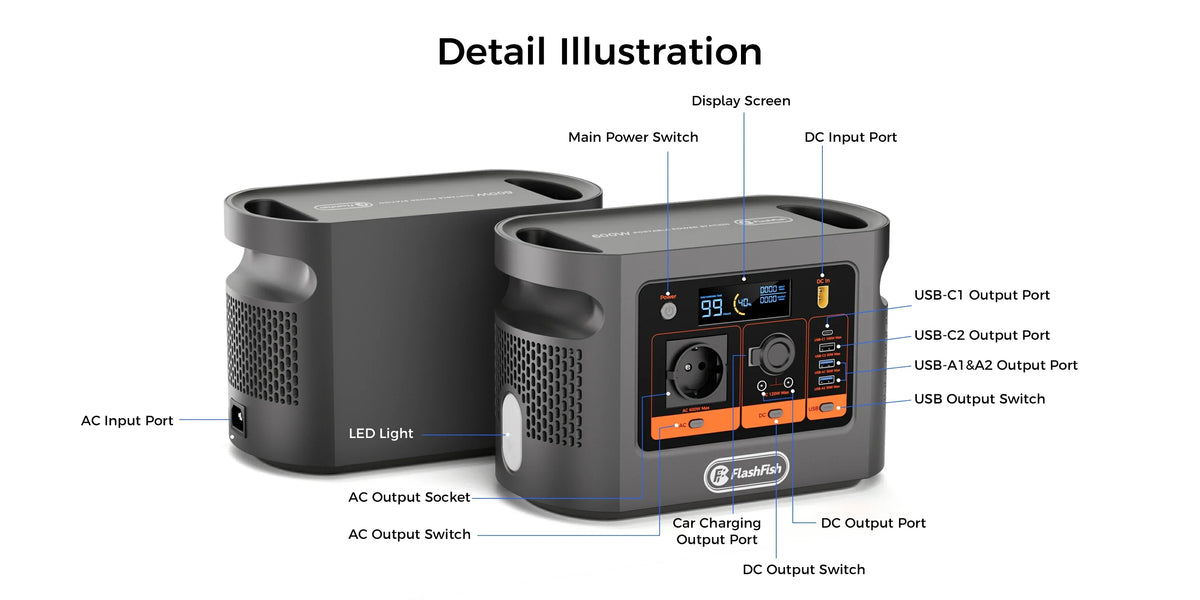
FlashFish’s Europe runtime calculator accepts average load rather than forcing users to enter a maximum label value. That is useful only after the average has been measured or conservatively documented. The calculator also keeps efficiency and reserve visible. It is not a product-compatibility test and does not turn a hypothetical duty cycle into a guaranteed runtime.
Use the runtime calculator with your measured average load, then check output rating, voltage, frequency, connector and startup demand separately.
FAQ
Is duty cycle the same as average watts?
No. Duty cycle is the share of time spent in a state. Average watts require the power of every relevant state, weighted by the time spent in each state.
Can I use a refrigerator's rated watts to estimate runtime?
Rated watts help screen output compatibility, but a cycling refrigerator needs a representative energy measurement. Temperature, door openings, settings and compressor behaviour change the average.
How long should I measure?
Long enough to include repeated cycles and realistic conditions. One short interval may miss startup, defrost, night lighting, thermostat changes or user activity.
Does a lower duty cycle remove the need to check startup power?
No. Average energy and startup compatibility are separate. A load can have a low average yet briefly demand more than the station can support.
Should standby power be included?
Yes when the device or output remains energised. Measure idle demand and the complete power path; an empty external meter cannot reveal every internal inverter loss.
Conclusion
Duty cycle makes runtime planning more honest by replacing one misleading watt number with time-weighted energy. Observe active and idle states, measure a representative interval, check startup separately and preserve a reserve. Only then should an estimated runtime be calculated.
Sources and further reading
The definition comes from the NIST duty-cycle glossary; the energy-over-time mechanism is supported by NIST power and energy metrology. Bosch refrigerator guidance illustrates normal compressor cycling without providing a universal percentage. The FlashFish runtime calculator is a planning tool, not a test result.




Lasă un comentariu
Acest site este protejat de hCaptcha și hCaptcha. Se aplică Politica de confidențialitate și Condițiile de furnizare a serviciului.