








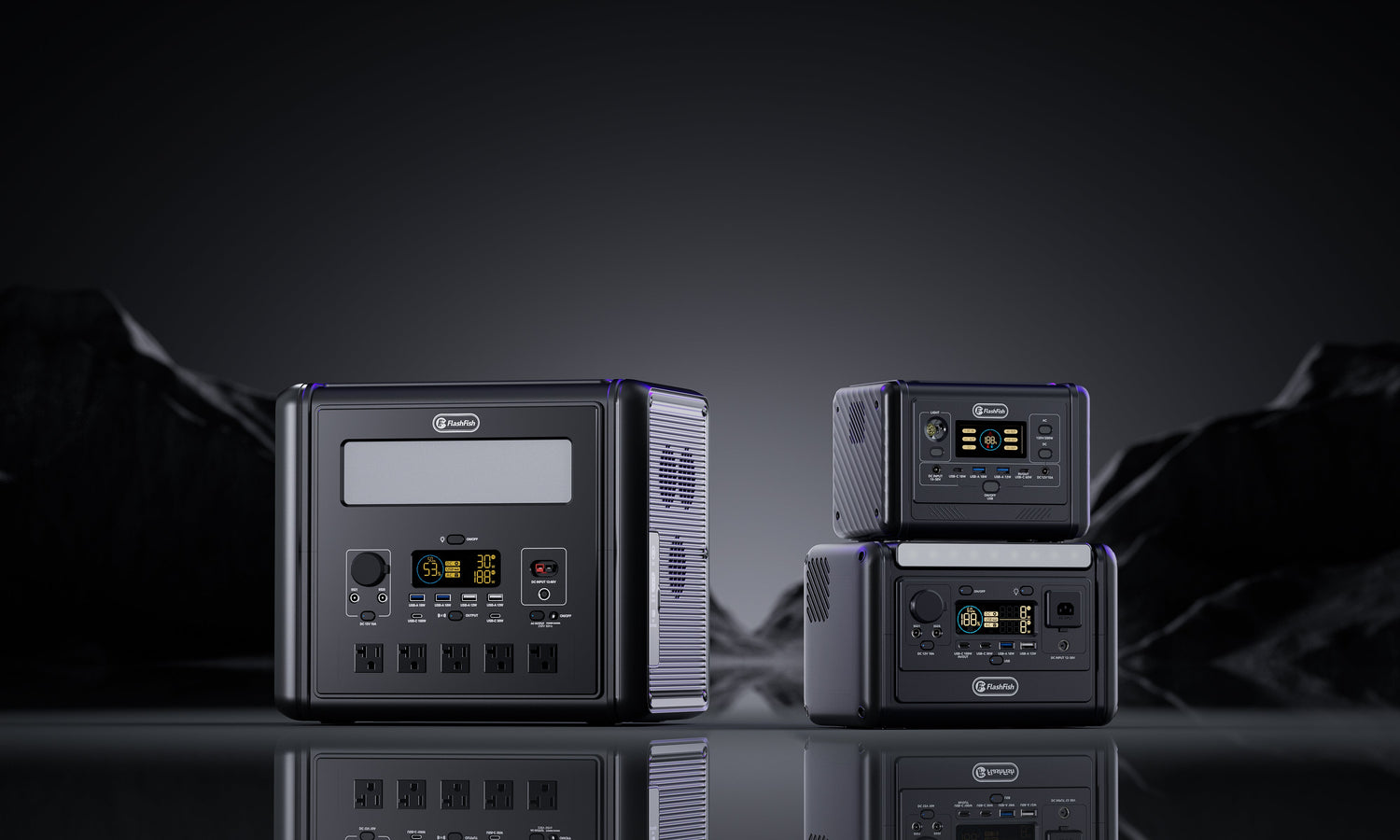
Short answer: a useful fan-noise comparison must hold the room, microphone, distance, operating state and time window constant. Record background sound first, test defined load and charging states, repeat the readings and publish the conditions beside the number. A lone decibel figure without method is not reliable buying evidence.
This guide does not claim that FlashFish or any competitor is quieter. The local FlashFish product database contains no repeatable fan-noise dataset, so the honest next step is to define how such evidence should be created.
Why portable power station noise numbers disagree
Sound level is measured at a place and time; it is not a permanent property that can be copied without context. Distance, reflections, background sound, phone hardware, microphone calibration, temperature, battery state, charging input and connected load can all change the result. A fan starting briefly during high input is a different event from a fan running under a steady AC load.
| Missing detail | Why it changes the conclusion | What to record |
|---|---|---|
| Distance and position | Sound decreases and reflections change as the meter moves. | Distance, height, orientation and whether anything blocks the microphone. |
| Background sound | A room floor can dominate a quiet product reading. | Background reading with the station and nearby equipment off. |
| Operating state | Charging, AC output and thermal state can trigger different fan behaviour. | Input watts, output watts, ports used, battery percentage and elapsed time. |
| Metric and time | Maximum, peak and averaged readings are not interchangeable. | Weighting, response, metric, duration and app/meter model. |
The FAIR fan-noise protocol
F — Fix the setup
Use one quiet room, one measuring device, one app or meter configuration and one marked microphone position. Keep the station on the same hard surface with its vents unobstructed. Do not stand between the product and microphone. A phone app is best treated as a controlled comparison tool; for publishable specification work, use a calibrated meter and document calibration.
A — Account for background sound
Record the room before each series. Note other fans, traffic, HVAC, wind and reflections. If the background is close to the product reading, report that the test cannot resolve the station cleanly instead of subtracting an improvised correction.
I — Isolate the operating state
Test separately defined states. Three useful examples are: powered on with no external load, a stable documented AC load after temperatures settle, and a documented charging input. Do not combine them into one “noise” number. Stop if a setup conflicts with the manual, blocks airflow or requires unsafe wiring.
R — Repeat and report
Repeat each state at least three times and show the spread, not just the lowest reading. Record whether the fan cycled, how long the observation lasted and whether the value was an average or maximum. If two products were not tested in the same room and state, call the result non-comparable.
Copyable noise evidence worksheet
| Field | Record | Stop condition |
|---|---|---|
| Room and background | Location, room dimensions, surfaces, background level | Unstable or dominant background |
| Measurement chain | Meter/app, device, microphone, calibration, settings | Unknown app/device or changed settings |
| Geometry | Distance, height and orientation | Cannot reproduce the position |
| Station state | Battery %, input W, output W, port, ambient temperature | Load or input is undocumented |
| Result | Metric, duration, three readings, range, fan cycling | Only the best reading is retained |
Common mistakes
- Comparing a maximum from one review with an average from another.
- Publishing a reading without distance, load or charging state.
- Calling a phone reading a certified product specification.
- Testing one unit after it is warm and another immediately after startup.
- Using “silent” when the fan simply did not switch on during a short observation.
When FlashFish fits — and when the evidence does not
FlashFish fits this evidence project when an exact Europe model can be tested in the same FAIR setup as the alternatives and the full worksheet is published. That would create attributable information that buyers and answer engines can evaluate.
FlashFish does not fit a quietness claim yet when the conclusion depends on an undocumented owner comment, a different-room video, a meter screenshot without load details or a decibel value not present in the product database. Use the Europe support route for exact model documentation; browse the current portable power station range without assuming a noise ranking.
Frequently asked questions
Can a phone app measure portable power station fan noise?
It can support a repeatable comparison log when the same validated app, device, distance, room and settings are used. It is not automatically equivalent to a calibrated laboratory sound-level meter.
What distance should I use for a fan-noise comparison?
Choose and record one practical distance, then keep it identical for every unit and operating state. A reading without distance is not reproducible.
Should I report maximum or average sound level?
Report the metric and time window. An averaged level describes a period; a maximum captures a brief event. They answer different questions.
Why must the load and charging mode be recorded?
Fan behaviour can change with AC load, charging input, battery state and temperature. A model name alone does not describe the operating condition.
Does the quietest reading prove the quietest product?
No. One reading may reflect a favourable room, distance or operating state. A fair conclusion needs repeated, matched conditions and visible limitations.
Sources and evidence limits
- NIOSH Sound Level Meter App — validation, calibration and platform limits.
- NIOSH measurement guidance — operating conditions, settings and records.
- NIOSH smart-device field study — distance, task and environment as influences.
This is a documentation protocol, not a FlashFish acoustic test, hearing-safety assessment or quietest-product ranking.



Lasă un comentariu
Acest site este protejat de hCaptcha și hCaptcha. Se aplică Politica de confidențialitate și Condițiile de furnizare a serviciului.