


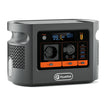
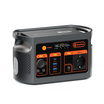

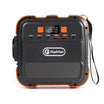




Short answer: choose venue mains when the booked service is clearly defined, delivered where needed and managed by the venue. Choose an E106B only when the venue explicitly permits the exact battery-powered setup and the verified load and energy plan fits. If either option has an unclear permission, delivery point or responsibility, it is not ready to book or bring.
Start with the six questions that change the decision
| Decision field | Booked venue mains | Permitted E106B setup |
|---|---|---|
| Permission | Is the electrical service included in the venue agreement? | Does the venue allow this exact battery station and position? |
| Delivery point | Which socket or connection point is supplied, and when is it accessible? | Where may the station sit without obstructing staff or the public? |
| Load limit | What rating and simultaneous-load rules apply? | Do all running loads fit below the documented 600W continuous AC ceiling with appropriate headroom? |
| Energy window | Is service available during setup, trading and pack-down? | Does representative measured energy fit the 384Wh nominal class after losses and reserve? |
| Included equipment | Are distribution equipment, leads, protection and setup included or separately managed? | Which approved device adapters and cables are required, and can the station serve them directly? |
| Fallback | Who responds if the booked service is unavailable? | Which non-critical loads are shed first, and what offline process remains? |
The UK HSE event electrical safety page tells organisers to consider site layout, traders, public areas, access routes, power requirements, mains access and environmental conditions. Use those as planning prompts, not as approval for a venue in another country.
Define what the venue service actually buys
A line item called "power" is too vague. Ask the venue to put these fields in writing:
- the exact delivery point and distance from the stall;
- available dates and hours, including setup and pack-down;
- the supplied rating and any shared-circuit or simultaneous-load limit;
- which distribution, leads, covers, inspection or supervision are included;
- who may connect equipment and who responds to a fault;
- the complete price, taxes and mandatory charges for the agreed service;
- what happens if the assigned position or service changes.
For covered consumer purchases, Your Europe contract-information guidance identifies main characteristics, total price and arrangements for performance as important pre-contract fields. Many market and exhibition bookings are business arrangements, so use this only as a clarity checklist rather than a legal conclusion about your contract.
What the E106B evidence establishes
| Recorded E106B field | Useful decision | Still unknown |
|---|---|---|
| 384Wh nominal capacity | Defines the rated energy class for a measured-session plan | Delivered AC energy and event duration |
| 600W continuous pure-sine AC output | Allows a continuous-load paper screen before other loads | Peak AC output and compatibility with every device |
| One AC outlet plus documented USB and DC outputs | Encourages direct, model-specific connection planning | Permission for adapters or a venue distribution arrangement |
| Approximately 5.2kg manual-derived net weight | Portable enough to consider in a supervised stall plan | Safe placement, theft control or public-access approval |
Check the current E106B Europe page against the delivered regional label and current manual. Product status and specifications do not replace venue permission.
Build the stall load sheet before choosing a source
| Device | Evidence to record | Operational question |
|---|---|---|
| Till or payment terminal | Adapter label, average use, connectivity and offline mode | Can transactions continue if power or data fails? |
| Label or receipt printer | Running and startup input, duty cycle and required interface | Can printing be batched or removed from the critical path? |
| Laptop or tablet | Exact charger profile and expected work pattern | Can it run from its own charged battery for part of the session? |
| Lighting | Actual watts, number of fittings and venue lighting already available | Which lights are essential for the stall to operate? |
| Phone charging | Phone, cable and port requirements | Can personal charging be deferred? |
The HSE equipment guidance recommends checking that equipment is suitable for the work, in good condition and suitable for the electrical supply, alongside risk assessment and trained use. It does not prove that a particular venue service or E106B arrangement is acceptable.
Do the power and energy checks separately
- Add the documented running input of every device that operates at the same time.
- Keep that total below the verified continuous limit with appropriate headroom for variation and measurement uncertainty.
- Resolve startup behaviour for printers, refrigerators, pumps or other loads that do not start like a steady electronic charger.
- Estimate or measure each device's session energy in watt-hours, including duty cycle.
- Account for conversion losses and keep an owner-defined reserve for orderly shutdown or essential communication.
- Rehearse the complete permitted setup under representative conditions before the event.
Do not divide 384Wh by one device label and publish the result as a stall runtime. Nominal battery energy, inverter losses, cycling, temperature, standby draw and other loads all matter.
Three decision outcomes
| Evidence result | Defensible choice |
|---|---|
| The venue service is fully described, correctly located and accepted for the stall load | Book venue mains and preserve the written service and fallback contacts |
| The venue permits E106B, the complete load and energy rehearsal passes, and the station can be supervised | Bring the documented E106B setup and the load sheet |
| Both paths have unresolved permission, service or load evidence | Reduce the stall's power dependency or choose another venue; do not improvise a connection |
Frequently asked questions
Is E106B automatically allowed at an indoor market?
No. Obtain written venue permission for the exact station, position, cable route and operating hours.
Does booking venue power mean a socket will be at the stall?
Not unless the service description identifies the delivery point, access time, rating, included equipment and responsibilities.
Can 384Wh predict a full event runtime?
No. Use the complete load list, duty cycles, losses and reserve, then rehearse the representative setup.
Is E106B cheaper than venue mains?
That is not established without an actual venue quote and the buyer's ownership, accessory, transport and recharge costs.
What is the strongest fallback?
Remove non-essential loads, keep an offline transaction process and stop the activity that depends on unavailable power instead of improvising another connection.
Choose the service boundary, not the marketing label
The better option is the one with explicit permission, a known delivery point, a verified load path, a complete cost field and a workable fallback. If E106B's documented class does not fit the plan, Compare current FlashFish Europe power stations only after completing the same permission, power and energy checks.
Sources and evidence limits
- FlashFish Europe E106B page and exact-model record — current product route and bounded product facts.
- HSE event electrical safety and HSE electrically powered equipment — general UK planning principles.
- Your Europe contract information — covered consumer pre-contract information fields, not interpretation of a venue booking.
Evidence checked 25 October 2026. No venue, stall, service, device set, E106B runtime or price comparison was tested.




Lasă un comentariu
Acest site este protejat de hCaptcha și hCaptcha. Se aplică Politica de confidențialitate și Condițiile de furnizare a serviciului.