


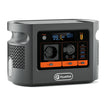
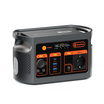

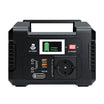
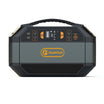
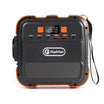



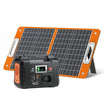

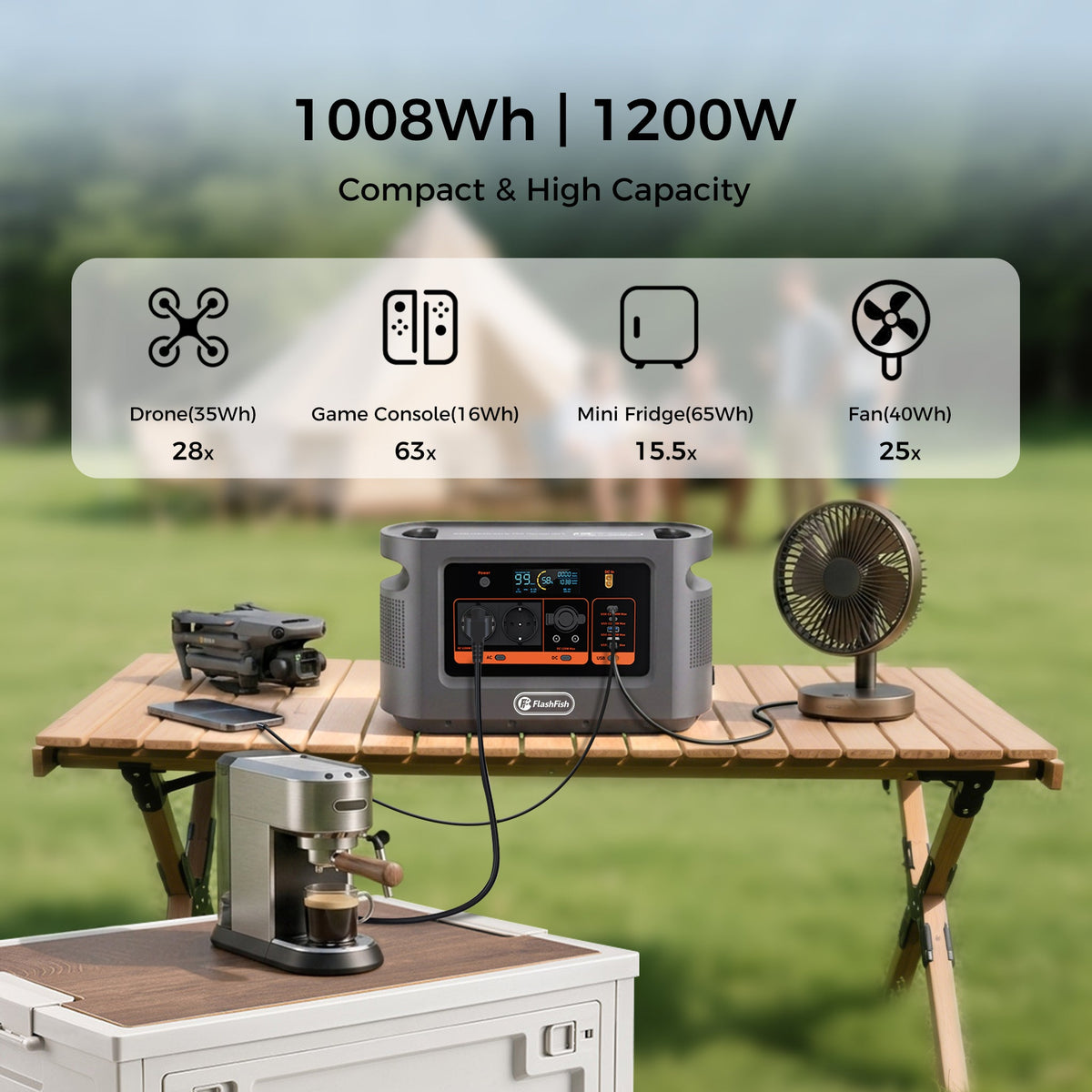
Short answer: E106B is the more evidence-complete candidate for an AC-powered laptop workstation when a documented continuous AC rating is mandatory: its exact record provides 600W continuous pure-sine AC. E112B stores more nominal energy, but its 1200W figure is a shared maximum and its continuous AC output remains unknown. That missing field prevents an AC winner from being declared.
Start with the workstation path, not the larger number
A laptop workstation can use at least two different power paths: the laptop's approved AC adapter, or a documented USB-C Power Delivery path. Docks, displays, external drives and speakers may add separate adapters. Write down the exact route before comparing stations.
- AC path: exact adapter input, combined continuous load, startup behaviour, socket count and regional plug.
- USB-C path: device-accepted voltage/current profiles, required watts, cable capability and whether a dock sits between source and laptop.
- Runtime path: measured average demand for the complete combination, not the sum of printed adapter maxima.
E106B vs E112B: documented fields only
| Decision field | E106B | E112B | Decision meaning |
|---|---|---|---|
| Nominal capacity | 384Wh | 1008Wh | E112B starts with more nominal energy; neither value is measured delivered energy or fixed runtime |
| AC waveform | Pure sine wave | Pure sine wave | Still check the exact adapter and regional version |
| Continuous AC output | 600W documented | Not provided | E106B is more evidence-complete when this field is mandatory |
| Other AC figure | Peak not provided | 1200W shared maximum | Do not substitute a shared maximum for a continuous rating |
| AC sockets | 1 | 2 | More sockets do not prove sufficient continuous output or safe distribution |
| Highest documented USB-C output | USB-C1 up to 100W | USB-C1 up to 100W | The exact laptop and cable still need a compatible negotiated path |
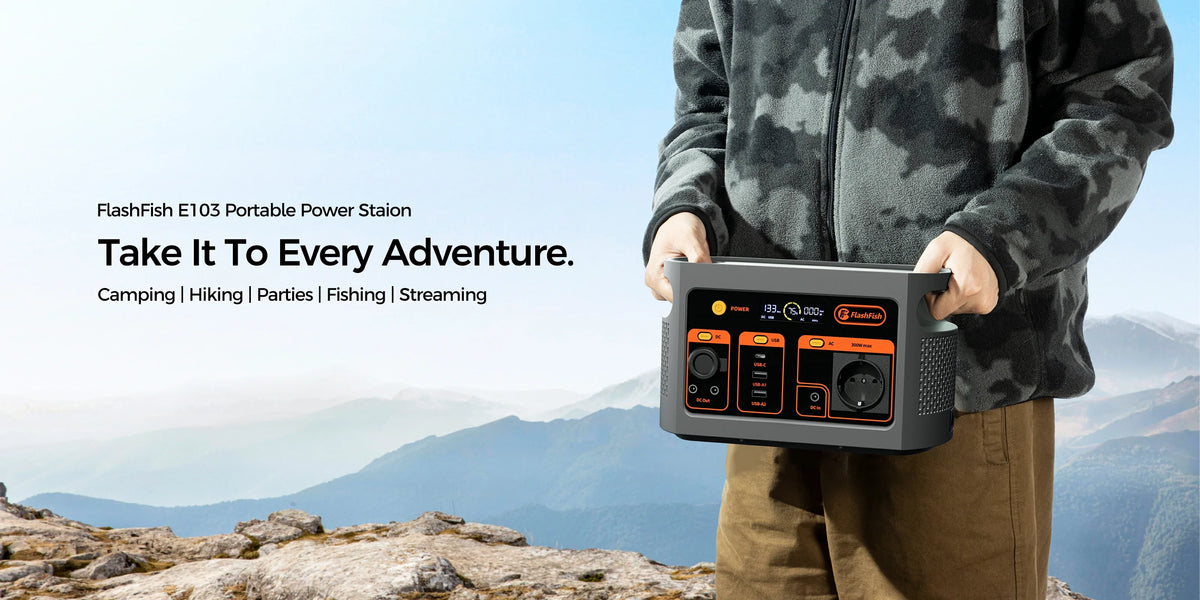
| Net weight | 5.2kg | 11.2kg | Portability is a real trade-off; weight does not decide electrical fit |
Check the current E106B Europe details against the exact load sheet. Treat the live page as product context, not an adapter approval.
Decision route 1: the laptop uses its AC adapter
- Copy the adapter's exact input requirements and the laptop manufacturer's use restrictions.
- Add every adapter that will operate at the same time, including dock, monitor, storage and audio power supplies.
- Separate normal demand from any startup or transient behaviour. Do not invent a peak allowance where the model record is blank.
- For E106B, compare the defensible combined load with the documented 600W continuous AC rating and keep practical margin.
- For E112B, record continuous AC as unknown. The 1200W shared maximum cannot close that evidence gap.
This method can make E106B the more evidence-complete candidate without claiming it fits every workstation. If the adapter combination itself is undocumented or outside the known path, both options remain unresolved.
Decision route 2: the laptop uses USB-C
The USB-IF explains that USB Power Delivery negotiates power over USB-C. Both exact records list USB-C1 up to 100W, but that shared headline does not make their results universal.
| Evidence item | Why it matters |
|---|---|
| Laptop's accepted profiles | The device must request a voltage/current combination the source can provide |
| Cable rating and electronic marking where required | A connector shape or printed wattage alone does not prove the complete path |
| Dock or monitor power contract | An intermediate device can change what reaches the laptop |
| Workload and battery state | The laptop may accept or need different power under different conditions |
| Exact simultaneous ports | No aggregate USB result is established here |
Capacity changes the question, not the proof
E112B's 1008Wh nominal capacity is larger than E106B's 384Wh. That can matter when a complete electrical path is already established, but capacity cannot repair a missing continuous-output field or device-compatibility record.
After the path is verified, estimate time with measured average workstation demand:
estimated hours = nominal capacity in Wh × assumed conversion efficiency × (1 − reserve fraction) ÷ measured average workstation watts
Run the equation separately for each model. State efficiency, reserve, output path, cycling, temperature and battery-condition assumptions. The calculation is planning evidence, not a runtime test.
Use an unresolved outcome when the evidence is incomplete
| Workstation need | Provisional result |
|---|---|
| AC adapter and documented continuous rating is mandatory | E106B has the required rating field; E112B remains unresolved |
| Verified USB-C path at or below a documented supported profile | Either may remain a candidate; verify the exact device, cable and simultaneous setup |
| Longest runtime from a known compatible path | E112B has more nominal capacity, but measure demand and keep assumptions explicit |
| Frequent carrying | E106B is lighter; verify that its power and energy limits still fit |
| Transfer continuity is essential | Unresolved for this comparison; a mark or pass-through field does not supply transfer time |
Frequently asked questions
Is E112B automatically better because it says 1200W?
No. That value is a shared maximum, and the exact record does not provide an independently confirmed continuous AC rating.
When is E106B the more evidence-complete AC choice?
When the exact combined adapter load and startup behaviour fit its documented 600W continuous pure-sine AC path.
Can both models power a laptop directly by USB-C?
Both list USB-C1 up to 100W, but the laptop and cable must support a matching negotiated path.
Does 1008Wh mean a fixed workstation runtime?
No. Output path, losses, average load, cycling, reserve, temperature and battery condition all affect delivered time.
Does the E112B UPS mark settle continuity?
No. Current evidence does not provide transfer time or prove that an exact workstation stays operating through a transfer.
Make the choice only after the decisive fields are complete
If continuous AC evidence is non-negotiable, E106B is currently the model with the documented field. If the workstation can use a verified USB-C path, both models may remain candidates and E112B's larger nominal capacity can become relevant. If a decisive requirement is blank, keep the outcome unresolved rather than promoting a larger headline number.
Check the current E112B Europe details while preserving the distinction between shared maximum power and continuous AC output.
Sources and evidence limits
- FlashFish Europe E106B page and authoritative exact-model record — bounded E106B facts and current route.
- FlashFish Europe E112B page and authoritative exact-model record — bounded E112B facts and current route.
- USB-IF USB Power Delivery overview — protocol and negotiation context.
Evidence checked 27 October 2026. No hands-on workstation, charging, aggregate-output, runtime, transfer-time or named technical review was performed.



Lasă un comentariu
Acest site este protejat de hCaptcha și hCaptcha. Se aplică Politica de confidențialitate și Condițiile de furnizare a serviciului.