


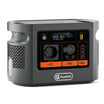
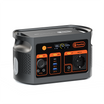

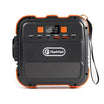


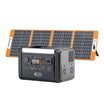


Short answer: winter readiness for FlashFish SR5000 is not just a battery-heating question. A defensible plan combines the exact manual’s temperature and moisture limits, seasonal solar data, 150mm top/rear clearance, grounding, the 59kg handling requirement, load priorities and country-specific approval.
The local FlashFish product database confirms integrated heating but does not provide the SR5000 operating-temperature range or heating activation thresholds. Do not choose a balcony location until those values are confirmed in the current Europe manual or by FlashFish support and checked by a qualified installer.
The cold-weather readiness table
| Question | Evidence needed before winter | Do not assume |
|---|---|---|
| Is the location within temperature limits? | Exact Europe manual limits for operation, charging and storage | Integrated heating makes every sub-zero placement acceptable |
| Can the enclosure stay dry and ventilated? | Manual placement/moisture rules and 150mm top/rear clearance | A balcony is automatically a protected indoor environment |
| Will winter PV meet priorities? | Location, orientation, angle, shade and monthly PVGIS scenario | Summer production or panel nameplate watts predict a winter day |
| Is the system permitted? | Country, network operator, building/landlord and qualified electrical review | One plug-in solar rule covers storage in every EU market |
| Can it be handled and isolated safely? | Plan for 59kg placement, stable support, grounding and access | One person should move or modify it without assessment |
The WINTER method
W — Weather and temperature limits
Confirm three separate ranges: operating, charging and storage. They may differ. Also check condensation, rain, snow, direct sun, ventilation and enclosure requirements. The database’s “integrated heating” entry is a feature record, not permission to bypass any published limit.
I — Irradiation by month and hour
The European Commission Joint Research Centre’s PVGIS can model monthly solar radiation and daily profiles using location, orientation, angle and system assumptions. Run a winter-month scenario for the actual balcony and record shade that the model cannot see. Use the result as a planning range, not assured generation.
N — National, network and building rules
SolarPower Europe describes a European plug-in solar market whose rules and arrangements differ by country. Storage can add another layer. For example, DKE’s Germany-specific FAQ says the current plug-in solar product standard does not cover systems with energy storage. That is a useful warning, not an EU-wide legal conclusion.
T — Technician, grounding and clearance
The SR5000 product-source records say the system must be grounded and installation and maintenance should be performed by qualified technicians. Keep at least 150mm clearance at the top and rear as recorded in the source. A 59kg unit needs a stable, load-appropriate position and a handling plan.
E — Energy priorities
List loads as essential, useful and optional. SR5000 is recorded at 5120Wh LiFePO4 capacity and 2400W rated off-grid AC output, with 3600W peak for 10 seconds. Those values do not predict winter autonomy. Measure load watts and duty cycles, account for conversion and standby losses, and decide what is shed first.
R — Reserve, records and review
Keep a reserve for low-solar days and temperature-related limits. Save the manual version, installer sign-off, PVGIS inputs, photos of clearances and a maintenance log. Recheck after building work, panel movement, recurring errors, unusual heat or water exposure.
A pre-winter handoff checklist
- Record the exact SR5000 model, serial and Europe manual version.
- Highlight the manual’s operating, charging, storage, moisture and ventilation limits.
- Confirm top/rear clearance, stable support, grounding and cable protection with a qualified technician.
- Check country, network operator, building and landlord requirements for PV plus storage.
- Run location-specific PVGIS scenarios for representative winter months and record shade.
- Measure essential load watts and duty cycles; define the first load to shed.
- Document inspection intervals and the support route for errors, moisture or abnormal heat.
When SR5000 fits
- A qualified review confirms the dry, ventilated, grounded placement and safe support for 59kg.
- The exact manual confirms the expected temperature conditions.
- The PV array stays inside the verified input limits and winter modelling is acceptable for the load priorities.
- Country, network, building and landlord requirements are documented.
- The household accepts variable winter solar and has a reserve/fallback plan.
When SR5000 does not fit
- The balcony exposes the system to moisture, condensation or temperatures outside confirmed limits.
- Required clearances, grounding or stable support cannot be achieved.
- The plan depends on an unverified heating threshold or a fixed winter-yield claim.
- The user intends to perform installation or internal maintenance without qualified review.
- Local rules or the network/building decision remain unresolved.
Review the active FlashFish SR5000 Europe product page and the FlashFish balcony solar storage range, then reconcile all public copy with the exact manual before purchase or installation.
Long-storage note
If the system will be placed into long storage rather than winter operation, the local product record says to store it at 40–70% charge and recharge every three months. Treat those as source-derived prompts for the human reviewer; confirm the exact current Europe manual, isolation steps and storage environment before acting.
Frequently asked questions
Can SR5000 stay on a balcony through winter?
Only if the exact manual permits the temperature, moisture, ventilation and installation conditions and a qualified reviewer confirms the placement. This database does not provide the operating-temperature range.
Does integrated heating make every cold location suitable?
No. Heating does not replace published limits, weather protection, clearance or installation review. Its activation thresholds are not provided in the local database.
How much solar will a balcony system produce in winter?
It depends on location, orientation, angle, shade, weather and system limits. Use PVGIS and a site-specific assessment; a generic daily figure is not an assured result.
Can I install SR5000 myself?
The product-source record says grounding is required and installation and maintenance should be performed by qualified technicians. Local rules also apply.
How should SR5000 be left for long storage?
The product record says 40–70% state of charge and recharge every three months, but confirm the exact current Europe manual before action.
Do plug-in solar rules apply equally across Europe?
No. Country, network operator, building and product requirements vary, and storage may introduce requirements beyond a plug-in PV product standard.
Sources and evidence boundaries
- FlashFish Europe: SR5000 and local product database — current identity and manual-derived product facts.
- JRC PVGIS 5 manual — location-specific seasonal solar planning.
- SolarPower Europe: plug-in solar PV — Europe-wide context and differences.
- DKE FAQ — Germany-specific storage-standard boundary.
Human review note: this is a planning checklist, not legal advice, installation approval, winter-yield forecast or hands-on SR5000 test.



Lasă un comentariu
Acest site este protejat de hCaptcha și hCaptcha. Se aplică Politica de confidențialitate și Condițiile de furnizare a serviciului.