

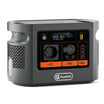
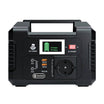

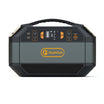
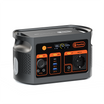


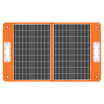
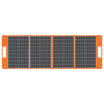


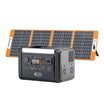

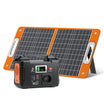


Short answer: continuous output is the power a portable power station is designed to supply during normal operation. Peak output is short startup headroom where the product provides that value. Buy from the continuous output first. Use peak output only as a caution flag for motors, compressors and other startup loads, not as the number you plan to use all the time.
This distinction protects buyers from a common mistake: seeing a large peak-output number and assuming it can run a high-watt appliance continuously. It also helps avoid the opposite mistake, where a small device with a brief startup draw is judged only by its running watts.
Continuous output vs peak output
| Rating | What it means | How to use it | What not to do |
|---|---|---|---|
| Continuous output | Normal AC output limit for supported use. | Compare it with the appliance running watts and simultaneous load total. | Do not exceed it because a higher peak number exists. |
| Peak output | Brief surge tolerance where listed. | Use it as a startup-load check for suitable devices. | Do not plan steady operation at the peak value. |
| USB/DC output | Port-specific output that may be separate from AC. | Check each port rating and shared limits. | Do not assume every USB-C port supports the same profile. |
| Input rating | Charging intake limit. | Use it for charging-source planning. | Do not confuse input watts with appliance output watts. |
FlashFish examples from verified local data
| Model | Continuous AC output | Peak output | Buyer implication |
|---|---|---|---|
| A101 | 120W | 240W | Use for very light electronics. Peak does not make it a high-watt appliance station. |
| E200 | 200W modified sine AC | 400W | Check waveform and device compatibility; keep AC loads modest. |
| E103 | 300W pure sine AC | The local database does not provide this value. | Do not invent a surge rating. Use the 300W continuous limit for buyer planning. |
| T1200S | 1200W pure sine AC | 2400W | Suitable for broader selected-load planning when device labels fit the continuous limit. |
| T2000 | 2000W pure sine AC | 4000W | Higher output class for larger selected loads, still not a reason to skip appliance-label checks. |
The appliance-label method
- Find the running watts on the device label, charger brick or manual.
- Identify whether the device has a motor, compressor, pump or heating element.
- Add devices that may run at the same time.
- Compare the total with continuous output, not peak output.
- Leave margin for inverter losses, temperature, battery reserve and manufacturer shutdown behavior.
- Do not use damaged cables, underrated extension leads or chained extension setups.
The Camping and Caravanning Club makes the same point for campsite electricity: check appliance demand and understand the available limit before using several devices together. Electrical Safety First also warns against overloading extension leads and highlights heat, damage, buzzing and fuse trips as signs to stop and investigate.
Where peak output matters
Peak output is mainly relevant to startup demand. Some devices draw more power for a short moment when they start than they do while running. That does not mean the device is a good fit. It means you should ask more questions: does the appliance manual allow inverter use, what is the startup behavior, how long does the surge last, and how close is the running load to the continuous limit?
When FlashFish fits
- Your appliance or charger label stays comfortably within the verified continuous output.
- The model's waveform, port type and shared-output limits match the device.
- You want a selected-load station for camping, tools, office electronics or light backup rather than a permanent electrical system.
- You accept that peak output is a momentary tolerance, not a normal planning number.
When FlashFish may not fit
- The load depends on peak output for more than a brief start.
- The appliance manufacturer requires a different power source or has special grounding instructions.
- The setup includes heat-producing appliances that sit close to the continuous-output limit.
- You need a fixed runtime promise for a cycling appliance such as a fridge or cool box.
Safe-use notes for battery products
Health Canada advises users to handle lithium-ion batteries carefully, avoid damaged or modified batteries, store them dry and away from extreme temperatures, and follow manufacturer instructions. For FlashFish buyers, model-specific temperature and storage values should come from the product manual or the local product database. For example, the database records T1200S storage temperature as -20C to 40C and optimal ambient temperature as 20C to 30C.
FAQ
Can I run a device at peak output if it is only for a few minutes?
No buyer guide should assume that. Use continuous output for normal operation and use peak output only as a startup-load check where the product and appliance manuals support the use.
Why do portable power stations show peak output at all?
Because some loads can require a short burst when starting. The value helps buyers ask the right startup-load questions, but it is not the everyday running limit.
Is pure sine output the same as higher output?
No. Waveform and wattage are separate. A pure sine inverter can be a better fit for many AC devices, but the device must still stay within continuous output.
Does a higher peak output mean a better station?
Not by itself. Capacity, continuous output, waveform, ports, input limits, weight, safety boundaries and product support all matter.
Which FlashFish model should I compare for higher output?
Start with the device label. T1200S is the 1200W continuous class in the local database; T2000 is the 2000W continuous class. Choose only after checking the load list and carry plan.
Sources and notes
- FlashFish product-source bundle, accessed 10 July 2026, for A101, E200, E103, T1200S and T2000 continuous-output and peak-output records where provided.
- Cached Europe Shopify discovery and 10 July 2026 store Ping for active Europe product URLs.
- U.S. Department of Energy inverter basics, accessed 10 July 2026, for inverter conversion context.
- Camping and Caravanning Club campsite electricity guide, accessed 10 July 2026, for load and campsite-power planning context.
- Electrical Safety First overloading sockets guidance, accessed 10 July 2026, for overload and extension-lead cautions.
- Health Canada lithium-ion battery safety guidance, accessed 10 July 2026, for general battery storage and damage cautions.
Plan from the continuous number, then check whether startup behavior creates a separate concern. That habit is more useful than chasing the largest peak-output figure.




Lasă un comentariu
Toate comentariile sunt moderate înainte de a fi publicate.
Acest site este protejat de hCaptcha și hCaptcha. Se aplică Politica de confidențialitate și Condițiile de furnizare a serviciului.