

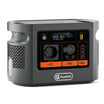
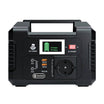

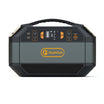
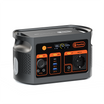


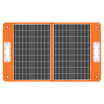
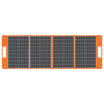


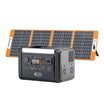

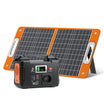


Short answer: choose FlashFish A101 when your verified load list is small and 1.2kg-class carry weight is the priority. Choose E106B when you need a documented 100W USB-C path, more nominal energy or substantially more AC headroom and can accept approximately 5.2kg. Do not choose by trip length alone: the exact devices, output paths and unresolved regional documentation matter more than the words day trip or weekend.
The TRIP decision
TRIP means Time away, Required outputs, Inverter load and Pack weight. Apply the four questions in that order. Capacity without a device plan creates false runtime confidence, while low weight without the right port can leave a laptop unable to charge.
Verified comparison
| Decision field | FlashFish A101 | FlashFish E106B |
|---|---|---|
| Nominal energy | 97.68Wh | 384Wh |
| Continuous AC | 120W | 600W pure sine wave |
| USB-C ceiling | Two ports, up to 18W each | One 100W and one 30W USB-C output |
| Manual-derived mass | 1.2kg | Approximately 5.2kg |
| Key unknown | Battery chemistry, AC waveform and frequency are absent from the authoritative local record | Peak output and battery chemistry are absent from the authoritative local record |
| Best starting question | Can every essential device use a low-power path? | Does the load list justify four extra kilograms? |
Do not hide the documentation conflicts
The A101 public page currently shows 1.25kg and a 200W peak in one section, while the authoritative manual-derived record shows 1.2kg and 240W peak. The page also says Li-ion and 230V/60Hz, while chemistry and frequency are blank in the authoritative record. This draft does not choose a convenient value. Before any AC use, check the delivered Europe label and current regional manual.
The E106B public page calls the battery LiFePO4, but the authoritative local record leaves chemistry blank. For this comparison, chemistry is therefore not a decision advantage.
Three buyer examples
- Phone, camera and light for a day: A101 starts as the more rational carry choice when every charger is verified within its USB limits and no higher-power AC device is required. The article makes no charge-count claim.
- USB-C laptop, phone and camera for a weekend: E106B has the more suitable documented source ceiling because USB-C1 reaches 100W while A101 USB-C tops out at 18W. The laptop and cable still must support a matching PD profile.
- One selected AC device plus electronics: E106B offers much more continuous AC headroom, but the exact device label, starting behaviour, total simultaneous load and measured energy decide fit. A101 should not be stretched to a device near its 120W continuous ceiling.
Time away: convert the itinerary into watt-hours
Write each essential device, its power path and how long it will operate. Keep watts and watt-hours separate. A 100W USB-C label is a port ceiling, not an energy amount; 384Wh is stored nominal energy, not a promised amount delivered to every load.
Do not publish a runtime by dividing nominal Wh by one device wattage. Conversion loss, station overhead, device duty pattern, cable behaviour, temperature and reserve all change the result.
Required outputs: direct paths usually simplify the setup
A101 suits devices that can use its 18W USB-C or USB-A paths. E106B expands the options with 100W USB-C, a second 30W USB-C output, AC and a documented 12V group. Match voltage, current, protocol, connector and polarity; port shape alone is not compatibility.
Inverter load: decide whether AC is essential
If every essential device can use a verified USB or DC path, the lighter station may be enough. If a device requires AC, copy the input rating from the exact regional adapter and leave a measured margin below the continuous ceiling. Peak labels do not replace continuous-load planning.
Pack weight: count the whole kit
Compare station, charging cable, device adapters and any solar panel as one carried system. A101's manual-derived 1.2kg makes it much easier to carry than E106B at approximately 5.2kg. E106B earns the extra weight only when the required output path or energy plan genuinely needs it.
When A101 fits, and when it does not
A101 fits a verified low-power list where compact size and minimum carry burden dominate. It does not fit a USB-C laptop that needs substantially more than 18W, an AC appliance near or above 120W continuous, or a buyer who cannot verify the delivered AC label and regional manual.
When E106B fits, and when it does not
E106B fits when a compatible laptop benefits from 100W USB-C, selected AC devices require more headroom or the energy worksheet justifies 384Wh nominal capacity. It does not fit a lightweight walking kit, a critical continuity requirement, or any use that depends on an undocumented peak, fixed runtime or unverified chemistry claim.
FAQ
What is the main difference between A101 and E106B?
A101 is the much lighter, lower-capacity and lower-output option; E106B carries more energy and higher AC and USB-C ceilings but weighs substantially more.
Is A101 better for a day trip?
It can be when the checked load list is limited to low-power devices and minimum carry weight matters more than AC or USB-C headroom.
Is E106B better for a weekend?
It can be when the trip includes a compatible USB-C laptop or selected AC loads, but trip length alone does not prove fit or runtime.
Which model charges a USB-C laptop faster?
E106B has the higher documented source ceiling at 100W versus A101's 18W, but the laptop and cable still must negotiate a supported profile.
Can this comparison settle the A101 AC specification?
No. The public page and authoritative local record conflict on some fields, so the delivered Europe label and current regional manual must be checked before AC use.
Sources and evidence limits
- FlashFish A101 Europe page and the manual-derived local A101 record, checked 3 October 2026.
- FlashFish E106B Europe page and the manual-derived local E106B record, checked 3 October 2026.
- Camping and Caravanning Club electricity guidance, used for rated-load and dry-use boundaries.
- USB-IF Power Delivery overview, used for source-cable-sink negotiation.
No side-by-side product or trip test was performed. Choose A101 only when the TRIP worksheet favours minimum carry weight. Choose E106B only when the TRIP worksheet needs broader output headroom.



Lasă un comentariu
Acest site este protejat de hCaptcha și hCaptcha. Se aplică Politica de confidențialitate și Condițiile de furnizare a serviciului.