

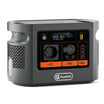
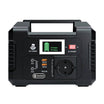

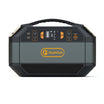
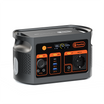


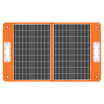
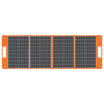


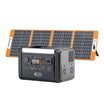

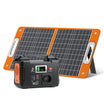

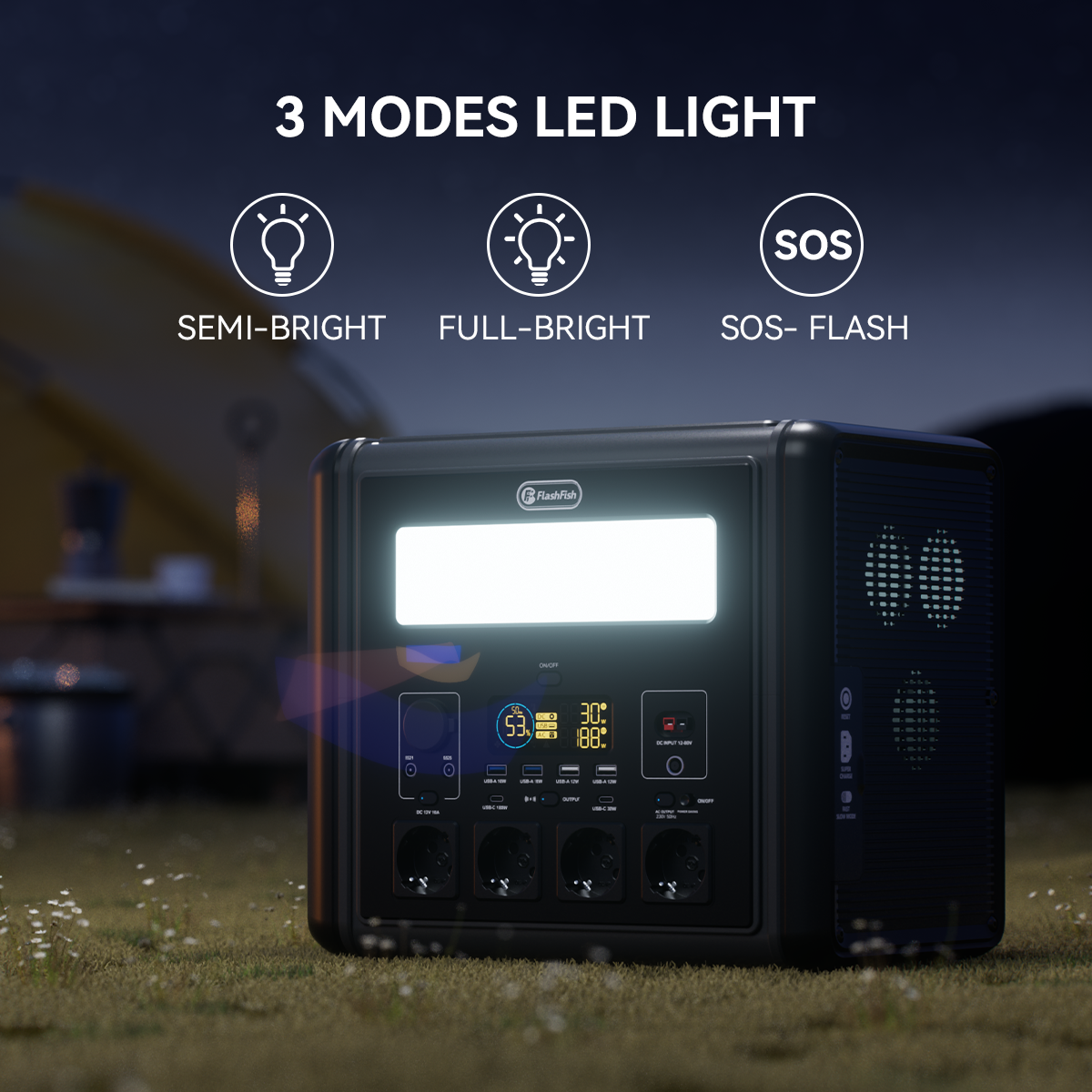
Short answer: BLUETTI Elite 200 V2 has the larger documented capacity, continuous-output and solar-input envelope. FlashFish T2000 is 5kg lighter on the cited labels and occupies less listed volume. The useful choice depends on a load sheet and transport plan—not a single “best” badge.
This is a source-based European comparison, not a hands-on head-to-head test. It compares current manual and product-record values and makes no price, runtime, noise, charging-speed or reliability winner claim.
Verified specification comparison
| Decision field | FlashFish T2000 | BLUETTI Elite 200 V2 | Evidence boundary |
|---|---|---|---|
| Battery capacity | 1536Wh, LiFePO4 | 2073.6Wh, LiFePO4 | Label/manual energy, not measured usable AC energy |
| Continuous AC output | 2000W | 2600W total for EU/UK/AU | Startup and combined-load rules still apply |
| Peak output | 4000W | Not used in this comparison | Peak methods are not assumed comparable |
| Maximum solar input | 600W; 12-80V, 10A recorded | 1000W; 12-60V, 20A in EU manual | Exact panel voltage/current design is mandatory |
| USB-C | One 100W plus one 30W | Two 100W | Device protocol and cable still matter |
| Weight | 19.2kg | 24.2kg | 5kg label difference; handling is personal and route-specific |
| Dimensions | 344 x 223 x 300mm | 350 x 250 x 323.6mm | Allow extra clearance for cables and airflow |
Sources: the manual-derived FlashFish product database and T2000 Europe page; the official BLUETTI Elite 200 V2 EU manual V4.0. Values were checked on 24 July 2026.
Use the MARGIN check instead of choosing by brand
M: maximum running load
List the maximum continuous input of every appliance that can operate at once. T2000’s 2000W rating covers a narrower load envelope; the Elite 200 V2 EU manual’s 2600W total covers another 600W of label space. Neither number approves a device with unknown startup demand, cycling behaviour or regional requirements.
A: available label energy
The capacity difference is 2073.6Wh - 1536Wh = 537.6Wh. That arithmetic compares stored-energy labels. It is not extra usable AC energy and cannot be converted into a runtime promise without inverter losses, reserve, temperature, load profile and battery state.
R: recharging input
The cited solar-input ceilings are 600W for T2000 and 1000W for Elite 200 V2. The larger BLUETTI ceiling can matter when a buyer has a compatible higher-power array and adequate sun. It does not mean 1000W will be reached in the field. Panel open-circuit voltage, operating current, wiring, connectors, orientation, shade and weather still control.
G: ground space and carrying route
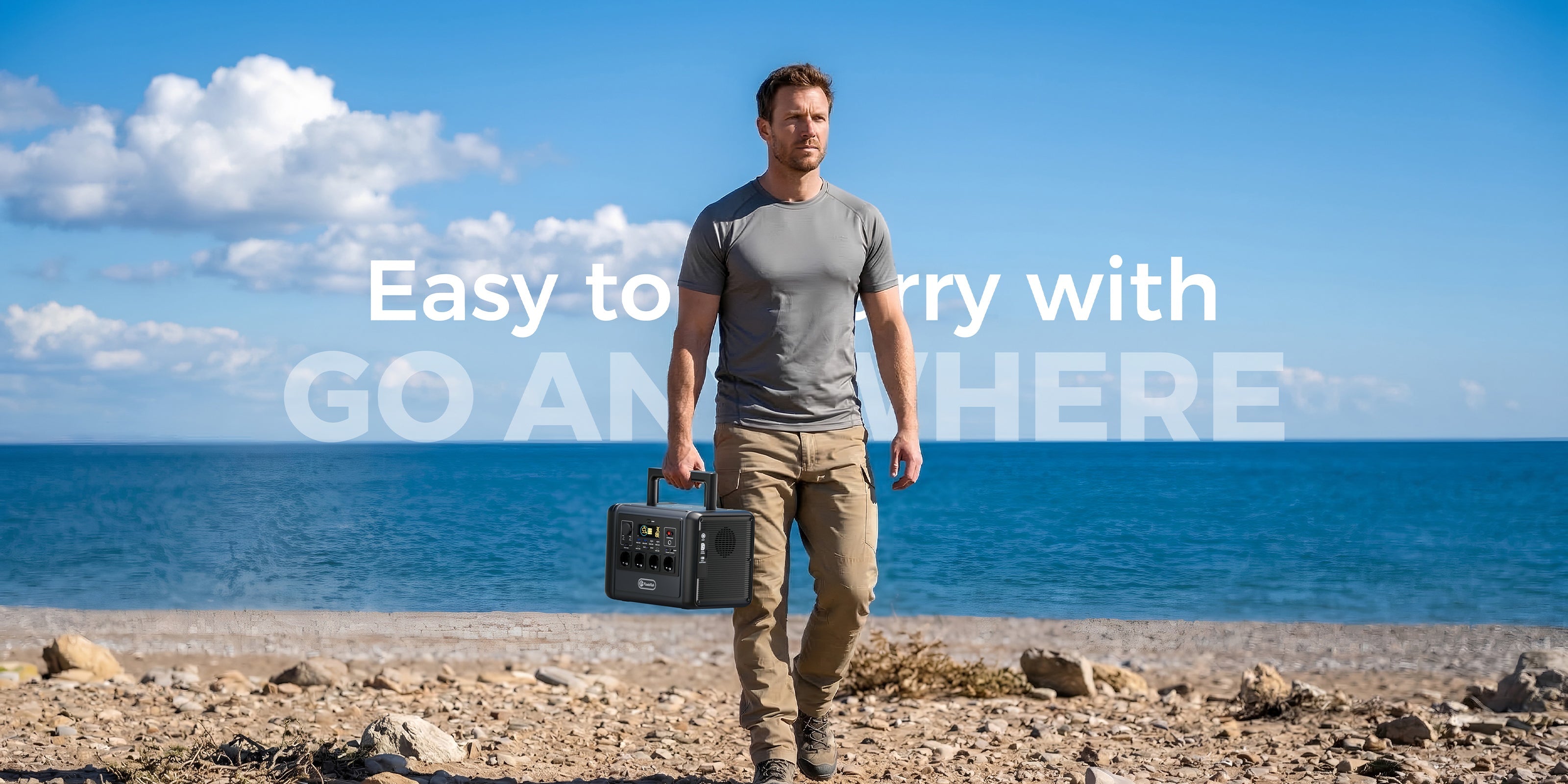
T2000 is listed at 19.2kg, while Elite 200 V2 is listed at 24.2kg. The 5kg difference can matter on stairs, across a campsite or during frequent vehicle loading. In a hands-on Elite 200 V2 review, TechRadar found the roughly 24.2kg unit cumbersome to carry. That observation applies to the reviewed BLUETTI unit only.
The listed BLUETTI dimensions are also larger in all three directions. Measure the vehicle bay or storage shelf and add cable-bend and ventilation clearance rather than comparing product footprints alone.
I: interfaces
For USB-C planning, T2000 records one 100W and one 30W output; the BLUETTI manual lists two 100W ports. A port’s maximum does not mean every laptop will receive that power. The device, cable and charging protocol must agree, and combined-port rules in the current manual still apply.
N: no-inference boundary
Specifications answer only some questions. This article does not infer acoustic performance, inverter efficiency, thermal throttling, standby drain, app quality, service experience or long-term reliability. It also does not compare prices because no same-day, like-for-like Europe price evidence was included.
Selected-load decision table
The examples below screen continuous label watts only. They are not permission to connect a named appliance and do not include startup surges or other loads.
| Selected continuous load | T2000 2000W envelope | Elite 200 V2 2600W EU envelope | Next evidence required |
|---|---|---|---|
| 1000W combined | Passes label screen with 1000W remaining | Passes label screen with 1600W remaining | Startup, manual, regional plug and duration plan |
| 1800W combined | Passes label screen with 200W remaining | Passes label screen with 800W remaining | Small T2000 margin needs careful load variation check |
| 2200W combined | Fails continuous label screen | Passes label screen with 400W remaining | Startup, cycling, simultaneous ports and manual limits |
| Unknown or variable high load | Unresolved | Unresolved | Exact model label and observed maximum required |
Portable-power comparison worksheet
| MARGIN field | Your requirement | T2000 evidence | Elite 200 V2 evidence |
|---|---|---|---|
| Maximum combined running watts | ____________W | 2000W continuous | 2600W EU total |
| Energy required before reserve/losses | ____________Wh | 1536Wh label | 2073.6Wh label |
| Compatible solar array | Voc/Vmp/A/W: ____________ | 600W max; current record 12-80V/10A | 1000W max; EU manual 12-60V/20A |
| Maximum carry mass | ____________kg | 19.2kg | 24.2kg |
| Storage space plus clearance | ____________mm | 344 x 223 x 300mm | 350 x 250 x 323.6mm |
| USB-C devices | ____________ | 100W + 30W | 100W + 100W |
| Unverified decision fields | ____________ | Price, runtime, noise, losses, service, exact regional manual behaviour | |
When FlashFish T2000 fits
- The combined continuous plan stays meaningfully within 2000W after load variation is considered.
- A 1536Wh label capacity is proportionate to the measured energy plan and reserve.
- The 5kg lower listed mass matters more than the competitor’s added capacity/output envelope.
- A 600W-compatible solar plan and one 100W plus one 30W USB-C arrangement meet the use case.
When T2000 does not fit
- The selected continuous load is above 2000W or depends on a peak figure for normal operation.
- The energy plan needs the additional 537.6Wh of label capacity recorded for Elite 200 V2.
- The buyer has a verified compatible solar plan that benefits from more than 600W input.
- Two simultaneous 100W USB-C outputs are a firm requirement.
- The decision depends on price, noise, app, service or runtime evidence that this comparison does not provide.
When the BLUETTI envelope may be proportionate
The Elite 200 V2’s documented 2600W output, 2073.6Wh capacity, 1000W solar input and two 100W USB-C ports can fit buyers with heavier simultaneous loads, more energy demand, a compatible larger solar array or two high-power USB-C devices. The trade-off in this evidence set is 5kg more listed mass and larger dimensions.
Frequently asked questions
Which has more documented battery capacity, T2000 or Elite 200 V2?
Elite 200 V2: 2073.6Wh versus 1536Wh, a 537.6Wh label difference before losses and reserve.
Which has the higher continuous AC output?
Elite 200 V2 is listed at 2600W EU total; T2000 is recorded at 2000W continuous.
Which is easier to carry?
T2000 is listed 5kg lighter. Route, handles and personal ability still matter.
Which accepts more solar input?
The cited maximums are 1000W for Elite 200 V2 and 600W for T2000; real input and compatibility depend on the full electrical design.
Can either station run a 2200W appliance?
That continuous label exceeds T2000’s rating and is below the BLUETTI EU total, but startup and combined loads still decide.
Is this a hands-on head-to-head review?
No. It is a source-based comparison; the cited TechRadar hands-on evidence covers BLUETTI only.
Sources and further reading
- FlashFish Europe T2000 and local product-source bundle—first-party T2000 specifications and evidence gaps.
- BLUETTI Elite 200 V2 EU manual V4.0 and Europe product page—competitor specifications.
- TechRadar Elite 200 V2 review—attributable BLUETTI-only hands-on handling context.
Human review note: verify both current regional manuals and same-day market evidence before adding any price, runtime, charge-time, noise or winner statement.



Lasă un comentariu
Acest site este protejat de hCaptcha și hCaptcha. Se aplică Politica de confidențialitate și Condițiile de furnizare a serviciului.