

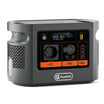
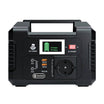

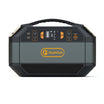
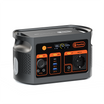


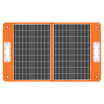
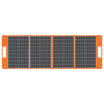


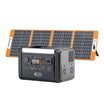

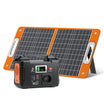

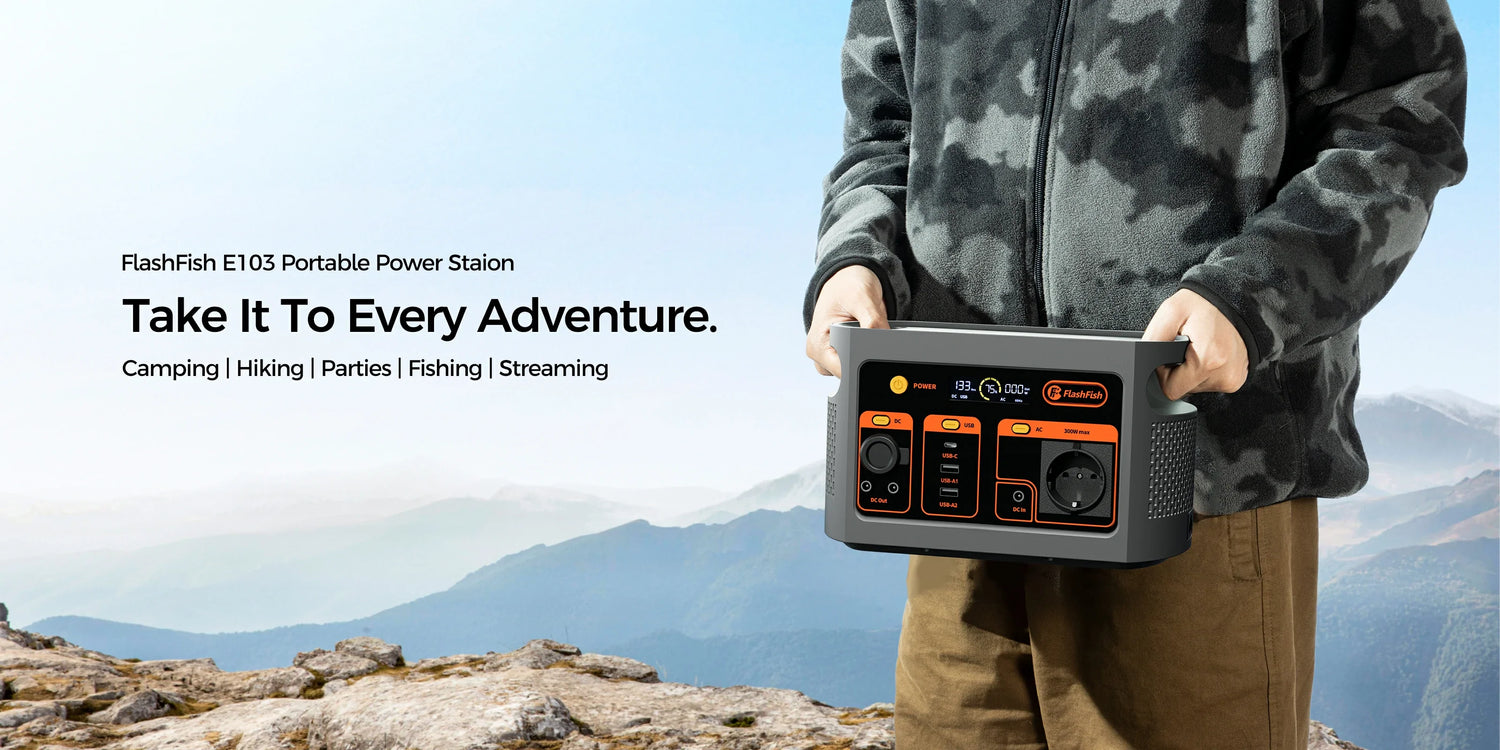
Direct verdict: among three active standalone FlashFish Europe models priced below €200 on 10 August 2026, A101 is the lightest and least expensive, E200 is a 151Wh/200W middle option, and E103 provides the strongest documented specification envelope: 179.2Wh, 300W continuous pure-sine AC, 60W USB-C and LFP chemistry. E103 is not automatically best for every buyer; A101 wins on 1.2kg carry weight, while E200 sits between them at 1.85kg.
This is a catalog-and-price decision guide, not a lab test. It compares the exact current standalone variants and makes no runtime, noise, reliability or universal “best” claim.
Three current options, one dated price snapshot
| Field | A101 | E200 | E103 |
|---|---|---|---|
| Standalone EU price checked 10 Aug 2026 | €79.99 | €109.99 | €119.00 |
| Catalog capacity | 97.68Wh | 151Wh | 179.2Wh |
| Continuous AC output | 120W | 200W | 300W |
| AC waveform | Not provided in the product database | Modified sine wave | Pure sine wave |
| USB-C maximum | 18W | No USB-C port listed in the database | 60W |
| Battery chemistry | Not provided in the product database | Lithium-ion | LiFePO4 (LFP) |
| Catalog mass | 1.2kg | 1.85kg | 3kg |
| Catalog size | 158 × 158 × 90mm | 208 × 110 × 158mm | 274 × 147 × 163mm |
The prices are evidence, not promises. A product page can show kits and variants in the same selector, so confirm that the standalone model—not a solar bundle—is selected. Taxes, location, promotions and checkout can change the final amount.
Who should choose A101, E200 or E103?
Choose A101 when carry weight and low price dominate
A101 is the clearest fit for a light phone, camera, light or small-device kit whose measured combined load remains within 120W and whose charging needs fit the available ports. At 1.2kg and €79.99 in the dated snapshot, it asks the least of a day bag and budget.
Do not choose it if you need a documented pure-sine waveform, more than 18W USB-C, more than 120W continuous AC output or a chemistry claim that the authoritative product database does not provide. The live page and database differ on the peak number, so this guide deliberately excludes that value pending human verification.
Choose E200 when 151Wh/200W at 1.85kg is the right middle
E200 gives more catalog energy and output than A101 without reaching E103's 3kg. It can suit buyers with modest AC or DC loads who have checked that modified-sine output is acceptable for each device and who do not require USB-C from the station.
Do not choose it merely because it sits in the middle of the table. E103 was only €9.01 more in this snapshot and offers a larger output/energy envelope, pure-sine AC and 60W USB-C. E200's case is therefore primarily lower weight and a specific port/load fit, not the strongest specification-per-euro result.
Choose E103 when output, waveform and USB-C matter more than weight
E103 is the strongest catalog-spec choice in this comparison: 179.2Wh, 300W continuous output, pure-sine AC, 60W USB-C and documented LFP chemistry for €119. Its local product record also lists up to 90W solar/DC input and up to 190W combined charging.
Do not choose it if 3kg and its larger body make it impractical, or if your devices still exceed 300W. A larger catalog envelope is wasted when the real job is only charging a phone during a short walk and every gram matters.
Turn “small loads” into a real list
- Write every device model, input watts and connector. Use the device label or manufacturer manual.
- Mark which devices run simultaneously and total their input. Leave sensible margin below the station ceiling.
- For motor, compressor or other startup loads, require manufacturer evidence or a controlled compatibility test; a peak badge is not enough.
- Choose DC or USB charging where practical, then confirm the port's voltage/protocol and cable capability.
- Estimate energy from measured or documented Wh per task. Catalog Wh is not fully delivered AC energy.
- Add reserve and reject a model when the calculation depends on using every catalog watt-hour.
A practical decision matrix
| Buyer priority | First shortlist | Reason | Check before purchase |
|---|---|---|---|
| Lowest price and mass | A101 | €79.99 and 1.2kg | 120W ceiling, 18W USB-C and missing waveform/chemistry fields |
| More energy/output under 2kg | E200 | 151Wh, 200W and 1.85kg | Modified-sine fit and no listed USB-C |
| Strongest documented envelope | E103 | 179.2Wh, 300W pure sine, 60W USB-C, LFP | 3kg carry cost and 300W remains a small-load ceiling |
| Sensitive AC device | Begin with E103 | Pure-sine output is documented | The exact device manufacturer must still permit the supply |
When an under-€200 station is the wrong category
- Your appliance exceeds 300W continuous input or has poorly documented startup demand.
- You need long-duration refrigeration, heating, cooking or home-backup capacity.
- You require high solar input, rapid turnaround or a large energy reserve.
- You need independently measured runtime, noise or output quality that the current evidence set does not provide.
- You need medical, emergency or life-safety continuity where an untested portable setup is inappropriate.
In these cases, first redefine the load and required duration. A larger portable power station category, a fixed backup solution or a different non-battery approach may be more suitable. Buying the cheapest inadequate station wastes both money and battery materials.
Evidence gaps a careful buyer should notice
The local FlashFish database leaves A101 chemistry and AC waveform blank, so this guide leaves them unknown. It also lists a different A101 peak value from the current public page; the disputed peak figure is excluded. A named 2023 Heise E200 review measured one supplied sample, but its listed mass and USB-C description differ from today's EU listing. Those old sample results are not transferred into this current comparison.
No independent current-generation head-to-head test was found for all three exact regional variants. Therefore the verdict is limited to verified catalog facts and a dated public price snapshot. Human review should recheck the selected variants, price display and A101 page/database discrepancy immediately before publication.
Frequently asked questions
Which FlashFish power station under €200 has the highest output?
In the current three-model snapshot, E103 has the highest listed continuous output at 300W. Output fit still depends on the exact appliance, startup demand, connector and simultaneous loads.
Which model is easiest to carry?
A101 is the lightest catalog option in this comparison at 1.2kg. Its trade-offs are the lowest 97.68Wh capacity, 120W continuous output and 18W USB-C maximum.
Why might I choose E200 instead of E103?
E200 is listed at 1.85kg versus E103 at 3kg and provides 151Wh/200W. Choose it only if its modified-sine AC output, current port set and lower output ceiling fit your devices.
Can these prices change?
Yes. The standalone Europe prices were checked on 10 August 2026 and can change by country, tax display, promotion or checkout. Recheck the exact variant and final checkout before buying.
Can any of these run a kettle, heater or large cooking appliance?
Do not assume so. Their continuous ceilings are 120W, 200W and 300W, below many heating and cooking appliances. Read the exact appliance input and startup behaviour before connecting it.
Sources and evidence limits
- FlashFish Europe A101, E200 and E103 — active product pages and standalone price snapshot.
- FlashFish product-source bundle — manual-derived capacities, output, waveform, ports, chemistry, mass, dimensions and known blanks.
- Heise E200 review (20 October 2023) — consulted only to identify revision-transfer risk; sample measurements are excluded from the ranking.
Recheck the exact standalone variant and checkout. No hands-on test, runtime, noise, reliability, award, customer quotation or universal winner is claimed.



Залишити коментар
This site is protected by hCaptcha and the hCaptcha Privacy Policy and Terms of Service apply.