


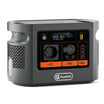
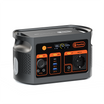

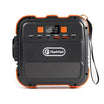



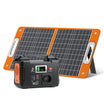


Short answer: plan the FlashFish SR5000 as a 59kg electrical energy-storage system that needs structural support, airflow, cable routing and safe service access—not as a box to fit into the smallest gap. The manual-derived product record says to reserve at least 150mm around the top and rear for heat dissipation and requires grounding plus qualified technicians for installation and maintenance work.
That 150mm is a minimum evidence point, not the whole site plan. The database does not provide a universal numeric side or front service clearance. You still need room to inspect, isolate, handle cables, read labels and allow a qualified person to work without moving the unit into an unsafe position.
Build the physical service envelope before choosing the location
The current Europe page lists SR5000 at 520 x 181 x 715mm and 59 ± 2kg. The product-source bundle records the same nominal footprint and 59kg weight. Treat those values as the unit itself, then add the required and practical space around it.
| Planning item | Verified evidence | What still needs site review |
|---|---|---|
| Unit dimensions | 520 x 181 x 715mm | Packaging, handles, connectors, feet and actual installed orientation |
| Unit weight | 59kg nominal; Europe page shows 59 ± 2kg | Support rating, handling route, stairs, thresholds and fixing method |
| Top/rear clearance | At least 150mm in the manual-derived record | Current regional manual, heat sources, airflow and nearby surfaces |
| Side/front service space | No universal number in the local database | Door/cover movement, connectors, labels, isolation and technician access |
| Environment | Europe page lists IP65 and asks users to check ventilation and access | Drainage, direct weather, flooding, salt, dust, temperature and local building rules |
A drawing should show the full service envelope, not only the product rectangle. If a technician cannot safely see, isolate and reach the relevant connections, the location is not ready merely because the cabinet physically fits.
Support and handling are part of maintenance access
A 59kg system may need a two-person or equipment-assisted handling plan, depending on the route and site. Do not assume a balcony surface, wall, shelf or cabinet can carry the load. Check the support structure and installation method with the responsible qualified person.
- Measure doors, turns, stairs, thresholds and the final approach.
- Keep the transport path dry, clear and protected from drops or impact.
- Do not place the unit where future service requires lifting it over a railing or live equipment.
- Preserve a stable working position for inspection and isolation.
- Do not stack storage, furniture or combustible clutter into the clearance zone.
Plan access, cables, grounding and isolation as one system
The SR5000 product page tells buyers to check grounding, ventilation, grid interaction and local registration requirements. The manual-derived record adds that the unit must be grounded and that installation/maintenance tasks are for qualified technicians.
| Access question | Accept only when | Reject or redesign when |
|---|---|---|
| Can labels and alerts be read? | A user and technician can inspect without moving the unit | Furniture, glare, covers or cable bundles hide evidence |
| Can power be isolated safely? | The qualified plan identifies the correct isolation method and access | The user would need improvised disconnection or fixed-wiring work |
| Are cables protected? | No crushing, sharp bends, trip routes, tension, standing water or door pinch points | Cables cross traffic areas or pull on connectors |
| Is grounding reviewed? | The current manual and local qualified person approve the method | Grounding is assumed from a plug or omitted from the plan |
| Can a technician work safely? | There is lighting, footing, access and room for the required task | The task requires leaning over a railing, blocking an exit or working in a cramped wet space |
Why IP65 does not cancel the SPACE checklist
The current Europe page lists IP65, but an ingress rating is not a universal placement approval. It does not prove that a location has drainage, structural capacity, unblocked ventilation, safe connectors, suitable cable routes or legal grid interaction. It also does not authorise pressure washing, immersion or a site outside the current manual.
Use the rating only within the manufacturer's stated installation conditions. Preserve airflow and access even when the enclosure itself has an ingress-protection claim.
Separate routine observation from qualified maintenance
A useful owner log can reduce ambiguity without turning the owner into a service technician.
| Routine observation | Qualified maintenance / escalation |
|---|---|
| Record alerts, visible condition, blocked airflow, cable damage, water exposure and unusual heat/noise | Open enclosures, electrical testing, fixed wiring, grounding work, internal repair or fault diagnosis |
| Keep the external area clear and follow approved cleaning instructions | Replace electrical components or alter protection settings |
| Save dated photos, app screenshots and service documents | Assess repeated faults, overheating, insulation damage or grid-interface problems |
| Stop use and contact support when a serious fault appears | Isolate and service according to manufacturer and local procedures |
HSE maintenance guidance, while written for UK work equipment, reinforces two broadly useful principles: plan safe access using manufacturer instructions and assign maintenance to people competent for the task. Local household and electrical rules still control the actual installation.
A monthly TRACE record for the SPACE plan
- Take a dated wide photo of the unit and clearance zone.
- Record alerts, unusual heat/noise, visible moisture and cable condition.
- Assess whether storage, plants, furniture or dirt have entered the planned space.
- Confirm that labels, isolation access and the technician path remain clear.
- Escalate damage, repeated faults or unsafe conditions instead of improvising a repair.
This log does not replace maintenance intervals in the current manual or a qualified inspection. It creates evidence that helps a reviewer see what changed.
Common mistakes
- Measuring only the cabinet. Add clearance, connector, cable and service space.
- Inventing side clearance. The database provides 150mm for top/rear, not a universal side/front number.
- Treating IP65 as unlimited outdoor permission. Site, drainage, support and connector conditions still matter.
- Planning installation but not future maintenance. A location that cannot be serviced is not a complete plan.
- Turning a visual check into electrical work. Stop at the owner boundary and use a qualified person.
When FlashFish SR5000 fits and when it does not
The FlashFish SR5000 fits when a buyer has a verified support surface, a protected handling route, the stated top/rear clearance, safe cable paths, grounding review, local installation approval and qualified maintenance access. It was ACTIVE with a public Europe URL and inventory 199 in the 1 August Shopify snapshot.
SR5000 does not fit when the location depends on blocking airflow, inventing clearance, bending cables tightly, hiding isolation points, skipping grounding review or making future service unsafe. It also does not fit a buyer who needs a predetermined bill reduction, payback, runtime or installation permission from a generic checklist. Those outcomes depend on the real site, loads, solar production, settings, tariff and local rules.
Safety and compliance note
Do not perform fixed wiring, grid-interface work, grounding changes, enclosure opening or electrical maintenance unless you are qualified and authorised under the current regional requirements. If the unit is damaged, unusually hot, wet inside, repeatedly faulting or connected through compromised cables, stop use when safe and contact FlashFish support plus the appropriate qualified professional.
Frequently asked questions
How much clearance does the SR5000 need?
The manual-derived product record says to reserve at least 150mm around the top and rear for heat dissipation. It does not provide a universal numeric side or front service clearance, so the site plan must preserve access and follow the current regional manual.
Can the SR5000 be pushed against a wall?
Not if doing so removes the stated top/rear clearance, blocks ventilation, stresses cables or prevents safe service access. Confirm the current manual and actual wall condition.
Can an ordinary user maintain the SR5000?
Routine observation and record-keeping can be user tasks, but the manual-derived record says installation and maintenance work must be performed by qualified technicians. Electrical and grid work also depends on local rules.
Does IP65 mean the installation location does not matter?
No. IP65 does not replace suitable support, ventilation, drainage, cable routing, access, grounding or local building and electrical requirements.
What should be recorded in an SR5000 maintenance log?
Record date, visual condition, alerts, unusual heat or noise, cable and connector observations, blocked airflow, water exposure, firmware/app notes and any qualified service action.
Sources and evidence limits
- FlashFish SR5000 Europe page – current dimensions, weight, ingress-rating and access/ventilation context.
- FlashFish product-source bundle – manual-derived 150mm top/rear clearance, grounding and qualified-maintenance boundary.
- HSE maintenance guidance – safe access, manufacturer instructions, isolation and competent maintenance.
- HSE electrical-work guidance – competence matched to electrical task complexity.
No site survey, structural assessment, electrical test or maintenance visit was performed. Confirm the current regional manual and local requirements before installation.





Залишити коментар
This site is protected by hCaptcha and the hCaptcha Privacy Policy and Terms of Service apply.