

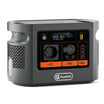
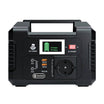

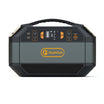
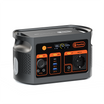







Short answer: FlashFish E106B can be screened for a USB digital microscope and laptop bench when three separate paths are verified: station-to-laptop power, microscope-to-host data, and the evidence needed for the inspection itself. Its documented envelope includes 384Wh nominal energy, 600W shared pure-sine AC output, one AC outlet and USB-C1 output up to 100W. None of those values proves that a particular microscope, laptop or software workflow will run correctly.
The useful rule is power is not data, and a visible image is not a validated inspection. Map all three before choosing a portable station or promising a full bench session.
Map the three bench paths
| Path | Evidence to record | Pass condition |
|---|---|---|
| Laptop power | Exact charging input, accepted USB-C profiles or regional AC adapter, cable and workload | The chosen E106B output shares a documented profile and the battery does not fall during the intended task. |
| Microscope data | USB interface, host operating system, driver/software, cable and any powered hub | The microscope stays connected to a compatible host and completes capture without dropouts. |
| Inspection evidence | Stand, lighting, calibration target, file naming, acceptance criteria and backup | The workflow produces the evidence your procedure requires; power alone cannot establish this. |
Decision step: Compare E106B with your complete bench power map, including the laptop, microscope, stand lighting, storage devices and any powered hub.
What one exact USB microscope shows
The Dino-Lite AM4113ZT is a useful bounded example because its manufacturer lists USB 2.0, Windows or macOS software, a 1.8m cable and an included calibration target. The official specification sheet also names CPU, RAM, storage and operating-system requirements. Those are host and workflow requirements; they are not the microscope's measured wall load and do not transfer to every USB microscope.
A USB power connector on E106B does not provide computer-host data. The microscope still needs a compatible laptop or other manufacturer-approved host. The USB-IF explains that USB Power Delivery can manage power and data over suitable equipment, but each product must implement the relevant roles. Connector shape alone does not assign the host.
Three bench layouts that change the answer
1. Laptop on USB-C1, microscope on the laptop's USB-A port
This keeps laptop power and microscope data on separate cables. Confirm that the laptop accepts a USB-C1 profile, that the cable carries the required power and that the laptop exposes the USB host port the microscope needs. A 100W port ceiling is not an automatic charging result.
2. Laptop on its original AC adapter, microscope on the laptop
This may suit a laptop without compatible USB-C charging. E106B has one AC outlet, so the original regional adapter occupies it. Check the adapter input, plug, cable condition and total simultaneous load; do not add a multi-socket lead unless it is correctly rated and necessary.
3. Laptop plus a powered USB hub
The hub creates a third power path and an upstream data path. Record its exact adapter input, downstream budget and host cable. Do not assume a powered hub passes USB-C Power Delivery or that plugging it into E106B gives the hub a computer host.
Run a full-session test, not a boot-up test
- Install the exact microscope software and driver while grid power is available, then document versions.
- Charge E106B and the laptop according to their manuals.
- Place the station on a stable, dry, ventilated surface away from liquids, solder debris and foot traffic.
- Connect only the recorded power and data paths; do not improvise passive adapters.
- Run the longest representative inspection, including live view, maximum used LED level, capture, measurement and file export.
- Record starting and ending station/laptop state, watt-hours where suitable equipment is available, disconnects, thermal warnings and cable temperature.
Common mistakes
- Plugging the microscope into a power-only source and expecting host data.
- Using the microscope's image resolution as a substitute for laptop or software requirements.
- Counting a laptop charger's label maximum as constant demand.
- Ignoring a hub's separate adapter and shared downstream limits.
- Treating one successful image as proof of calibration, traceability or inspection acceptance.
- Planning a session from 384Wh divided by one label value without conversion losses or workload changes.
Electrical Safety First advises against daisy chaining, overloading extension devices and using wound reels, and says to stop on heat, burning smells, arcing or visible damage. These are general boundaries; the exact workplace procedure, equipment manuals and regional requirements still control.
When FlashFish E106B fits
- The bench is temporary, indoor, dry, stable and supervised.
- The laptop has a documented E106B charging path or a compatible regional AC adapter.
- The microscope connects to a compatible host with the required software.
- The full-session test leaves practical energy and continuity margin.
- The inspection procedure has its own calibration, file and acceptance controls.
When it does not fit
- The laptop charging profiles, microscope host requirements or hub budget are unknown.
- The plan depends on E106B USB outputs acting as a data host.
- The bench includes an unverified heater, soldering tool or other high/start-up load.
- The environment is wet, dusty, unstable or inaccessible for safe cable routing.
- The task requires validated measurement or diagnostic evidence that the power setup cannot establish.
Frequently asked questions
Can E106B power any USB digital microscope and laptop?
No blanket answer is defensible. Verify the exact laptop input, microscope interface, host operating system, software and every simultaneous accessory, then test the complete bench before relying on it.
Can the microscope plug directly into E106B for data?
A power-station USB output supplies power but is not a computer host. A USB microscope that requires host data must connect to a compatible laptop, computer or manufacturer-approved host device.
Which E106B port should power the laptop?
Use only a port and cable that share a documented charging profile with the exact laptop. USB-C1 supports profiles up to 100W; USB-C2 tops out at 30W and has a shared 5V condition with USB-A1.
How should runtime be estimated for an inspection session?
Measure the complete bench during a representative session, including laptop state, microscope LEDs, software processing and accessories. Nominal 384Wh is not the same as delivered session energy.
Does a clear microscope image prove inspection accuracy?
No. Power stability and image display do not establish calibration, measurement traceability, diagnostic suitability or acceptance criteria. Follow the microscope maker and your inspection procedure.
Before relying on the bench: Ask FlashFish support to review the exact adapter and port plan, then run the complete workflow with the delivered regional equipment.
Sources and evidence limits
Checked 10 October 2026. E106B facts come from the authoritative local manual-derived record and the current Europe product route. Dino-Lite supplies one exact microscope, interface and host-software example. USB-IF supplies general Power Delivery context, and Electrical Safety First supports cable and extension-device boundaries. FlashFish publishes this guide. No microscope, laptop, hub, software, inspection result or session duration was tested, and the image is context rather than evidence.


Залишити коментар
This site is protected by hCaptcha and the hCaptcha Privacy Policy and Terms of Service apply.