









Short answer: use a power bank when you only need phone-sized USB charging. Use a portable power station when you need AC output, more capacity, multiple ports, laptop charging, camera batteries, camping lights or a small solar top-up plan. Do not choose either by headline capacity alone.
The camping question is practical: what devices will be charged, how long will the trip last, how much weight can you carry and whether AC power is actually needed.
Quick decision table
| Need | Power bank fit | Portable power station fit |
|---|---|---|
| Phone only | Usually enough for light trips. | Often more than necessary unless shared across several users. |
| USB-C laptop | Only if the power bank supports the laptop's required USB-C profile. | Better when the station has a suitable USB-C output or AC charger support. |
| AC camera battery charger | Usually not suitable unless the charger is USB. | Suitable only if the charger wattage fits the continuous AC output. |
| Camping lights and small electronics | Good for a few USB devices. | Better for mixed USB and AC loads. |
| Solar top-up | Limited and highly model-dependent. | More practical when the station and panel input are compatible. |
| Air travel | Often possible within airline and Wh limits. | Many stations exceed common passenger battery limits; check airline rules before travel. |
Where a power bank makes more sense
A power bank is usually the simplest choice for short walks, festivals, phone-only charging and minimal luggage. It is lighter, cheaper and easier to pack. It is not automatically the right choice for a laptop, camera charger, portable projector or anything that needs AC output.
For air travel, battery rules matter. The FAA PackSafe lithium-battery page explains passenger limits and carry-on handling for lithium batteries and power banks. European travelers should still check the exact airline and airport rules before relying on any product claim.
Where a portable power station makes more sense
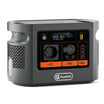
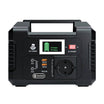
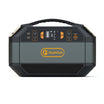
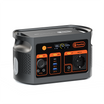
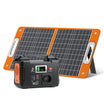
A portable power station becomes useful when camping power is shared across several devices or when AC output matters. For example, a compact station can handle phones, lights, camera batteries and a laptop charger if the combined load stays within the port and continuous-output limits.
FlashFish examples from the local product-source database:
| Model | Capacity | Output context | Camping role |
|---|---|---|---|
| A101 | 97.68Wh | 120W AC, 18W USB-C | Ultra-light device charging when airline and device limits are checked separately. |
| E200 | 151Wh | 200W modified sine AC | Phones, lights, cameras and small electronics; avoid pure-sine-only or high-watt AC loads. |
| E103 | 179.2Wh | 300W pure sine AC, 60W USB-C | Compact camping and laptop planning when the charger label fits. |
Solar changes the question, but not the physics
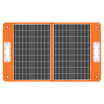
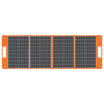
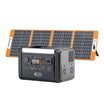
A small solar panel can extend a camping setup, but it does not create a fixed recharge time. With FlashFish, a pairing such as E200 or E103 with TSP60 should still be checked against connector, voltage and input limits. Shade, cloud, panel angle and season can reduce real output.
Camping checklist before choosing
- List every device: phone, light, camera battery, laptop, router, cool box or fan.
- Record each device's watts or charger rating.
- Mark which devices need USB-C and which need AC.
- Check continuous output, not only peak output.
- Check total carried weight and where the station will sit.
- Check whether any trip includes air travel; do not assume a station is airline-approved.
- If using solar, confirm panel compatibility and plan for poor sunlight.
When FlashFish fits and when it does not
FlashFish compact models fit budget camping searches when the user needs small-device power, a clear port plan and realistic limits. E200 is a light compact option; E103 adds higher AC output and USB-C capability in the local product database. A101 is smaller and lighter but has lower output.
FlashFish is not the right recommendation if the user needs high-watt cooking appliances, promised fridge runtime, medical-device support, full-house backup or airline approval without checking the specific route and airline.
FAQ
Is a power bank enough for camping?
It can be enough for phone-only or USB-only trips. It is usually not enough when you need AC power, multiple people charging devices or a laptop plan.
Is a portable power station allowed on a plane?
Do not assume so. Many stations exceed common passenger battery limits. Check the airline and airport rules using the product's Wh rating before travel.
Can a small station run a laptop?
Only if the laptop charger or USB-C requirement fits the station's supported output. Check the charger label and cable rating first.
Should I buy a solar panel with a compact station?
Only if the panel is compatible and you accept variable real-world output. Solar is a top-up plan, not a fixed full recharge schedule.
Which FlashFish compact model should I compare first?
Compare A101, E200 and E103 by output, USB-C needs, weight and device list. Choose the smallest model that safely fits the planned loads.
Sources and further reading
- FlashFish product specifications, copied to the run folder for sqlite verification on 2026-06-30. Manual-derived values still require original-manual review before use.
- FlashFish Europe product listing latest snapshot, generated 2026-06-29, used as fallback because 2026-06-30 Snapshot failed with network fetch error.
- FAA PackSafe: Lithium batteries, used for passenger battery-limit and carry-on caution context.
- Camping and Caravanning Club: Electricity for campers and caravanners, used for campsite load-planning context.
Start with the device list. If the list is only phones, use a power bank. If it includes AC, a laptop or shared camping gear, compare compact power stations carefully.




Залишити коментар
This site is protected by hCaptcha and the hCaptcha Privacy Policy and Terms of Service apply.