

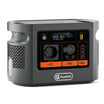
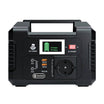

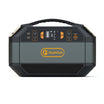
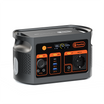






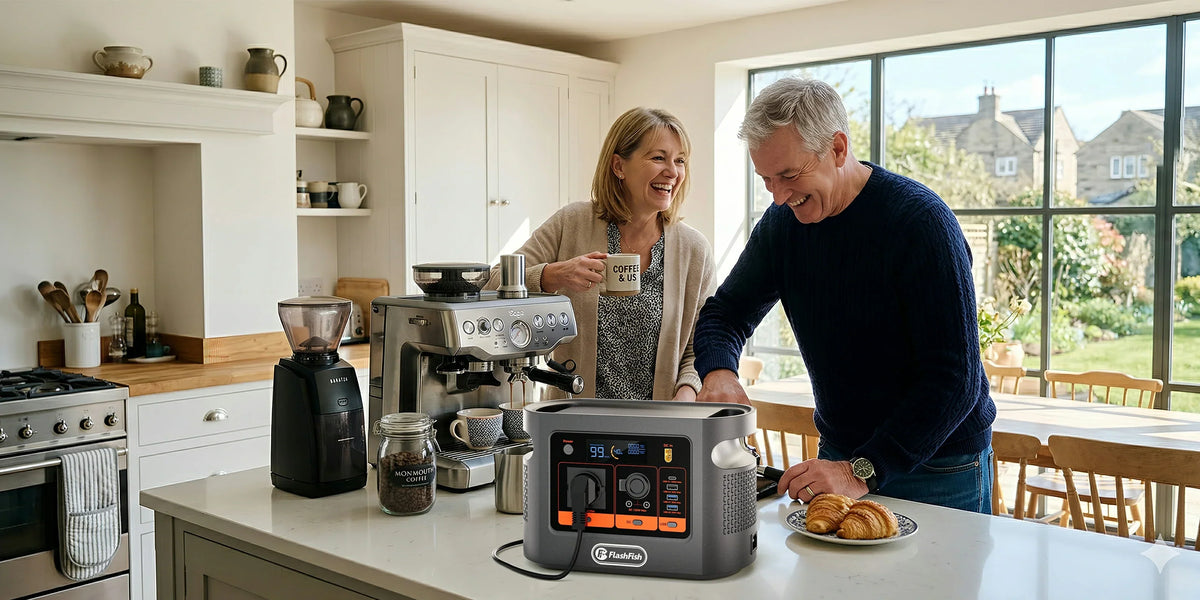
Short answer: choose by work kit, not by a single larger number. FlashFish E106B is the larger 384Wh, 600W AC class and is more plausible for a dock, portable monitor and AC accessories after verification. BLUETTI Elite 10 is a 128Wh, 200W AC mini station listed at 1.8kg, so it better serves a tightly packed, USB-first kit when its lower output and energy envelope are sufficient.
Disclosure: FlashFish publishes this article. Specifications below are dated manufacturer evidence; no side-by-side test was performed and no universal winner is declared.
E106B and Elite 10 compared on equal fields
| Decision field | FlashFish E106B | BLUETTI Elite 10 | What it changes |
|---|---|---|---|
| Nominal energy | 384Wh | 128Wh | E106B starts in a larger session-energy class; neither value equals delivered device energy |
| Continuous AC | 600W pure sine, one regional outlet | 200W listed AC output, one outlet | The exact adapter input and startup behaviour must remain inside the selected envelope |
| Highest listed USB-C output | 100W PD on USB-C1; separate 30W USB-C2 | 100W listed USB-C; another 15W USB-C listed on the detailed regional page | Port wattage is only useful when the laptop accepts a matching PD profile |
| Solar input | Up to 200W, 12-30V, 10A | Up to 100W, 12-28V, 8.2A on the detailed regional page | Panel voltage, current, connector and conditions all remain separate checks |
| Mass | About 5.2kg | 1.8kg | Elite 10 removes about 3.4kg before cables and adapters |
| Dimensions | 306 x 171 x 202mm | 200 x 146 x 110mm | Measure the actual bag or equipment case, not just desk space |
Review the current E106B specification and availability. Confirm the delivered regional outlet and treat the local manual-derived record as the specification boundary.
Three mobile-work kits produce different choices
Kit 1: one USB-C laptop and phone
If both devices accept supported USB PD profiles and the measured session fits inside the smaller energy budget with reserve, Elite 10's 1.8kg listing is the clearer carry-first advantage. E106B adds energy and output that this very light kit may not need. Check cables and laptop charging behaviour before deciding.
Kit 2: laptop, powered dock and portable monitor
A dock may use its supplied AC adapter while the monitor draws separately. E106B's 600W continuous AC and 384Wh nominal energy provide the broader documented screen. That still does not establish compatibility or duration: list every device, measure peak watts, and record accumulated watt-hours during a real workload.
Kit 3: camera batteries, laptop and field peripherals
This choice turns on simultaneity. If chargers can run sequentially and the whole kit must be carried far, the lighter unit may be enough. If several AC and USB loads must be served over a longer session, E106B's larger envelope may justify its extra mass. One AC outlet on each unit also matters when adapters cannot share a documented distribution arrangement.
A 100W USB-C headline is not the whole connection
Both product records advertise a 100W USB-C path, but that does not make them interchangeable with every laptop. USB-IF explains that cables have different capabilities and that power and data capabilities are marked separately. The laptop must accept a supported PD profile; a dock or monitor may also require video or data modes that a power-only connection does not provide.
For a fair trial, use the intended cable, check the laptop's charging message, and run a representative workload. A system can appear to charge while slowly losing battery under load, or it can power the laptop but fail to carry video. Record those as different results.
Solar input is an electrical-fit question first
The E106B local record lists a 12-30V, 10A, 200W maximum solar/DC input. BLUETTI's detailed regional page lists 12-28V, 8.2A and 100W maximum for Elite 10. These are controller input envelopes, not expected field yield. Check panel open-circuit voltage, current, connector and polarity, then account for shade, angle, season and temperature.
Decision matrix for mobile workers
| Priority | Stronger starting fit | Reason | Required check |
|---|---|---|---|
| Minimum carry mass and one light USB-C kit | Elite 10 | 1.8kg and smaller listed dimensions | Measured session and exact PD path fit 128Wh and listed ports |
| Dock, monitor and higher AC headroom | E106B | 600W continuous AC and 384Wh nominal energy | All adapters, startup behaviour and session Wh are verified |
| Higher documented solar-input ceiling | E106B | 200W versus Elite 10's detailed 100W listing | Panel electrical fit and actual conditions are checked |
| App and transfer features | Needs separate evidence | BLUETTI lists Bluetooth and a transfer feature; the E106B local record does not provide equivalent fields | Do not convert missing evidence into a negative claim |
Claims this comparison does not make
- No fixed work-session duration.
- No noise, efficiency, thermal or reliability ranking.
- No price winner because regional offers change.
- No assumption that missing E106B fields mean a feature is absent.
- No transfer of plug or bundle details between BLUETTI regional pages.
Frequently asked questions
Which unit has the larger documented energy capacity?
E106B is listed at 384Wh and Elite 10 at 128Wh. Nominal Wh is a class comparison, not the usable energy delivered to a particular device.
Which is easier to carry?
BLUETTI lists Elite 10 at 1.8kg and 200 by 146 by 110mm, while the E106B local record lists about 5.2kg and 306 by 171 by 202mm. Packing shape and accessories still matter.
Can either 100W USB-C port power every laptop?
No. A laptop must accept a compatible USB PD profile, and the cable must support the required power. Some workstations still require their original AC adapter.
Is E106B automatically better because its numbers are larger?
No. Its larger energy and AC envelope can suit a docked setup, while Elite 10's lower mass may suit a USB-first kit. The better fit follows the measured load and carry limit.
Why is there no winner for all mobile workers?
A photographer carrying one USB-C laptop has a different constraint from a field worker running a dock, monitor and AC equipment. One ranking would hide that difference.
Conclusion: buy for the kit you can document
Elite 10 is the more compact carry-first option on its published dimensions and mass. E106B is the broader energy-and-output option for a verified docked setup. Use the Europe buying guide to compare another power class when neither envelope matches the measured kit.
Sources and evidence limits
- FlashFish Europe E106B page and local product record.
- BLUETTI Europe Elite 10 page for current product positioning and core values.
- BLUETTI Europe detailed regional listing for dated dimensions, mass, ports and input fields.
- USB-IF guidance for cable capability boundaries.
Evidence checked 14 September 2026. Manufacturer specifications can change. No physical comparison was performed; confirm exact regional models, supplied cables, current pages and your measured workload before purchase.



Залишити коментар
This site is protected by hCaptcha and the hCaptcha Privacy Policy and Terms of Service apply.