








Short answer: cycle life and warranty answer different questions. A cycle-life statement describes battery endurance to a stated capacity-retention point under defined conditions. A commercial warranty describes covered faults, remedies, exclusions and time. Neither is a promise that a portable power station will deliver a fixed number of calendar years.
For an EU buyer there is a third concept too: legal guarantee rights against the seller. Those rights operate independently of an additional manufacturer or brand warranty. The useful comparison is therefore not one number. It is a five-part evidence check: test conditions, endpoint, real use, commercial terms and statutory rights.
Five phrases that are easy to confuse
| Phrase | What it tells you | What it does not tell you |
|---|---|---|
| Cycle | A charge-throughput event defined by the test or manufacturer method | One cycle does not automatically equal one day or one plug-in session |
| Cycle-life claim | A number of cycles to a stated endpoint under conditions | Guaranteed calendar years or identical results for every owner |
| Capacity retention | The fraction of original capacity remaining at the endpoint | That the station stops operating immediately at the threshold |
| Commercial warranty | Covered defects, period, remedies, exclusions and claim route | A full guarantee against normal ageing or misuse unless terms say so |
| EU legal guarantee | Minimum conformity rights against the seller under EU rules | The same thing as an optional manufacturer warranty or a battery-life forecast |
Use the TERMS check before comparing models
T — Test conditions
Regulation (EU) 2023/1542 defines endurance in cycles using cycles performed under specified conditions before capacity falls below a specified fraction. That wording matters. A bare claim such as “thousands of cycles” is incomplete if the temperature, charge and discharge rates, depth of discharge or endpoint are unclear.
A full cycle is also not necessarily one charging session. Two partial discharges may contribute roughly one equivalent full cycle under a manufacturer’s accounting method. The exact method controls, so do not translate the number into days without evidence.
E — Endpoint
Look for the remaining-capacity threshold. “3500 cycles to more than 80% capacity” carries more information than “3500 cycles” alone. The threshold describes ageing, not instant failure. At 80% retention, a battery may still operate, but it stores less energy than when new and its suitability depends on the owner’s load and reserve needs.
R — Real use and calendar age
Batteries age while being used and while time passes. An NREL battery-lifetime study treats calendar and cycle ageing as coupled and records conditions such as temperature, state of charge, depth of discharge and duty cycle. That paper uses a particular NMC dataset, so it is not evidence for a FlashFish or LFP result. It does show why a cycle count alone cannot describe every owner’s lifetime.
Ask how often the station will be used, how deeply it will be discharged, where it will be stored, and whether heat or cold is likely. Then follow the exact model manual. Do not invent an ideal storage percentage or charging routine from a different battery.
M — Manufacturer or seller terms
Read the current commercial warranty statement, not just a product-page badge. Check the start date, territory, registration requirement, proof of purchase, covered parts, exclusions, shipping responsibility, remedy and claim contact. A 12-month record does not mean every performance change during those months is covered, and a high cycle-life statement does not extend the warranty automatically.
S — Statutory rights
Your Europe explains that EU consumers have legal guarantee rights against the seller and that an additional commercial guarantee applies independently. National rules can add protection. Buyers outside the EU, including other European markets, should check their local rules. This article is a comparison guide, not legal advice.
A FlashFish example—without turning cycles into years
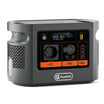
The local FlashFish product-source bundle records the FlashFish T2000 at more than 3500 cycles with more than 80% capacity remaining, alongside a 12-month commercial warranty record. These two statements are not inconsistent because they describe different things.
| T2000 record | Defensible interpretation | Do not infer |
|---|---|---|
| >3500 cycles | Endurance reference linked to specified battery use/testing | 3500 calendar days, charge sessions or guaranteed owner results |
| >80% capacity remaining | Retention endpoint paired with the cycle statement | Sudden failure when the threshold is crossed |
| 12-month warranty record | Commercial-service period that must be read with current terms | Only 12 months of useful battery life or coverage for normal ageing |
Before publication, a human reviewer must reconcile those records with the current Europe manual and warranty statement. The example is explanatory; it is not an independent life-cycle test.
A practical buyer worksheet
- Copy the exact cycle wording, including remaining-capacity threshold.
- Find the cited test conditions or manual method; mark any missing conditions.
- Write down expected use frequency, depth of discharge, temperature and storage pattern.
- Save the commercial warranty terms for the correct country and seller.
- Identify the legal seller and the statutory-rights route in the purchase country.
- Compare serviceability, weight, output, ports and real job fit—not only cycle count.
When FlashFish fits
- The selected model’s capacity, rated output, ports and weight match the job before cycle life is considered.
- The cycle statement includes a retention endpoint and the buyer accepts that real ageing depends on conditions.
- The current Europe warranty terms and support route are clear enough for the buyer.
- The owner can follow the model’s storage, charging and temperature instructions.
When FlashFish—or any cycle-life claim—does not fit
- The decision depends on converting cycles directly into promised years.
- The seller cannot provide the applicable manual or commercial warranty terms.
- The buyer expects normal capacity fade to be identical to a covered defect.
- The unit’s weight, output or energy store is unsuitable even if its cycle number looks attractive.
- The use environment falls outside the confirmed manual limits.
Compare the active FlashFish portable power station range by the whole job: energy, simultaneous load, ports, carrying plan, charging route, warranty and evidence quality.
Frequently asked questions
Does 3500 cycles mean 3500 days?
No. A cycle is an energy-throughput and test concept, not a calendar day. Partial cycling and test conditions affect the relationship.
What does 80% capacity after a cycle count mean?
It is a capacity-retention endpoint under stated conditions. It does not mean the battery instantly stops working at that point.
Is cycle life the same as warranty length?
No. Cycle life describes endurance to an endpoint. Warranty terms describe covered faults, remedies, exclusions and time.
Does a warranty replace EU legal guarantee rights?
No. Your Europe states that EU legal guarantee rights against the seller operate independently of an additional commercial guarantee.
Which cycle claim is most useful?
Prefer wording that includes a capacity-retention threshold and test conditions. Then compare warranty terms and real use fit.
Does a rarely used battery still age?
Yes. Calendar ageing also matters. Follow the exact model’s storage and temperature instructions.
Sources and evidence boundaries
- Regulation (EU) 2023/1542 — cycle, capacity and lifetime terminology.
- NREL battery-lifetime analysis — calendar/cycle methodology and operating variables; not FlashFish testing.
- Your Europe: guarantees — distinction between EU legal and commercial guarantees.
- FlashFish Europe: T2000 and local product-source bundle — current product identity and source-derived example.
Human review note: this is buying education, not legal advice, a laboratory test or a guaranteed lifetime statement.



Commenta
Questo sito è protetto da hCaptcha e applica le Norme sulla privacy e i Termini di servizio di hCaptcha.