

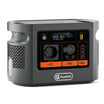
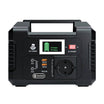

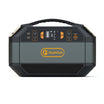
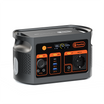


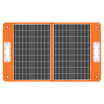
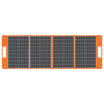


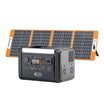

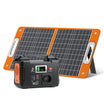

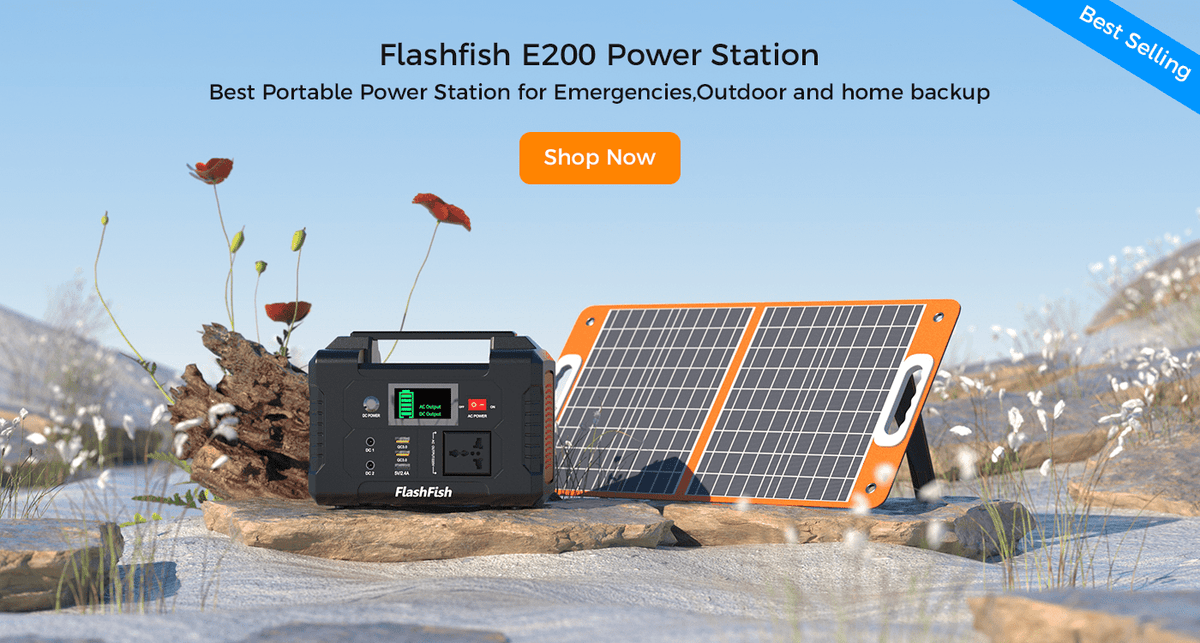
Short answer: a 60W panel nameplate does not mean 60W reaches the FlashFish E200. The authoritative E200 record lists an 11-24V solar/DC input with a 40W maximum. That station ceiling applies even before real sunlight, temperature, angle, shade, connector and conversion losses are considered.
Use THREE CEILINGS: panel nameplate, electrical fit and station acceptance. Then apply field conditions. This explains a lower display reading without inventing a fault, recharge time or daily energy yield.
The three ceilings at a glance
| Ceiling | Question | Evidence for this example | What it does not prove |
|---|---|---|---|
| Panel nameplate | What can the panel produce under stated test conditions? | Local SP18V60W record: 60W nameplate | 60W at every moment outdoors |
| Electrical fit | Are voltage, current, connector and polarity compatible? | Panel record and E200 both require exact label/manual review | Compatibility from watts alone |
| Station acceptance | What can E200 take? | 11-24V, 40W maximum solar/DC input | That a larger panel raises the station ceiling |
| Field conditions | What reaches the station now? | Irradiance, temperature, angle, shade and losses vary | A fixed European daily yield |
Ceiling 1: 60W is a laboratory-style nameplate
PV module power ratings are measured under standard test conditions. JRC PVGIS describes nominal or peak power as a standardized measurement rather than a promise of constant field output. Real irradiance and module temperature change during the day, across seasons and between European locations.
For a portable panel, orientation can change whenever the sun moves or the campsite setup shifts. A narrow shadow, haze, cloud, warm panel surface or soiling can reduce available power. The 60W label remains useful for classifying the panel, but it is not a live meter reading.
Ceiling 2: electrical compatibility comes before wattage
The local SP18V60W record lists 18V at maximum power, 3.34A at maximum power, 22.14V open-circuit voltage and a DC5521 output. E200 lists an 11-24V input window and a 40W maximum. These values illustrate why a buyer must compare more than the large watt number.
Confirm the exact delivered panel's voltage, current, connector dimensions and polarity against the E200 manual. Open-circuit voltage matters because it can be higher than the operating voltage printed most prominently. A connector that appears to fit mechanically still needs the correct polarity and electrical specification.
Ceiling 3: E200 accepts up to 40W
The station's documented 40W maximum is the decisive bottleneck after electrical fit. If a compatible panel can make more than 40W at a particular moment, the E200 should not be described as accepting the full 60W nameplate. A larger panel rating does not rewrite the station input specification.
Conversely, a display below 40W does not by itself show a defect. The panel may be operating below nameplate because of sunlight or temperature, and the controller and cables add their own losses. Diagnose the setup against documented limits and controlled observations rather than one expected number.
Why the displayed input moves
- Solar irradiance: clouds, haze, season and time of day change the light reaching the panel.
- Angle and orientation: the panel produces differently when the sun strikes it less directly.
- Temperature: JRC notes that module performance depends on temperature as well as irradiance.
- Partial shade and soiling: a small obstruction or dirty surface can reduce available output.
- Cable and controller losses: energy is lost between panel cells and stored battery energy.
- Charge state: the station may change accepted power as charging progresses.
PVGIS can show solar-resource variability for a location, but its long-term model is not a promise for one portable panel on one afternoon. Use it to understand seasonal and geographic context, not to generate an exact E200 recharge time.
A safe troubleshooting sequence
- Confirm the station is E200 and read its regional input label and manual.
- Read the exact panel model label; do not infer SP60 or TSP60 identity from a bundle photo.
- Compare operating voltage, open-circuit voltage, current, connector and polarity.
- Inspect the cable and connectors for damage, looseness or contamination.
- Place the panel in open light, keep it secure and adjust orientation without creating a trip hazard.
- Observe input over time rather than treating one moment as the system's capability.
- Stop on repeated disconnects, warnings, damaged insulation, unusual heat or a specification mismatch; do not bypass protection.
Do not turn 40W into a recharge-time promise
E200's local record lists 151Wh nominal battery energy, but dividing 151Wh by 40W gives only an idealized arithmetic result. It ignores changing sunlight, cable/controller loss, charge taper, station overhead and the difference between nominal battery energy and energy accepted during charging.
A useful field record includes location, date, weather, panel orientation, starting charge level, displayed input over time and final charge change. Repeat observations under comparable conditions. Even then, report a measured session rather than a universal time.
Check the FlashFish E200 input specifications and compare them with the exact panel label before connecting the system.
Frequently asked questions
Why does E200 not accept the full 60W panel rating?
E200's documented solar/DC input maximum is 40W. The station cannot be assumed to accept 60W simply because the panel nameplate says 60W.
Does a 60W panel always produce 60W outdoors?
No. The nameplate is measured under standard test conditions. Irradiance, temperature, angle, shade, soiling and system losses change field output.
Is voltage more important than panel watts?
Both matter. The panel's voltage envelope, current, connector and polarity must fit the station, and the station's watt limit still caps accepted input.
Can I calculate E200 recharge time as 151Wh divided by 40W?
No. That division ignores charge taper, conversion losses, station overhead, changing sunlight and the fact that the panel may not hold 40W.
Are SP60 and TSP60 the same panel?
Do not assume so. The local database treats SP18V60W/SP60, TSP18V60W and YSP60 as distinct records. Confirm the label on the supplied panel and its manual.
Conclusion: the lowest applicable ceiling wins
A 60W nameplate is only the first ceiling. The exact panel must match E200 electrically, E200 accepts no more than its documented 40W maximum, and field conditions can lower available input further. Record the actual setup and conditions instead of expecting a fixed number. To compare panel classes after checking compatibility, Review FlashFish portable solar panels.
Sources and evidence limits
- FlashFish Europe E200 page and local E200/SP18V60W records for bounded electrical facts and the model-name warning.
- JRC PVGIS methods for standard test conditions and PV performance variables.
- JRC PVGIS user manual for irradiance, temperature and location/time variability.
- U.S. Department of Energy PV performance guidance for field conditions versus ratings.
Evidence checked 16 September 2026. No E200 or panel was physically connected or measured. Confirm the regional manual, the actual panel label, connector and polarity before use; no recharge time or European daily yield is claimed.



Commenta
Questo sito è protetto da hCaptcha e applica le Norme sulla privacy e i Termini di servizio di hCaptcha.