









Short answer: a 65W charger label describes a maximum output capability, not a promise that the charger continuously takes 65W from a portable power station. Real demand changes with the negotiated voltage and current, the connected device, battery state, workload and charging phase. The power station's AC-side input can also be higher than the charger's DC output because conversion is not lossless.
For runtime planning, the useful number is the energy used by the complete session at a defined measurement point—not the biggest watt figure printed on the adapter.
Use RATED to read charger power correctly
RATED means: Read the nameplate input and output separately, identify the Available source ceiling, note the Task and charging phase, account for the Efficiency path, and use Direct measurement over the full session. This keeps watts, watt-hours and port capability from collapsing into one misleading number.
What a 65W label actually tells you
| Label or reading | What it means | What it does not mean |
|---|---|---|
| 65W charger rating | Maximum documented output capability under supported conditions | Constant wall draw or constant laptop demand |
| Multiple output profiles on a charger label | The charger documents more than one supported voltage/current combination | Every device or cable accepts every profile |
| 100W station USB-C port | Maximum documented source ceiling for that port | A connected device will take 100W |
| 18W station USB-C port | Lower documented source ceiling | A universal 18W protocol or laptop fit |
| Station display | A reading sampled at one point and time | The charger's rating, battery energy delivered or full-session average |
Negotiation changes the number
USB Power Delivery is designed so a source advertises capabilities and a sink requests a supported level. USB-IF explicitly describes devices taking only the power they require. A 65W adapter can therefore serve a low-power device at a lower profile, a laptop at a higher profile, or a battery-full laptop at a much lower demand. Cable capability and device policy remain part of the path.
Read the exact voltage/current combinations on the charger label or manual, but treat them as supported options—not as proof that the highest profile is active whenever the charger is plugged in.
Three concrete charging-phase examples
- Low battery and active workload: the laptop may request a higher profile while charging the battery and running the processor, display and peripherals. The exact input still depends on the model, cable and settings.
- Battery nearly full: the charging system may reduce power even though the same 65W adapter remains connected. A falling station display is not proof of a charger fault.
- Adapter plugged in with no device: output load can be near zero while the adapter still has some no-load consumption. The European Commission treats no-load power and active efficiency as separate states.
AC charger path versus direct USB-C
| Path | Conversion chain | What to verify |
|---|---|---|
| Station AC outlet to laptop charger | Battery DC to inverter AC to charger DC to laptop | Regional AC label, waveform requirement, charger input, continuous station load and measured session energy |
| Station USB-C directly to laptop | Battery DC through station USB conversion to negotiated USB-C | Station profile, cable rating, laptop accepted profile and stability under the real workload |
Direct USB-C can remove an AC conversion stage, but no fixed efficiency advantage follows automatically. Compare the exact compatible paths under the same conditions if the difference matters.
The RATED measurement worksheet
- Record the charger model, regional input, output profiles and maximum rating.
- Record the station output used and its exact per-port or AC limit.
- Record the device model, starting battery percentage, workload, brightness, peripherals and power mode.
- Define the measurement point: station AC display, USB meter, plug meter or another instrument.
- Measure the full intended session, including high-demand, taper and idle periods.
- Record both peak observed watts and total watt-hours instead of turning one snapshot into a runtime promise.
Bounded FlashFish examples
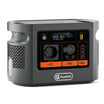
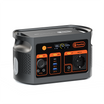
The authoritative local E106B record lists one USB-C output up to 100W, while P66A lists USB-C up to 18W. Those are source ceilings. They do not prove that a particular laptop will request 100W or accept 18W, and they do not reveal the actual draw of a 65W charger. Use the device, cable and station records together.
If the needed profile is missing or ambiguous, use the exact manual or support route instead of experimenting with an unsupported cable or adapter.
Common mistakes
- Using 65W as a constant load in every runtime calculation.
- Confusing the charger's AC input label with its maximum DC output.
- Assuming a 100W USB-C port forces 100W into the laptop.
- Comparing an AC-side station display with a USB-side meter as if they measure the same point.
- Reading one peak snapshot as the average for a complete work session.
When to stop and check the exact manuals
- The charger input does not match the station's regional AC output or the plug path requires an improvised adapter.
- The laptop reports slow charging, repeatedly connects and disconnects or the cable becomes unusually hot.
- The station shows repeated overload, over-temperature or other protection messages.
- The device needs more power than the available USB-C profile or its manual requires a specific approved charger.
FAQ
Does a 65W charger always draw 65W?
No. It is a maximum output capability. Device demand, negotiated profile, battery state, workload and charging phase change real draw.
Can I use 65W in a runtime formula?
Use it only as a conservative first screen when better evidence is unavailable. A measured full session at a defined point is more useful.
Why does draw fall as the battery fills?
Charging systems can reduce requested power as battery state and device conditions change. The exact behaviour is device-specific.
Is direct USB-C always more efficient than an AC charger?
It can remove one conversion stage, but this article supports no fixed efficiency difference. Measure both exact compatible paths under the same workload.
Why do the label and station display disagree?
The label states capability; the display samples a point in the live power path. Timing, measurement point, conversion loss and changing demand can all create different numbers.
Sources and evidence limits
- USB-IF Power Delivery overview, used for negotiated source-and-sink behaviour.
- European Commission external power supply guidance, used to distinguish active efficiency and no-load power.
- E106B and P66A, used only as bounded examples of different documented source ceilings.
No charger, laptop, cable, station or meter was tested. Compare documented output paths after completing RATED. Ask for the exact station manual when a USB profile is unclear.




Commenta
Questo sito è protetto da hCaptcha e applica le Norme sulla privacy e i Termini di servizio di hCaptcha.