

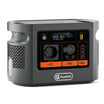
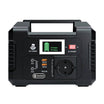

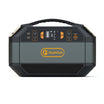
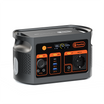


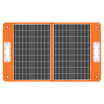
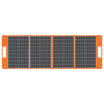


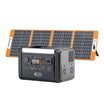

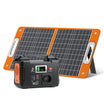

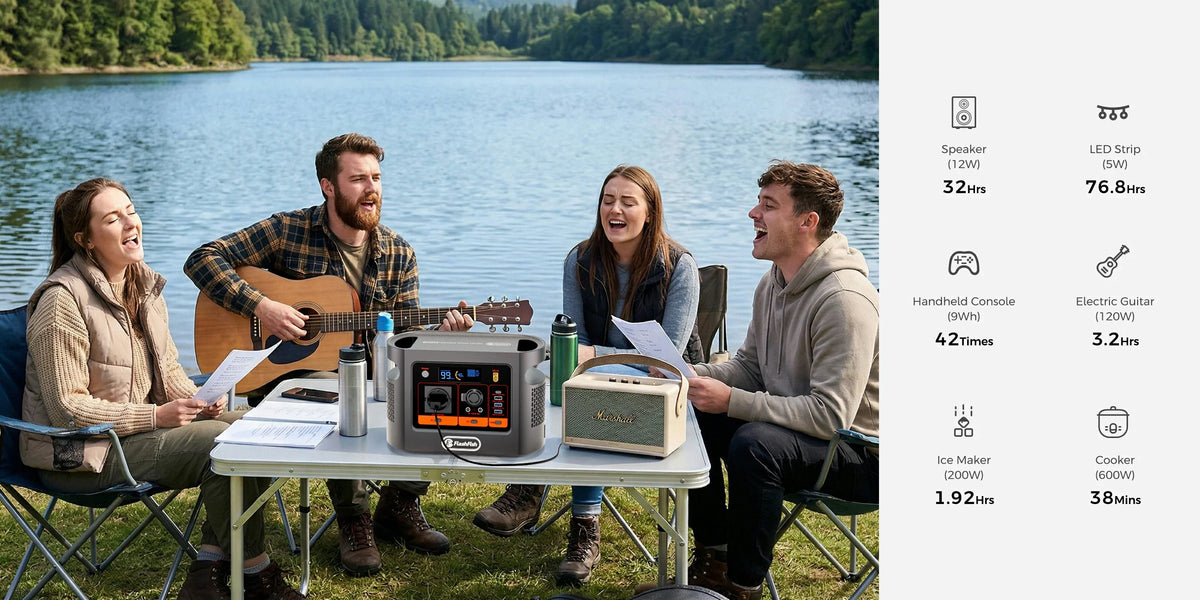
Short answer: E106B is a plausible source for a small, verified amplifier setup because it provides 600W continuous pure-sine AC output and 384Wh nominal energy. That is only a screening result. The amplifier's regional mains input, pedals and accessories, a measured session, dry placement and local public-performance rules decide the real fit.
Build a LAMP card before the performance
| LAMP check | Evidence to record | Stop or change the plan when |
|---|---|---|
| Load label | Exact amplifier model, regional voltage/frequency and maximum mains input | Only audio-output watts or a product-family name is known |
| All accessories | Pedal supply, mixer, vocal amp, wireless receiver, phone and lighting | Anything powered is absent from the total |
| Measured session | Observed peak watts and accumulated watt-hours at representative volume | An idle reading or nominal estimate is treated as a performance result |
| Placement and permission | Dry stable location, protected cables, public clearance and local rules | Rain, trip exposure, blocked access or unclear permission remains |
Compare your measured busking load with the E106B limits. Confirm the delivered European version and current instructions before a controlled rehearsal.
A 25W guitar amp may not be a 25W AC load
Amplifier marketing commonly highlights audio output. The power station must supply the amplifier's mains input. Fender's 230V Mustang LT25 guide lists 25W amplifier output but 84W power requirements. The gap is why a cabinet badge or model name cannot size the portable source.
For the first output screen, use the exact regional input label or current manual. Include every powered accessory and leave margin below the station's continuous limit. A watt rating alone does not establish noise floor, tone, electromagnetic behaviour or sound quality.
Three practical setup examples
- One compact combo amplifier: the exact mains input is documented, the load remains comfortably below 600W and a full-volume rehearsal is measured. This can pass the first LAMP screens, but it still needs dry placement and local permission.
- Amplifier plus pedalboard and wireless receiver: record every supply as part of one system. Test the real signal chain; do not treat a pedal's low-voltage output marking as its mains-side consumption.
- Guitar and vocal PA together: combine both maximum input ratings and measure peaks during the intended set. If evidence is missing or margin is poor, separate the loads or choose a documented higher class.
Plan session energy without promising hours
- Rehearse with the exact amplifier, accessories, volume and performance style.
- Measure both maximum watts and accumulated watt-hours over a representative interval.
- Scale only from measured energy, then add conversion and station overhead plus a deliberate reserve.
- Repeat after adding a vocal system, effects, lighting or device charging.
- Do not plan to nominal zero; preserve a fallback that does not depend on the same station.
A defensible worksheet is: session energy needed = measured complete-setup watt-hours + conversion and station overhead + chosen reserve. It belongs to that equipment and set; it is not a universal runtime claim.
Outdoor electrical and public-space controls
UK HSE event guidance emphasises planned power requirements, equipment suitability, adverse-weather controls, protected temporary cabling and public access. Apply the principle locally: keep the station and connections dry, stable and ventilated; route cables so performers and the public cannot trip, pull or tamper with them.
Permission is a separate gate. UK licensing guidance says busking is generally outside that Act while local authorities may still use codes, permits or bylaws. Treat that as one jurisdictional example, then check the actual city or venue for amplification, noise, trading, obstruction and time rules.
When E106B is a reasonable candidate
| Reasonable candidate when | Choose another plan when |
|---|---|
| Exact regional mains input and all accessories are documented | Only audio-output watts or guesses are available |
| Combined load stays well inside 600W and measured peaks are controlled | Unknown startup behaviour or poor margin remains |
| Representative session energy fits with reserve | The plan relies on 384Wh divided by one advertised watt number |
| Dry placement and protected cables are possible | Weather or public access cannot be controlled |
| Local performance rules are confirmed | Portable power is being mistaken for permission |
Common mistakes
- Using audio-output watts as the mains load.
- Forgetting pedals, mixers, wireless receivers, phones or vocal equipment.
- Measuring at idle instead of during a representative loud set.
- Presenting nominal battery watt-hours as assured performance time.
- Letting an outdoor product image imply rain protection or a public-space approval.
Frequently asked questions
Can the E106B power every guitar amplifier?
No. Check the exact regional mains-input requirement, startup behaviour and every connected accessory. The 600W continuous E106B rating is a screening limit, not universal compatibility evidence.
Is a 25W guitar amp a 25W AC load?
Not necessarily. Audio-output watts and mains-input watts describe different things. One 230V Fender Mustang LT25 guide lists 25W amplifier output but 84W power requirements, so use the exact input label or manual.
How long will E106B run a busking amp?
There is no defensible fixed answer from 384Wh and an amplifier name alone. Measure the complete setup over a representative session, account for conversion and station overhead, and keep a reserve.
Can I use E106B in rain while busking?
Do not infer weather protection from an outdoor image. Keep the station, plugs and connections dry, follow current product instructions, and stop when weather or public access cannot be controlled.
Does portable power mean I can busk anywhere?
No. Power availability is separate from permission. Check the intended municipality or venue for performance, amplification, noise, trading, obstruction and time restrictions.
Conclusion: size the whole performance, not the amp badge
E106B can be a sensible candidate for a verified small busking setup after all four LAMP checks close. Use the Europe buying guide if your complete setup needs a different power class, and keep a non-powered fallback.
Sources and evidence limits
- FlashFish Europe E106B page and the local product database for bounded E106B fields.
- Fender Mustang LT25 Quick Start Guide for one exact input-versus-output example.
- UK HSE event electrical safety guidance for temporary equipment, weather, cable and public-access planning.
- UK Government Licensing Act guidance for a clearly bounded busking-policy example.
Evidence checked 13 September 2026. No amplifier, pedalboard or E106B was connected or measured for this article; no compatibility, sound-quality, runtime, weatherproofing or permission assurance is made.



Commenta
Questo sito è protetto da hCaptcha e applica le Norme sulla privacy e i Termini di servizio di hCaptcha.