









Short answer: compare the exact hair dryer’s input label with the FlashFish T1200S’s 1,200W continuous AC rating. Official appliance examples at 1,600W and 2,000W exceed that continuous limit. A dryer labelled exactly 1,200W sits at the ceiling, leaving no rating headroom, so it is not a confident general recommendation. A genuinely lower-rated dryer is the more conservative candidate, subject to regional voltage, plug and manual checks.
The T1200S also lists a 2,400W peak figure, but peak output is not a continuous allowance. No hair dryer was connected to a T1200S for this article, and no runtime claim is made.
“Hair dryer” is not a wattage
Hair dryers that look similar can have very different electrical inputs. The number that matters for the first fit screen is the rated input on the exact appliance label, not the retailer category, travel size or heat-setting name.
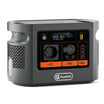
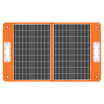
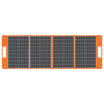
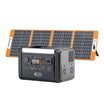
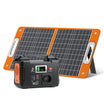
The FlashFish Europe T1200S product page currently lists 768Wh capacity, 1,200W continuous output and 2,400W peak output. The local product database confirms the 768Wh and 1,200W continuous figures. Because the available scanned manual is U.S.-spec while the live Europe page describes the regional product, this draft deliberately does not repeat a voltage or frequency value. Check the label on the delivered Europe unit and its current approved manual.
Three official appliance examples
| Manufacturer example | Published input | T1200S continuous-rating screen |
|---|---|---|
| Philips DryCare Essential BHD001/00 | 1,200W | At the 1,200W ceiling; no rating headroom |
| Philips DryCare Essential BHD029/00 | 1,600W | Exceeds 1,200W continuous output |
| Braun Satin Hair 3 PowerPerfection | 2,000W | Exceeds 1,200W continuous output |
These are manufacturer-published examples, not a complete European market survey. They show why a generic yes/no answer is unsafe: one cited dryer is at the station rating, while two exceed it.
Why “equal to 1,200W” is not the same as a comfortable fit
A station rated for 1,200W continuous output and an appliance rated at 1,200W produce a zero-headroom paper match. Labels, operating conditions, other connected loads and protection behaviour still matter. A conservative plan selects an appliance clearly below the continuous rating rather than treating the ceiling as a target.
- Count all AC loads. If another appliance is connected, its input belongs in the same continuous-load total.
- Do not substitute peak watts. The 2,400W peak figure is not permission to run a 1,600W or 2,000W dryer continuously.
- Do not infer watts from a setting name. “Low heat,” “eco” or a lower fan setting may behave differently by model. Use documented input or a suitable measurement method.
- Check the regional match. Plug shape alone does not prove that appliance and supply specifications agree.
A safe pre-use sequence
- Read the dryer’s input label and manual. If watts are absent, record volts and amps only for review by someone competent to interpret the rating.
- Confirm the exact T1200S regional label and approved manual. Do not rely on a manual from another market.
- Keep the planned dryer input clearly below 1,200W continuous and disconnect other AC loads from the calculation.
- Inspect the station port, plug and appliance cable. Electrical Safety First advises keeping hair dryers away from water and checking plugs and cables for damage.
- Operate in a dry, ventilated location and supervise the appliance. Stop if either device reports an alert, repeatedly shuts down, smells unusual or becomes abnormally hot.
Do not use the station as a way to make a damaged dryer, unsuitable travel adapter or wet-area setup acceptable. Both products’ instructions remain controlling.
What about runtime?
Dividing 768Wh by the label watts would produce only an idealised upper-bound arithmetic result. Real AC delivery includes conversion losses and control overhead, while dryer power can vary by setting and cycle. Battery state, temperature and station behaviour also matter. Without a measured dryer input and controlled method, a minute-by-minute promise would create false precision.
For a short grooming task, the first question is still output fit. Capacity becomes relevant only after the exact dryer is shown to be an appropriate electrical load.
When FlashFish fits — and when it does not fit
When the T1200S may fit
- The exact dryer is documented clearly below 1,200W input.
- No other AC appliance pushes the combined continuous load toward the limit.
- The delivered Europe unit, dryer, plug and voltage match without an improvised adapter.
- You accept that this guide is a label-based screen rather than a tested compatibility result.
When it does not fit
- The dryer is labelled 1,600W, 2,000W or any value above 1,200W continuous.
- The only argument for compatibility is the station’s 2,400W peak figure.
- The dryer is exactly 1,200W and you need a robust, repeatable setup with rating headroom.
- The dryer label, regional manual, plug condition or supply match cannot be verified.
In those cases, use a genuinely lower-input dryer, a more suitable power source or the site’s approved mains supply. Do not solve a rating mismatch with a travel adapter or an optimistic setting assumption.
Frequently asked questions
Can the T1200S run a 1,600W hair dryer?
Not from its 1,200W continuous AC rating. A 1,600W nameplate exceeds that continuous limit.
Does the 2,400W peak rating make a 2,000W hair dryer compatible?
No. Peak output is not the continuous operating allowance. Use the 1,200W continuous rating for sustained appliance fit.
Is a 1,200W hair dryer a good match?
It is at the station’s continuous ceiling, leaving no rating headroom. Confirm the exact dryer label, regional voltage and manual instructions; a lower-rated dryer is the more conservative fit.
Does the low-heat setting always use much less power?
Do not assume it does. Settings vary by model, and a temperature or fan label does not by itself document input watts.
How long will a hair dryer run from 768Wh?
This article does not give a universal runtime. Real draw, setting, conversion losses, battery state, temperature and the station’s operating behaviour all matter.
Sources and evidence limits
- FlashFish Europe T1200S product page — current capacity and output claims.
- Philips BHD001/00 — official 1,200W appliance example.
- Philips BHD029/00 — official 1,600W appliance example.
- Braun Satin Hair 3 PowerPerfection — official 2,000W appliance example.
- Electrical Safety First hair-dryer guidance — cable, plug, water and instruction checks.
Human review must reconcile the exact Europe manual and delivered unit label before publication.





Commenta
Questo sito è protetto da hCaptcha e applica le Norme sulla privacy e i Termini di servizio di hCaptcha.