

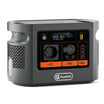
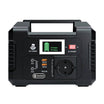

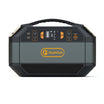
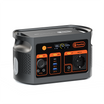


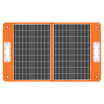
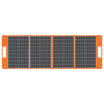


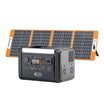

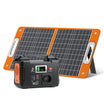

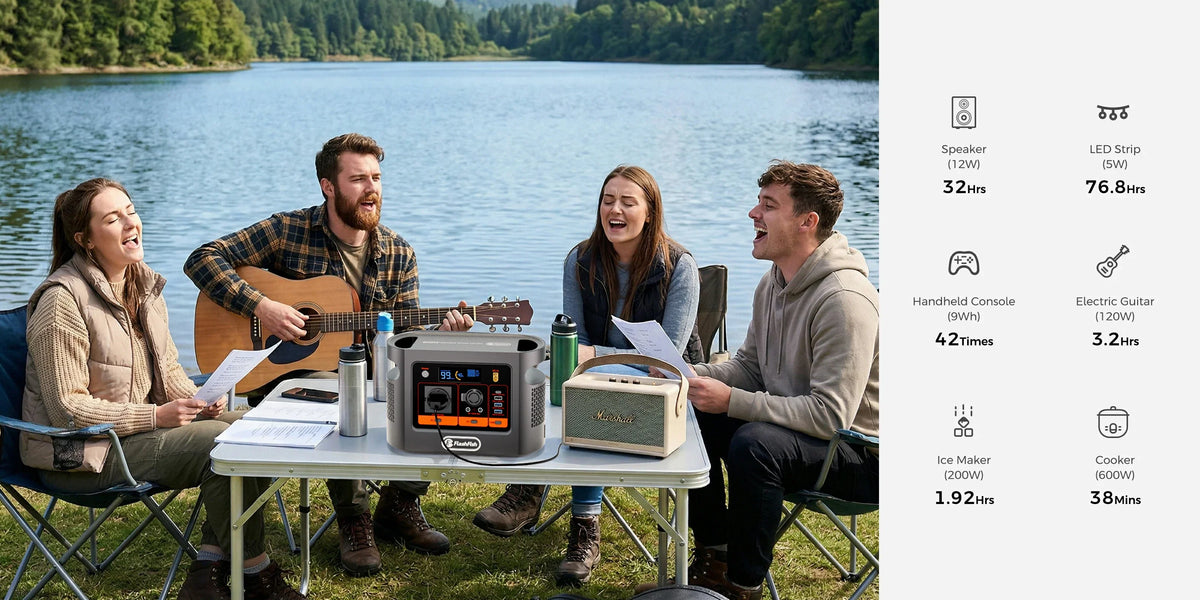
Short answer: choose A201 when the verified device list stays below its documented 200W continuous AC ceiling, 18W USB-C is sufficient or the laptop can use its original AC adapter, and a roughly 1.7kg carry matters most. Choose E106B when the kit needs more documented AC headroom, a pure-sine AC source, up to 100W USB-C for a compatible laptop or more nominal energy—and about 5.2kg is acceptable.
The documented difference
| Decision field | A201 | E106B | Why it matters |
|---|---|---|---|
| Nominal energy | 172.8Wh | 384Wh | Planning input only; delivered energy is lower and variable |
| Continuous AC | 200W | 600W shared | Screen every adapter plus the simultaneous AC group |
| AC waveform | Not provided in the authoritative local record | Pure sine wave | A missing waveform field is a stop condition when the device requires one |
| USB-C ceiling | Up to 18W | Up to 100W on USB-C1; 30W on USB-C2 | The laptop must support the same negotiated profile |
| Listed mass | About 1.7kg | About 5.2kg | Roughly 3.5kg difference before cables and adapters |
| Best documented advantage | Lower carry burden | More AC, USB-C and energy headroom | Choose the advantage your declared kit actually uses |
Use PATH-WATTS-CARRY
- PATH: Can the laptop use USB-C directly, or must it use its original regional AC adapter? How does the second device connect?
- WATTS: Record continuous and startup demand for every simultaneous AC device. Keep adapter DC output separate from wall input.
- Missing fields: Stop when waveform, regional voltage/frequency, polarity or another decisive field is absent.
- ENERGY: Measure watt-hours for a representative session; nominal Wh is not delivered AC energy.
- CARRY: Add the station, adapters, extension, case and any solar panel—not just the unit mass.
Three kit examples
1. USB-C laptop only
If the laptop accepts no more than 18W and the correct profile is documented, A201 may cover the direct path with much less weight. A laptop that expects 45W, 65W or 100W will not gain that from A201's 18W ceiling; E106B USB-C1 may be the more direct option only after the laptop and cable profiles are confirmed.
2. Laptop adapter plus one small AC device
Add the adapter's AC input and the second device's actual running and startup demand. A group that stays comfortably inside 200W may make A201 viable, but sensitive equipment that requires documented pure-sine AC cannot be approved from the A201 record. E106B offers 600W continuous pure-sine AC, not universal compatibility.
3. Frequently carried kit with occasional mains access
If the station is carried far more often than it is used, A201's roughly 3.5kg mass advantage can outweigh E106B's unused headroom. If the kit evolves, multiple devices run together or the direct 100W USB-C path removes a bulky laptop adapter, E106B may justify the extra mass.
Do not choose from capacity alone
384Wh is about 2.2 times 172.8Wh nominally, but that ratio is not a runtime multiplier. AC conversion, standby draw, device efficiency, temperature, battery condition and reserve all reduce delivered energy. More importantly, a station can have enough nominal energy but still lack the right port, waveform evidence or continuous/startup output.
Measure a representative work or camping session with the exact devices, then use the FlashFish runtime calculator as a planning aid with realistic efficiency and reserve. Do not treat the result as a guarantee.
When each model fits—and when neither does
| Choose A201 when | Choose E106B when | Choose neither yet when |
|---|---|---|
| The verified AC group stays comfortably below 200W and low mass is the priority | The verified group needs more than 200W but stays inside 600W continuous | Startup demand or the decisive device input field is unknown |
| An 18W USB-C path is sufficient, or the approved AC adapter is suitable | A compatible laptop can use the documented 100W USB-C1 path | Connector fit is the only compatibility evidence |
| No device decision depends on an undocumented A201 waveform | Documented pure-sine AC is required | The load is medical, life-critical, unattended or needs seamless transfer |
| Short, measured sessions and easier carrying matter most | More nominal energy and expansion headroom justify 5.2kg | A fixed runtime or battery-chemistry assumption is required |
Compare your exact device labels with the current E106B Europe page. If the larger station's documented features are unused, check A201 when low carry mass matters more than output headroom.
Common comparison mistakes
- Assuming a USB-C connector means the laptop's required power profile is available.
- Comparing an adapter's DC output with the station's AC limit as if they were the same measurement.
- Treating 172.8Wh or 384Wh as delivered energy.
- Using a 400W A201 peak field as permission for a continuously high load.
- Inventing A201 waveform or transferring E106B page chemistry language into the authoritative record.
- Ignoring the roughly 3.5kg station-only mass difference.
- Buying 600W headroom for a device list that is never verified.
FAQ
Is E106B always better because it has more watts?
No. It provides more documented headroom, but A201 is much lighter and may be sufficient for a verified low-power kit.
Can A201 charge a laptop over USB-C?
Only when the laptop accepts a compatible profile within A201's documented 18W ceiling. Many laptops require more; check the exact input specification.
Can I compare 172.8Wh and 384Wh as exact runtimes?
No. They are nominal energy values, not guaranteed delivered AC energy or session duration.
Does E106B's pure-sine output prove every AC device works?
No. Voltage, frequency, continuous and startup demand, grounding, adapters and device instructions still matter.
What if A201 waveform is important to my device?
Pause. The authoritative local record does not provide it; obtain written manufacturer/manual evidence or choose a power path with the required field documented.
Conclusion
A201 is the carry-first choice only after the device path is proven; E106B is the headroom-first choice only when the kit benefits from its documented 600W pure-sine AC, 100W USB-C1 or larger nominal energy. Use PATH-WATTS-CARRY, verify missing fields and select the smallest documented system that fits the real kit rather than the largest number on the page. Check A201 when low carry mass matters more than output headroom.
Sources and evidence limits
- FlashFish Europe A201 page plus the authoritative local product record.
- FlashFish Europe E106B page plus the authoritative local product record.
- USB-IF: USB Power Delivery.
- UK HSE: electrically powered equipment.
Evidence checked 27 September 2026. No device, charging speed, delivered energy or runtime was tested.




Commenta
Questo sito è protetto da hCaptcha e applica le Norme sulla privacy e i Termini di servizio di hCaptcha.