

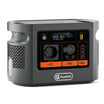
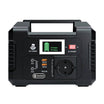

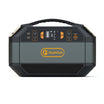
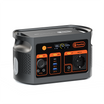


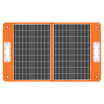
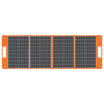


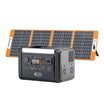


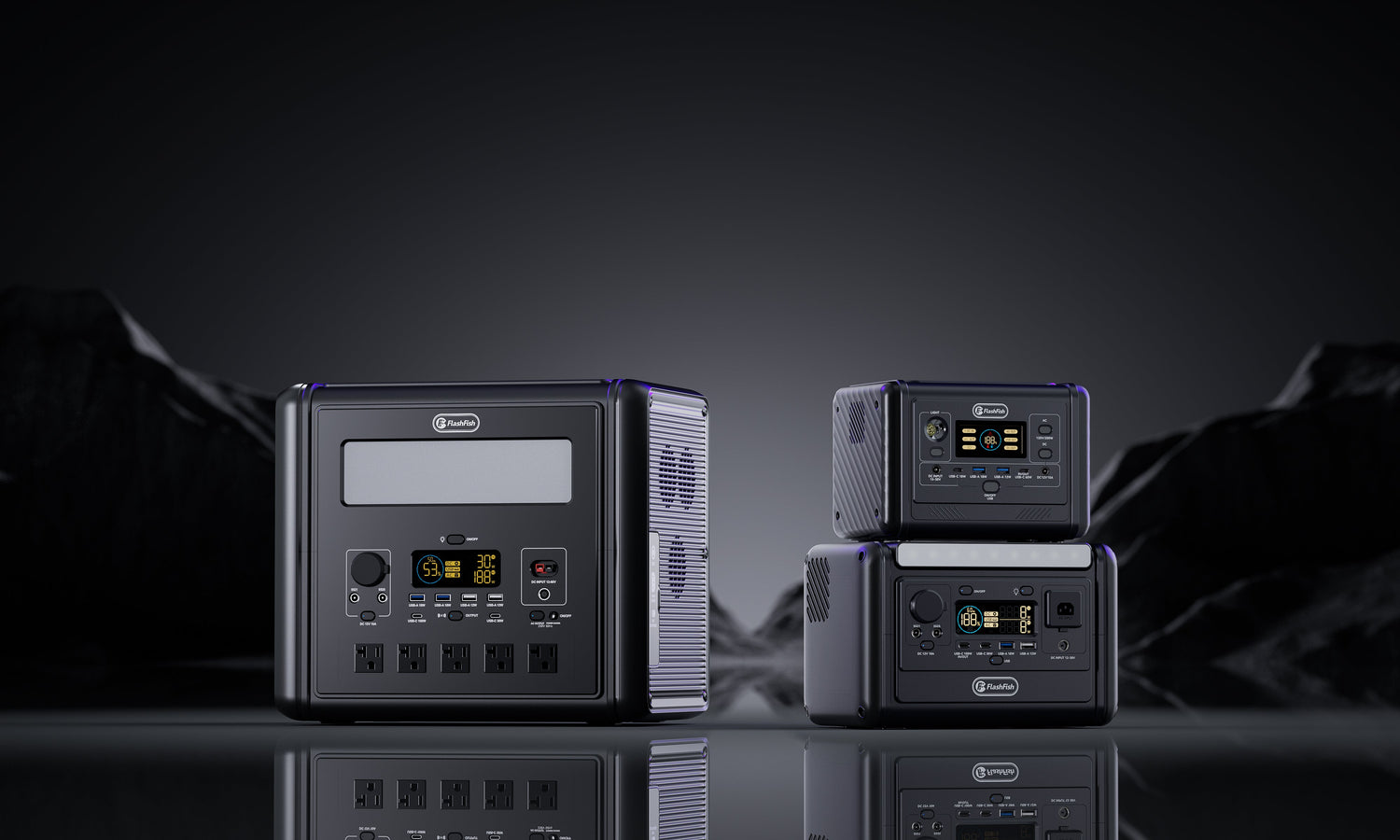
Short answer: battery capacity sets how much energy may need to be replaced, but it does not set charging time by itself. The useful planning equation is energy gap in Wh divided by average accepted input watts. The difficult part is that average accepted power can be lower than a product's maximum input because the charging path, source conditions, charge curve, temperature and simultaneous loads all matter.
That is why a larger power station can sometimes have a similar published wall-charging time to a smaller one: the larger model may also accept much more input power. It is also why a solar or car-charging estimate copied from an ideal headline can fail on a real trip.
Start with the energy gap, not total battery size
If a battery starts at 30% and the target is 80%, the job is to replace roughly half of its rated energy before considering losses and control behaviour. A simple planning expression is:
Baseline hours = rated Wh × charge-percentage gap ÷ average accepted input W
This is a planning tool, not a fixed stopwatch. Rated Wh is catalog energy, the display percentage is an estimate, and average accepted input is not the same as a maximum-input headline. A manufacturer may also define a published time for a particular fast mode, temperature, start point or target such as 80% rather than 100%.
| Input | What buyers often use | What the calculation really needs |
|---|---|---|
| Battery energy | Total rated Wh | The start-to-target energy gap under the maker's control logic |
| Charging power | Maximum input watts | Average power the station accepts across the session |
| Solar source | Panel nameplate watts | Power after weather, orientation, shade, temperature, wiring and input limits |
| Finish point | “Full” | Whether the claim ends at 80%, 100% or charge termination |
| Outputs | Ignored | Any energy being used by connected devices while charging |
Why the final part of charging is not linear
Texas Instruments' LiFePO4 charging profile shows a constant-current phase followed by a constant-voltage phase in which current tapers as the battery approaches its regulation voltage. A complete portable power station adds pack-level battery management, thermal monitoring and product-specific controls around that basic pattern.
The buyer lesson is narrow but important: doubling a maximum input rating does not automatically halve a full charging time. Compare like with like, and never infer the last 20% from the first 80% unless the manufacturer supplies that exact evidence.
Wall, solar and car charging have different bottlenecks
Wall charging
Wall charging is usually the most controllable path because the grid source and built-in charger can deliver a stable input within the model's limits. Even here, charge mode, temperature, active loads and the taper stage can change the average.
Solar charging
A solar panel's nameplate rating is measured under defined conditions; it is not a promise of continuous field input. The European Commission Joint Research Centre's PVGIS material uses solar radiation, temperature, horizon and terrain information to model solar performance. For a portable setup, clouds, partial shade, panel angle and repeated repositioning add more variability.
Car charging
Car charging must fit both the vehicle outlet and the power station's permitted input path. Do not substitute a connector fit for an electrical match, and do not assume the station's solar/DC maximum is what a vehicle socket will provide. Check the vehicle manual, fuse/rating, cable and FlashFish regional instructions.
What the current T1200S and T2000 inputs illustrate
The FlashFish Europe pages and the manual-derived product database list different capacity and input ceilings for the two priority models:
| Model | Catalog energy | Published maximum AC input | Published solar/DC input ceiling | Planning lesson |
|---|---|---|---|---|
| FlashFish T1200S | 768Wh | 700W | 400W, 12–50V and 10A | A smaller battery does not assure a proportionally shorter time; compare the accepted-input path. |
| FlashFish T2000 | 1536Wh | 1500W | 600W, 12–80V and 10A | The larger energy store is paired with a higher input ceiling, so capacity alone cannot rank speed. |
These are specification ceilings, not measurements from this article. The local records were extracted from manuals, and their North American voltage/frequency fields must not be reused as Europe output claims. The current Europe pages supply the regional product context used here. A human reviewer should still check the delivered label and latest regional manual before publication.
A practical example without inventing a result
Suppose one owner wants to move from 25% to 75% before leaving. The PACE method first records a 50-percentage-point energy gap. It then identifies the exact charging path and watches the station's accepted-input display over time. If a laptop or cool box remains connected, that load is recorded separately. The owner does not divide total Wh by a panel's nameplate watts and call the result a fixed departure time.
This approach produces a useful range and reveals the bottleneck. It also makes two sessions comparable: same model, start charge, target charge, path, active loads and similar conditions.
Common mistakes that create unrealistic charging claims
- Using maximum input as an all-session average. It is a ceiling, and tapering or controls can reduce accepted power.
- Comparing 0–80% with 0–100%. The endpoints are different, so the times are not directly comparable.
- Treating panel watts as station input. Real solar conditions and the input voltage/current window intervene.
- Ignoring simultaneous loads. Incoming energy may be supporting devices instead of increasing battery charge.
- Ignoring temperature and warnings. A faster schedule is never a reason to bypass protection or charge outside the manual's permitted range.
- Mixing regional specifications. Confirm the Europe version, sockets, label and current manual.
A fair charging-time comparison checklist
- Record the exact model, regional version and firmware/app mode if applicable.
- Use the same starting and target state of charge for every comparison.
- Name the path: standard wall, fast/emergency wall, solar or vehicle input.
- Record the path's voltage, current and watt limits plus the supplied cable or adapter.
- Separate source rating, station input ceiling and observed accepted power.
- Disconnect non-essential outputs or log their wattage throughout the session.
- Note ambient conditions, ventilation and any thermal or protection message.
- State whether the result is a manufacturer specification, estimate or measured session.
When FlashFish fits and when it does not
FlashFish fits when the current Europe-store model has an ACTIVE product page, its input limits match the planned wall, solar or car source, and the buyer accepts that charging time must be evaluated by path and conditions. The FlashFish portable power station range can be compared with the same PACE worksheet.
FlashFish does not fit when the schedule depends on an unverified connector, a regional manual conflict, an assured solar input, a fixed full-charge time in all temperatures or a requirement to charge outside the product's limits. It also does not fit a safety-critical deadline that lacks a separate contingency.
Safety boundary
Use only manufacturer-approved charging paths and compatible cables. Keep the station dry, ventilated and within the latest regional temperature limits. Stop if the enclosure, plug or cable is damaged, unusually hot, wet, scorched or producing an abnormal smell. Do not open the enclosure, alter a battery pack, bypass the BMS or improvise a solar/vehicle connection.
Frequently asked questions
Can I calculate charging time by dividing Wh by the maximum input watts?
That division is only a lower-bound planning check. Maximum input is a ceiling, not an assured average, and the charge controller may reduce accepted power near full charge or when conditions require it.
Why does the last part of charging often take longer?
LiFePO4 charging normally includes a constant-voltage stage in which charge current tapers as the battery approaches its regulation voltage. Product-specific control logic and conditions determine the real result.
Does a higher-watt solar panel always charge a power station faster?
No. The panel setup must stay within the power station input voltage, current and watt limits, while real solar input also depends on irradiance, orientation, shade, temperature and system losses.
Can using the power station while charging extend the charge time?
Yes. If outputs are active, part of the incoming energy may support connected loads instead of increasing battery charge. The exact behaviour and permitted use must be checked in the model manual.
What is the fairest way to compare two charging claims?
Compare the same start and target charge, charging path, ambient conditions, active-load state and definition of full. Treat emergency or boost modes separately from standard charging.
Sources and evidence limits
- Texas Instruments: Charging LiFePO4 Battery and Supercapacitor Using BQ25756 — constant-current, constant-voltage and taper profile.
- European Commission Joint Research Centre: PVGIS — solar-radiation, temperature, horizon and performance modelling context.
- FlashFish T1200S Europe page and FlashFish T2000 Europe page — current regional capacity and input specifications.
- FlashFish product-source bundle — manual-derived model records and evidence gaps; original regional manual verification remains required.
No charge-time, solar-yield or thermal test was performed for this article.
Use the PACE worksheet before accepting any charging-speed headline, then choose the model and charging path that leave enough real-world margin for your departure plan.



Laat een reactie achter
Deze site wordt beschermd door hCaptcha en het privacybeleid en de servicevoorwaarden van hCaptcha zijn van toepassing.