











Short answer: one battery cycle is best understood as cumulative charge-discharge throughput equal to one full usable-capacity equivalent, not simply one plug-in or one recharge session. Two half-capacity uses can add up to one equivalent full cycle. The counter shown by a particular power station may use its own manufacturer method, so buyers also need the operating window, test conditions and capacity-retention endpoint behind any cycle-life claim.
A cycle is throughput, not a charging event
The EU Batteries Regulation uses the concept of full equivalent charge-discharge cycles. That language matters because real users rarely run a station from a full display to an empty display in one uninterrupted session. They use part of the stored energy, top up, use another part and store the unit again.
Equivalent full cycles normalise that fragmented use. If cumulative discharge is equal to the defined full-capacity reference, the arithmetic reaches one equivalent cycle. It does not mean the battery was physically emptied to zero cell voltage; battery-management limits and displayed state of charge create an operating window.
Three partial-use examples
- Two 50% uses: using about half the defined capacity, recharging, then using about half again adds to one full-capacity equivalent. Apple uses this pattern as a consumer illustration, though its device category and counter are not a portable-station standard.
- Four 25% uses: four quarter-capacity withdrawals total one full-capacity equivalent by simple throughput arithmetic, even though the station was connected to a charger four times.
- Ten 10% top-ups: ten small withdrawals can also total one equivalent cycle. The number of plug-ins is ten; the normalised discharge throughput is one full-capacity equivalent.
These are clean arithmetic examples. A real battery-management system may estimate state of charge, capacity and counter increments differently. Charging losses also mean wall-input watt-hours are not identical to battery discharge throughput.
The complete COUNT checklist
| COUNT field | Question to ask | Why it changes the meaning |
|---|---|---|
| Cumulative throughput | Is the claim based on full equivalent discharge, charge throughput or another metric? | Plug-in count alone is not energy throughput |
| Operating window | What depth of discharge or state-of-charge range was used? | A narrow window can differ from repeated deep use |
| Unit counter | What exactly does the product display or service log count? | Firmware and manufacturer rules may differ |
| Conditions | What temperature, power, charge rate, discharge rate and rest periods applied? | Stress and measured capacity depend on conditions |
| Terminal criterion | At what remaining capacity is the cycle-life test considered complete? | 3000 cycles to one threshold is not the same claim as 3000 to another |
Compare current station specifications only after checking the cycle-life test boundary. A larger headline number is not automatically stronger evidence.
Why bare cycle-life claims are hard to compare
A complete endurance statement needs more than a number. The EU framework ties endurance evidence to full equivalent cycles, energy or capacity throughput and specified test conditions until capacity falls below a defined fraction. Temperature, charge-discharge rates, the operating window and the chosen capacity endpoint therefore belong beside the cycle number.
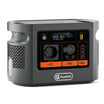
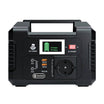
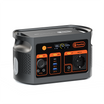
The local FlashFish T1200S record states more than 3500 cycles with remaining capacity above 80%. The E106B record states at least 3000 cycles, but its remaining-capacity threshold is blank. Neither record publishes a matched laboratory method, operating window, temperature or charge-discharge rate. The responsible conclusion is not that one model has proved longer life; it is that the two headline claims do not have equal documentation.
Cycle count is not battery health
Cycle count measures or estimates accumulated use. Battery health is broader. Capacity can change with calendar time, temperature history, storage state of charge, power level and cell variation. Internal resistance can also affect voltage under load without appearing in a simple cycle number.
A lightly cycled unit stored for years in harsh conditions may not be equivalent to a frequently used unit kept within gentler conditions. Conversely, a higher counter does not by itself prove unsafe or unusable condition. Follow the manufacturer's inspection and stop-use signs rather than diagnosing health from a single number.
A useful owner log
- Date and approximate start and end state of charge.
- Measured output watt-hours when the station provides that information or an appropriate meter is available.
- Load class and which output path was used.
- Ambient conditions and any unusually hot, cold or stored period.
- Displayed cycle or health value, firmware version if visible and any warning message.
This log cannot reproduce a laboratory test. It can show patterns, support a service conversation and prevent a memorable charge session from being mistaken for complete lifetime evidence. Do not open a battery pack or bypass protection to obtain more detail.
Advantages and limitations of equivalent full cycles
| Advantage | Limitation |
|---|---|
| Normalises many partial uses into a common energy-throughput unit | Does not capture every effect of temperature, power or calendar time |
| Avoids equating every charger connection with a full cycle | Depends on a capacity reference and measurement method |
| Helps compare test programmes when conditions match | Cannot make unmatched manufacturer claims comparable |
Common mistakes
- Counting every top-up as one complete cycle.
- Assuming displayed percentage equals measured cell-level state of charge.
- Comparing cycle numbers without their capacity-retention endpoint.
- Ignoring temperature, storage time and charge-discharge power.
- Treating a low cycle count as a complete battery-health certificate.
Frequently asked questions
Does every recharge count as one battery cycle?
Usually not in a throughput-based definition. Several partial discharges can add up to one equivalent full cycle, but the exact number shown by a product depends on its manufacturer-defined counter.
Do two 50% discharges equal one cycle?
They equal one full-capacity equivalent by simple throughput arithmetic. Actual device counting can differ because measured capacity, reserve, charging losses and firmware rules are manufacturer-specific.
Is cycle count the same as battery health?
No. Health also depends on capacity retention, resistance, calendar time, temperature, state of charge, power level and the test or estimation method.
Can I compare two products by the larger cycle number?
Only if the test temperature, depth or operating window, charge-discharge rates and end-of-life capacity threshold are comparable. A bare number can hide different methods.
What should I record when tracking battery use?
Record dated energy use or state-of-charge change, temperature, load class, charging method, storage periods and any displayed cycle or health value. Treat the display as one data point, not a laboratory measurement.
Conclusion: ask what the cycle number contains
A useful cycle claim tells you the cumulative throughput, operating window, unit-specific method, test conditions and terminal capacity criterion. Check the T1200S product evidence for a cycle claim that includes an end criterion, while remembering that the full laboratory method still is not in the local record.
Sources and evidence boundaries
- Regulation (EU) 2023/1542 for full equivalent cycles and endurance-data context.
- Apple cycle-count explanation for a clearly labelled cross-category partial-use illustration.
- FlashFish Europe station collection and local database for bounded product examples.
Evidence checked 8 September 2026. No battery was laboratory-tested for this article.



Zostaw komentarz
Ta strona jest chroniona przez hCaptcha i obowiązują na niej Polityka prywatności i Warunki korzystania z usługi serwisu hCaptcha.