


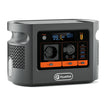
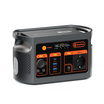

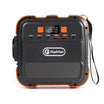



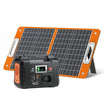

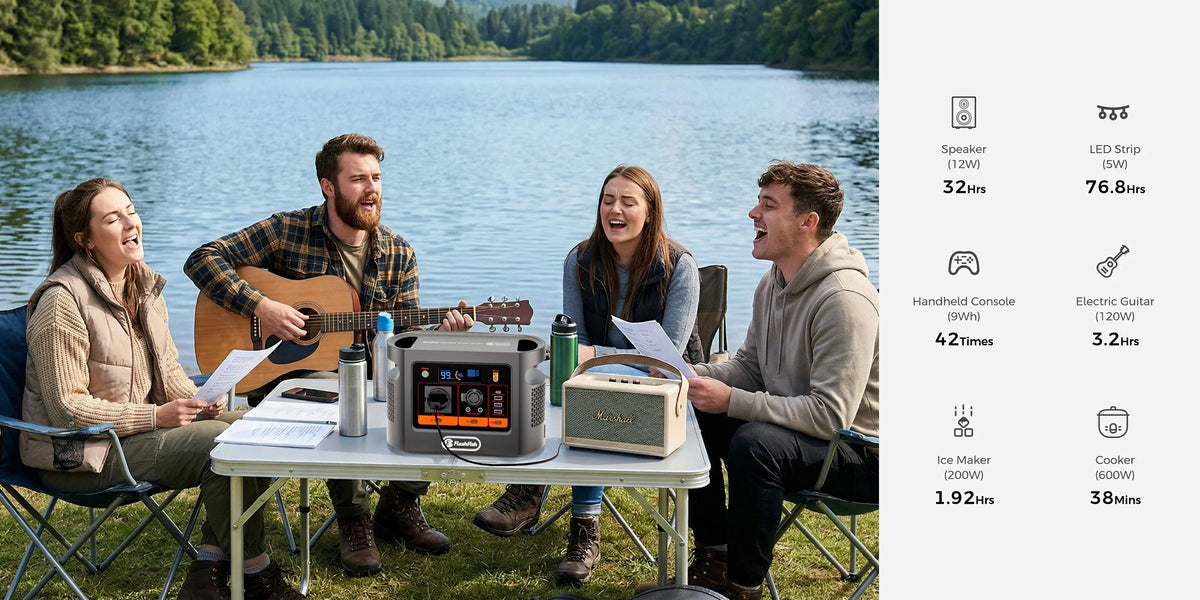
Short answer: calculate E106B cost per outing with four separate inputs: the final delivered purchase cost, necessary accessories, measured wall energy multiplied by your own electricity rate, and the number of outings you actually completed or explicitly assume. Do not divide the product-page price by 384Wh and call that ownership cost.
Record the purchase side first
The current E106B Europe page displayed EUR 199.99 for the EU Plug configuration on 24 October 2026. That is dated product-page evidence, not an address-specific delivered total. Your Europe guidance distinguishes the total price, taxes and charges from delivery and other additional charges. Enter the final seller-provided total for your address before purchase.
Check the current E106B price and configuration, then copy the exact regional variant and final total into the worksheet instead of carrying forward the dated example.
The worksheet
| Symbol | Input | How to obtain it |
|---|---|---|
| D | Final delivered station cost | Seller's final total for the exact configuration and address |
| A | Necessary accessory cost | Only items actually required and purchased for the outing plan |
| M | Measured recharge energy in kWh | Complete wall-energy measurement for each recharge |
| R | Applicable all-in EUR/kWh | Your contract or bill for the measured charging period |
| N | Outing count | Completed outings, or a clearly labelled planning scenario |
Use two formulas, not one shortcut
Recharge cost for one measured cycle = M × R.
Cost per outing after N outings = (D + A + total measured recharge costs + other recorded outing-specific costs) ÷ N.
Keep one-off ownership allocation and running energy cost visible as separate rows. That makes it clear which result changed when price, accessories, energy use or the outing count changed.
Measure wall energy instead of converting 384Wh
The E106B record lists 384Wh nominal battery capacity, but that is not the energy purchased from the wall. A charger has losses and a partial recharge differs from a full one. The Brennenstuhl PM 231 E manufacturer page is one example of a plug-in meter designed to record total energy consumption and calculate cost from tariffs. Use a suitable meter for your regional supply and follow its instructions; this article reports no E106B measurement.
Use your own electricity rate
The European Commission's electricity-bill explainer notes that bills include energy, network charges, taxes and levies and that tariffs vary by country, region and contract. Record the all-in marginal rate that applies to the measured charging period. If your contract changes by time, record the time window as well.
Run three use-count scenarios without predicting life
| Scenario | Calculation | What it means |
|---|---|---|
| 10 outings | Total recorded or assumed cost ÷ 10 | Short-horizon planning case, not an observed product life |
| 25 outings | Total recorded or assumed cost ÷ 25 | Midpoint sensitivity case |
| 50 outings | Total recorded or assumed cost ÷ 50 | Longer planning case, still not a durability promise |
Replace a scenario with the actual completed count as your log grows. Do not use a cycle-life statement as a substitute for outings because one outing need not equal one full battery cycle.
A worked blank example
Suppose your final delivered total is D, necessary accessories are A, and your first four recorded recharges cost C1 through C4. After ten completed outings, the tracked result is (D + A + C1 + C2 + C3 + C4 + any other recorded outing-specific costs) ÷ 10. Leaving symbols blank is more honest than inserting a generic tariff, assumed delivery fee or invented recharge measurement.
What this result does not prove
- It does not predict how many future outings the station will support.
- It does not establish runtime for a particular load.
- It does not prove savings versus a hotel, campsite socket, fuel generator or another station.
- It does not assign a resale value you have not received.
- It does not turn the dated EUR 199.99 product-page price into a delivered-price promise.
Frequently asked questions
Is EUR 199.99 the delivered E106B purchase cost?
No. It was the displayed EU Plug product-page price on the checked date; enter the seller's final total for your address.
Can I use 384Wh as wall energy?
No. Measure the complete recharge in kWh.
Which electricity price belongs in the worksheet?
Use your own applicable all-in marginal EUR/kWh and record the source and time window.
How many outings should I assume?
Use actual completed outings or clearly label 10, 25 and 50 as planning scenarios.
Does the worksheet prove savings?
No; avoided costs, future life, resale value and payback are not established.
Make the decision with current inputs
Update the worksheet immediately before purchase and after every measured recharge. If E106B's configuration or delivered total does not suit the plan, Compare current FlashFish Europe power stations using the same delivered-cost and measured-energy method.



Zostaw komentarz
Ta strona jest chroniona przez hCaptcha i obowiązują na niej Polityka prywatności i Warunki korzystania z usługi serwisu hCaptcha.