




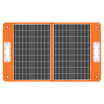
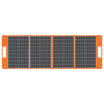


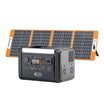

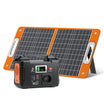

Power Bank or Portable Power Station for Weekend Camping?
Short answer: choose a power bank when your weekend list is only phones, headlamps, a small speaker or other USB devices. Choose a portable power station only when the measured plan needs AC, a verified 12V output, several higher-power devices or materially more energy. Buying the smaller tool that closes the real gap is usually the better camping decision.
The PORTS decision checks Powered devices, Output types, Required energy, Top-up plan, and Size plus site conditions. It avoids the weak shortcut that more watt-hours are automatically better.
The answer-first decision table
| Your real need | Power bank | Portable power station | Decision |
|---|---|---|---|
| Phones, headlamps, earbuds, small speaker | Usually the lighter fit if ports and energy close | Often unnecessary weight and complexity | Start with a power bank |
| USB-C laptop plus phones | Can fit when PD profiles, cable and energy are verified | Useful if several devices or longer reserve require it | Check the full USB chain |
| AC charger, 12V cool box or mixed outlets | Usually cannot supply the required output type | Relevant after exact watts, startup and energy are measured | Shortlist a station |
P — List every powered device
Write the exact phone, camera, laptop, light, speaker, cooler, pump or charger. Record how it accepts power: USB-A, USB-C PD, 12V DC or AC. Do not write electronics as one line because one USB-only trip is a different job from a campsite with a cool box and mains chargers.
O — Match the output, not just the connector
USB-IF explains that USB Power Delivery negotiates power between the source, cable and device. A USB-C shape does not prove that a bank supplies the laptop's required profile or that the cable carries it. Check the device input label, source output table and cable power marking together.
AC and 12V are a more decisive boundary. If one required device cannot run from verified USB, a normal power bank may not be the right class. A station still needs the correct regional AC output, continuous headroom, DC limits and exact cable.
R — Build the weekend energy card
- Record each device's battery Wh when available or measure charger energy for a normal refill.
- Multiply by the planned number of refills or operating hours.
- Add losses and a reserve without treating nominal capacity as fully deliverable.
- Separate must-run equipment from convenience loads.
- Choose the smallest class that closes the verified gap.
Three camping load cards
| Card | Device pattern | Likely class | Why |
|---|---|---|---|
| LIGHT | Two phones, headlamps and a small speaker | Power bank first | USB-only needs rarely justify carrying a 5.2kg or 12.45kg station without measured evidence |
| WORK | USB-C laptop, phones, camera batteries and lights | High-output power bank or compact station | The answer turns on PD profiles, cable limits, number of refills and reserve |
| MIXED | 12V cool box, AC charger, laptop and lights | Portable power station shortlist | Output diversity and energy matter; exact device watts and startup still control |
Compare your PORTS card with the current FlashFish Europe station range only if the power-bank branch no longer closes the need.
Where E106B and T1200S sit
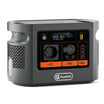
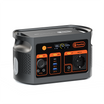
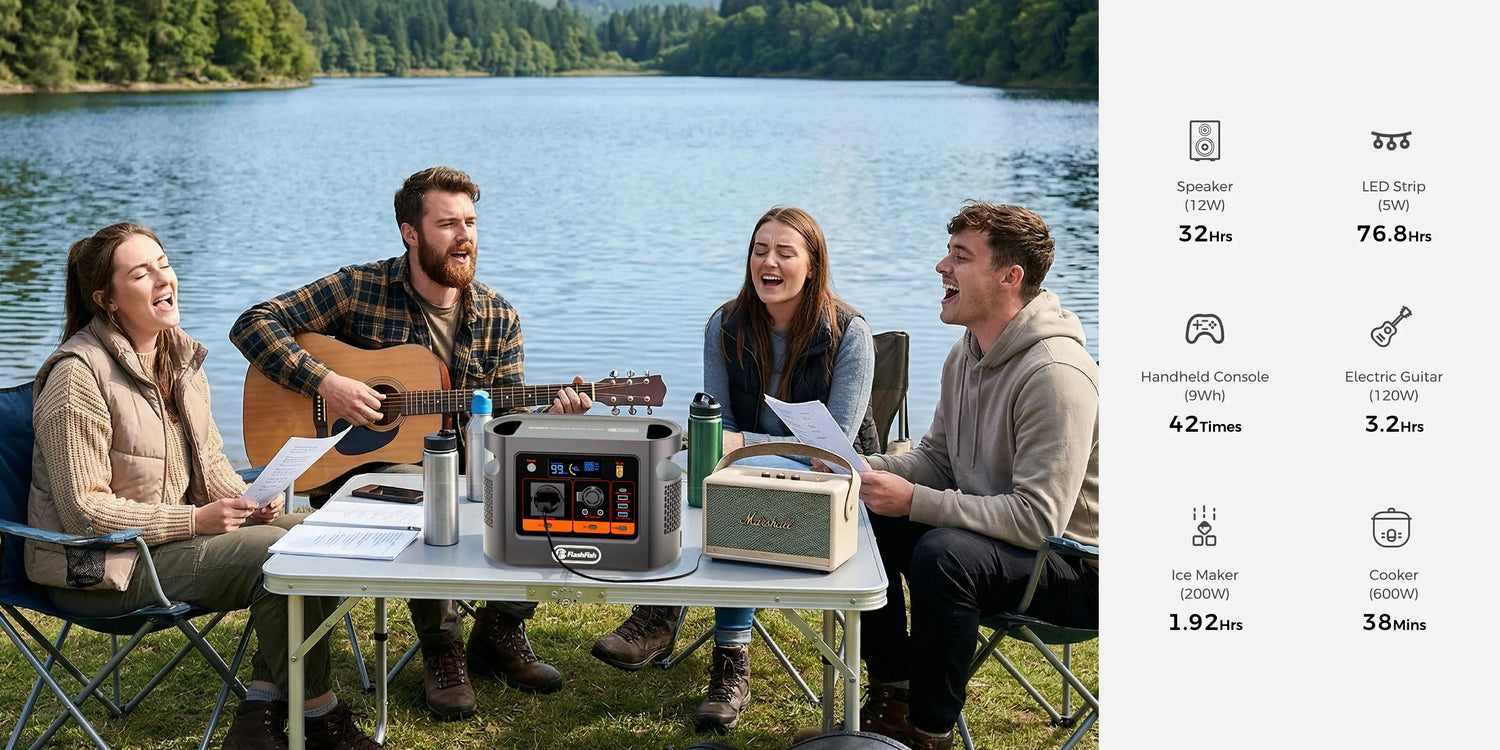
The current FlashFish E106B record supports 384Wh, 600W pure-sine AC, a 100W USB-C output, other USB outputs and approximately 5.2kg. It is the smaller FlashFish example when AC, 12V or a larger USB energy pool is genuinely needed. The local manual-derived record leaves chemistry blank, so this guide does not use chemistry to sell the choice.
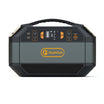
The FlashFish T1200S increases the documented envelope to 768Wh, 1200W continuous AC, 100W and 30W USB-C outputs, DC outputs and approximately 12.45kg. That can make sense for a mixed device list, but it is a poor answer to a phone-only trip where most of the capability stays unused.
T — Decide how energy will be replenished
A wall recharge before departure may be enough for a measured weekend. Car and solar top-ups add connectors, input limits, weather, placement and time. Do not buy a station merely because it can accept solar; first prove that the trip needs more energy than a simpler charged bank can carry.
S — Count carry mass and campsite conditions
Carry mass includes the source, chargers, adapters, cables and any panel. A 5.2kg station and a 12.45kg station occupy a different planning class from a pocket power bank. Keep every source and connection dry, ventilated, raised and protected from condensation, spills and foot traffic. Do not infer weather resistance from an outdoor marketing image.
When FlashFish fits
- Your measured plan needs AC, verified 12V or more energy than a suitable power bank can provide.
- The exact devices, regional outputs, cables and simultaneous loads fit a current ACTIVE Europe product.
- You accept the carry mass and can maintain a dry, supervised campsite setup.
When FlashFish does not fit
- Your trip is phone-only or USB-light and a suitable power bank closes the energy gap.
- You cannot verify a laptop's PD profile, cable rating or device input.
- You need weatherproofing, a medical-power assurance, airline carriage or a fixed runtime that this article cannot provide.
FAQ
Is a power bank enough for weekend camping?
Often yes for phones, headlamps, a small speaker and other USB devices when the bank, cable and device profiles fit and the measured energy includes reserve.
When do I need a portable power station?
When the verified plan needs AC, 12V, several higher-power devices or a larger measured energy pool than a suitable power bank can provide.
Does every USB-C port charge a laptop at full speed?
No. Source, cable and laptop must negotiate a compatible USB Power Delivery profile. Connector shape alone does not establish watts.
Should I choose E106B or T1200S?
E106B is the smaller listed class at 384Wh, 600W and about 5.2kg; T1200S is 768Wh, 1200W and about 12.45kg. The PORTS card, not the larger number, decides.
Can I leave a station outside the tent?
Do not assume weather resistance. Follow the exact instructions and campsite rules, keep it dry, raised and ventilated, and stop when conditions are damp or unsuitable.
Decision
If LIGHT closes with a suitable power bank, stop there. If WORK or MIXED proves a need for AC, 12V or a larger energy pool, Check E106B only if your measured trip genuinely needs AC, 12V or more USB energy. Move to T1200S only when the documented load and reserve justify its larger envelope and carry burden.



Zostaw komentarz
Ta strona jest chroniona przez hCaptcha i obowiązują na niej Polityka prywatności i Warunki korzystania z usługi serwisu hCaptcha.