

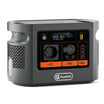
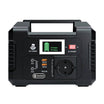

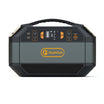
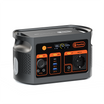


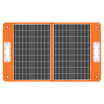
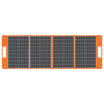


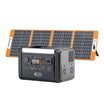

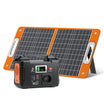


Short answer: price per watt-hour is a useful first filter, not a buying verdict. Divide the current delivered price by the advertised battery capacity, then keep continuous output, AC waveform, ports, weight, battery evidence and support beside the result. A low ratio is poor value if the station cannot run or charge the devices you bought it for.
The prices below are a dated FlashFish Europe snapshot for Germany/EUR on 26 July 2026. They are not a permanent offer, a competitor ranking or a measured usable-energy test.
The formula, with the right label
Price per catalog Wh = current purchase price ÷ advertised battery capacity in Wh.
For example, €119 divided by 179.2Wh is about €0.66 per catalog Wh. “Catalog” matters: a 179.2Wh battery does not deliver exactly 179.2Wh through AC. The inverter, battery-management system, standby draw, temperature, load and cut-off behaviour all affect energy delivered to a device. Without a controlled test, do not rename this result “price per usable Wh.”
A dated FlashFish Europe comparison
| Model | Price checked | Catalog capacity | Price/catalog Wh | Continuous AC / waveform | Weight |
|---|---|---|---|---|---|
| E200 | €109.99 | 151Wh | about €0.73 | 200W / modified sine | 1.85kg |
| E103 | €119.00 | 179.2Wh | about €0.66 | 300W / pure sine | about 3kg |
| T1200S | €339.99 | 768Wh | about €0.44 | 1,200W / pure sine | 12.45kg |
Arithmetic is rounded to two cents per Wh. The larger T1200S has the lowest ratio in this small same-brand snapshot, but that does not make a 12.45kg station the right answer for a phone-and-camera day trip. Likewise, the E200's higher ratio does not erase its much lower carry weight.
Apply the five-part VALUE framework
V: capture a verified, comparable price
Record the URL, country selector, currency, date, base model, promotion, tax, shipping and required accessories. Compare station-only prices with station-only prices. A solar kit, spare cable or different battery capacity changes the denominator and the use case.
- Use the price that applies to your delivery country.
- Exclude sold-out variants from an “available now” shortlist.
- Do not mix regular price for one model with promotional price for another without labelling it.
- Recalculate at checkout rather than copying an old search result.
A: screen appliance and port fit before value
Capacity answers “how much energy is stored”; output answers “what can be powered at one moment.” Read every device label. Compare continuous watts, startup behaviour, AC waveform and required ports. A low-watt USB-C setup may not need an AC inverter at all, while a sensitive or motor-based AC device may require a manufacturer-approved pure-sine source.
| Evidence | Question | Reject the model when |
|---|---|---|
| Device label/manual | Continuous and startup watts? | The value exceeds a documented output or remains unknown for an essential load |
| Station specification | Pure or modified sine? | The device maker requires a waveform the station does not provide |
| Port list | USB-C wattage, DC voltage or AC needed? | A required port or protocol is absent |
| Regional label | Voltage, frequency and plug? | The exact Europe configuration cannot be confirmed |
L: account for losses and battery evidence
Do not divide capacity by device watts and present the answer as a fixed runtime. AC conversion, standby consumption, temperature, load efficiency and battery limits change the result. Treat runtime as an estimate until measured with the actual device.
Chemistry and cycle wording also deserve context. “3,500+ cycles to above 80%” and “one-year warranty” answer different questions. A cycle statement is not the warranty period, and neither tells you the cost of a future repair or the delivered energy of a specific load.
U: value the inconvenience you will actually feel
The carry trade-off in the table is large: 1.85kg, about 3kg and 12.45kg are different travel categories. Also compare handle design, charging inputs, USB-C capability, display clarity, fan behaviour, storage space and the cables you must pack. Price per Wh ignores all of them.
A compact model can be better value when you carry it daily and power only small electronics. A larger model can be better value when the load list genuinely needs more output and stored energy.
E: expire the comparison deliberately
Price content decays. Put the check date beside the table, preserve the source URLs and refresh the data before publication. If price, stock or product configuration changes, recalculate rather than leaving an old conclusion under a new date.
A practical budget scorecard
| Field | Your evidence | Pass condition |
|---|---|---|
| Delivered price | Current checkout for your country | Inside budget with needed accessories |
| Price/catalog Wh | Price ÷ advertised Wh | Competitive inside the same use class |
| Largest load | Label/manual or measured watts | Within documented output and instructions |
| Daily energy | Measured Wh/day or watts × realistic hours | Fits with a loss and weather margin |
| Carry burden | Whole-unit kg plus accessories | You can move and store it as planned |
| Evidence gaps | Manual, waveform, region, support | No unresolved critical dependency |
When this FlashFish price snapshot is useful
- You are comparing currently active standalone models on the same Europe storefront and date.
- You keep small, medium and large stations in separate use-case groups.
- You use the ratio as one column beside output, waveform, ports and weight.
- You recheck the final delivered price and exact regional unit before buying.
When it does not fit
- You want a competitor ranking without collecting comparable current prices and specifications.
- You need measured usable energy or whole-life cost; this article supplies neither.
- You are comparing a station-only price with a kit, refurbished unit or unavailable variant.
- An essential load, regional voltage/frequency or required port remains uncertain.
Frequently asked questions
How do you calculate portable power station price per Wh?
Divide the dated purchase price by advertised capacity and label the result price per catalog Wh.
Is the lowest price per Wh always the best value?
No. Output, waveform, ports, weight, chemistry, charging and support can outweigh the ratio.
Does battery capacity equal usable AC energy?
No. System and inverter losses mean delivered AC energy differs from catalog capacity.
Can small and large stations be compared with the same ratio?
The arithmetic is comparable, but the stations may solve different jobs and larger models may benefit from scale.
How often should a price comparison be updated?
Recheck it at publication and purchase because price, stock, tax, shipping and promotions change.
Sources and evidence boundary
- FlashFish Europe E200 — dated price and product specifications.
- FlashFish Europe E103 — dated price and product specifications.
- FlashFish Europe T1200S — dated price and product specifications.
- FlashFish product-source bundle and Shopify discovery — model-fact and active-store controls.
Human review must refresh price, stock, regional labels and arithmetic before publication.




Zostaw komentarz
Ta strona jest chroniona przez hCaptcha i obowiązują na niej Polityka prywatności i Warunki korzystania z usługi serwisu hCaptcha.