

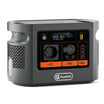
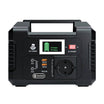

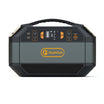
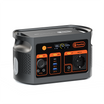


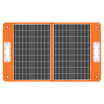
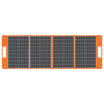


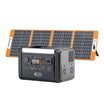

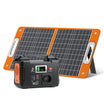


Short answer: the E103 can be a plausible power source for a modest travel-router and two-phone setup, but only after the router's approved input path and both phone cables are verified. Its local record lists 179.2Wh nominal energy, 300W continuous pure-sine AC, one USB-C output up to 60W and two USB-A outputs up to 18W each. Those ratings create a useful envelope; they do not establish compatibility, simultaneous charging speed or a fixed duration.
The safest planning method is ROUTE: Router input, Output path, USB phone demand, Total simultaneous load and Energy measured in a representative session. It keeps a connectivity question from becoming a guess based on one watt number.
Start with the router, not the station
Read the exact router label and manual. Record its input voltage, maximum current or watts, connector and whether the maker approves direct USB power. A USB-C-shaped input may expect a fixed 5V supply, a negotiated USB Power Delivery profile or the supplied adapter. These are not interchangeable assumptions.
As one documented example, GL.iNet lists the GL-MT3000 Beryl AX with USB-C 5V/3A input and power consumption below 8W. Its setup guide tells users to connect the supplied power adapter. This is useful evidence for that one router, not a template for every travel router and not an E103 test result.
The ROUTE worksheet
| Step | What to record | Pass condition | What remains unknown |
|---|---|---|---|
| Router input | Voltage, current, watts, connector, approved adapter | Exact manual and label agree | Real traffic-dependent consumption |
| Output path | E103 AC, USB-C or USB-A route | Router maker supports the complete path | Conversion loss for the exact route |
| USB phones | Each phone and cable requirement | Both negotiate and charge normally | Speed when all loads are active |
| Total load | Router plus two phones at the same time | No warning, reset or abnormal heating | Peak and duty-cycle behaviour |
| Energy | Watt-hours used during a real session | Session plus reserve fits the plan | Future network and usage variation |
Route A: use the router's original adapter
If the router maker specifies its supplied adapter, plugging that adapter into the E103 AC outlet preserves the intended router-side power conversion. This route uses the station's inverter and the adapter, so it may include more conversion stages than a supported direct-DC route. That is a reason to measure it, not to assign an invented efficiency percentage.
Confirm the adapter is a 230V-compatible European unit and that its input power is comfortably within the E103's 300W continuous AC ceiling. Keep the station ventilated and dry, and stop if a plug, cable or adapter becomes damaged, loose or unusually hot.
Route B: use direct USB only when documented
Direct USB can reduce the number of power bricks in a travel bag, but it is valid only when the router manual supports the voltage and protocol delivered through that route. E103's USB-C rating of up to 60W is a ceiling, not a command that forces 60W into the device. USB Power Delivery negotiates between compatible source, cable and device.
Do not select a direct cable by connector shape alone. Verify the cable's power capability, the router's accepted input and any required adapter tip or polarity. If the maker only documents the original adapter, keep that as the default route.
Add the two phones as separate loads
Each phone has its own accepted charging protocols and cable limits. Connect the router first, confirm stable operation, then add one phone and finally the second. E103 lists one USB-C and two USB-A outputs, but the local record does not state every simultaneous-output allocation. Therefore this guide does not promise full advertised power on all USB ports at once.
If charging slows, the router reboots or the station reports an abnormal condition, disconnect the newest load and check the phone, cable and port documentation. Avoid hubs and splitters unless every component is explicitly rated for the intended use.
Measure energy instead of publishing a runtime
Nominal battery energy is not the energy delivered to the devices. The station consumes some power, conversions have losses, phones taper their charging, and router demand changes with radios, traffic and attached storage. Dividing 179.2Wh by one router's label wattage ignores both phones and these system effects.
- Start with the E103 charged to a known level.
- Connect the exact router and two phones through their chosen paths.
- Use the same radio settings, mobile modem and traffic pattern planned for travel.
- Record elapsed time, station percentage change and, where possible, accumulated watt-hours.
- Repeat in representative conditions and retain a reserve rather than planning to empty the station.
The result belongs to that exact setup. A different phone battery level, weak mobile signal or firmware update can change demand.
Power availability is not internet availability
A powered router can still have no connection. Mobile coverage, SIM activation, roaming, data allowances, captive portals, upstream modem power and provider outages remain separate dependencies. Keep essential travel information available offline and maintain an alternative connection method when connectivity matters.
Where E103 fits—and where it does not
E103 fits the screening stage when the router and phones are low-power electronics, the approved connection paths are known and the complete session has been measured. Its 60W USB-C option can be convenient for supported devices, while AC allows use of a documented original adapter.
It is not a verified fit when the router input is unclear, a proprietary adapter is missing, cables are damaged, the setup must run unattended or continuous connectivity is critical. In those cases, resolve the device evidence and backup plan before selecting a station.
Check the FlashFish E103 specifications against the exact router adapter and both phone chargers before building the travel kit.
Frequently asked questions
Can E103 power every travel router?
No. Check the router's required voltage, current, connector and approved power method. A USB-C socket alone does not prove compatibility.
Should I power the router through AC or USB-C?
Use the route documented by the router maker. Its original adapter through E103 AC is the conservative default when direct USB-C input is not explicitly supported.
Can I charge two phones at the same time?
E103 lists one USB-C and two USB-A outputs, but the local record does not define every simultaneous-output rule. Test the exact cables and phones progressively.
How can I estimate runtime without guessing?
Measure watt-hours used by the complete router-and-phone setup during a representative session, include station overhead and keep a reserve.
Does powering the router keep internet service available?
No. Router power and internet availability are separate. Mobile coverage, SIM service, upstream modem power, data limits and provider outages can still interrupt service.
Conclusion: verify the route, then test the session
The E103 ratings make a small router-and-phone setup worth evaluating, but the decision should follow the router's approved input, the exact cables, progressive connection and a measured session. Keep network continuity as a separate plan. If the measured load needs a different output or energy class, Compare FlashFish portable power stations.
Sources and evidence limits
- FlashFish Europe E103 page and local product-source record for bounded E103 facts.
- GL.iNet Beryl AX product page for one manufacturer-documented router example.
- GL.iNet Beryl AX setup guide for the supplied-adapter path.
- USB-IF Power Delivery overview for negotiated USB power.
Evidence checked 16 September 2026. No E103, router, phone, adapter or cable was physically connected or measured for this article. Confirm the exact regional manuals and perform a supervised trial before relying on the setup.



Zostaw komentarz
Ta strona jest chroniona przez hCaptcha i obowiązują na niej Polityka prywatności i Warunki korzystania z usługi serwisu hCaptcha.