








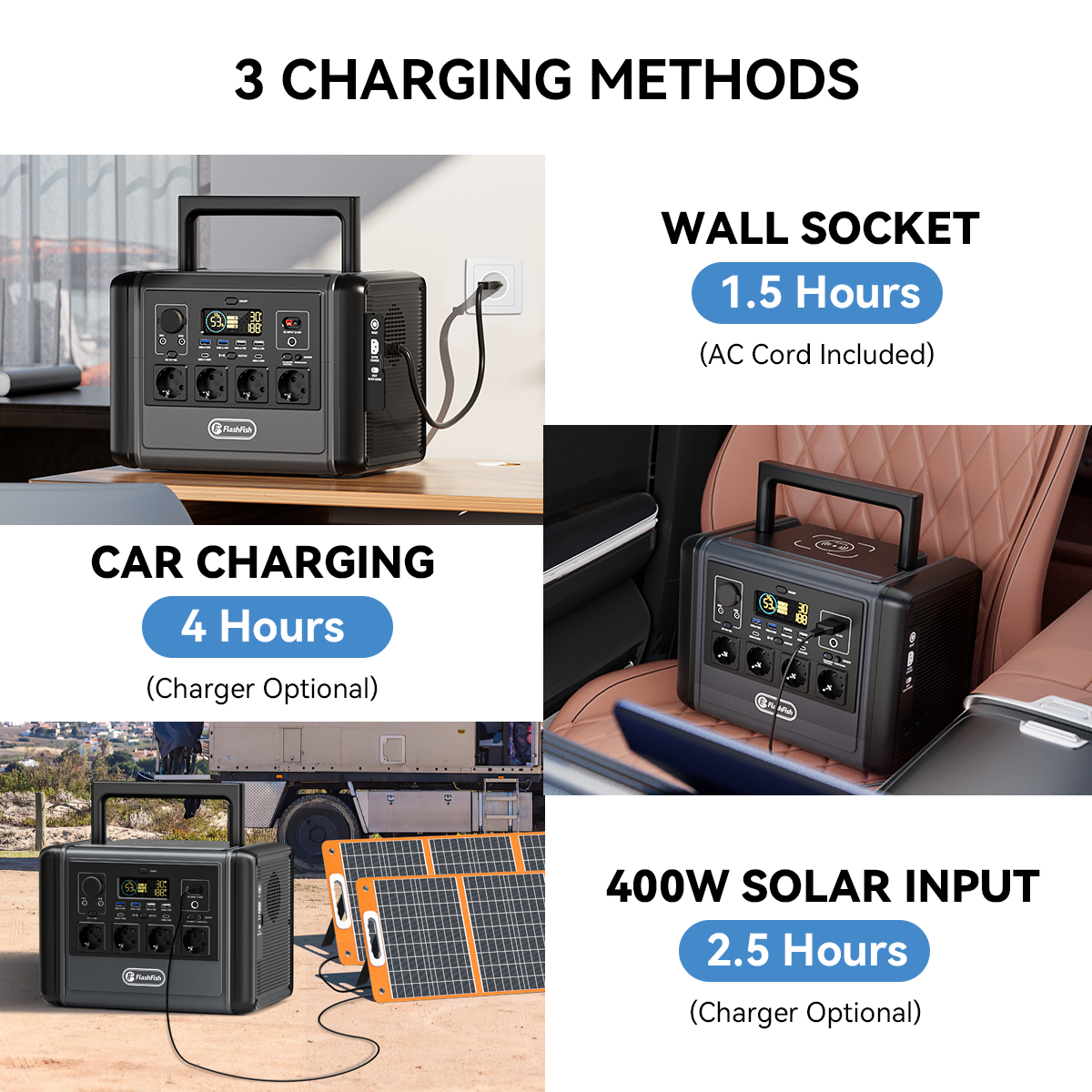
Short answer: a portable power station can run camping fans, LED lights and phones when the combined wattage stays inside the station output limit and the battery capacity is sized with margin. Start with labels, not guesses: watts multiplied by hours gives the first estimate, then add reserve for conversion losses, warm nights, extra devices and solar variability.
This page is written for campers who want a real planning method, not a thin ??est power station??claim. The right FlashFish model depends on the load list.
Simple sizing worksheet
| Device | What to check | Planning action |
|---|---|---|
| Camping fan | Rated watts on the adapter or product label. | Multiply by planned hours and add margin for hotter nights. |
| LED string light or lantern | USB or AC input rating. | Group low-watt lights together, but keep cable safety in mind. |
| Phone or camera charger | USB-A/USB-C output needed. | Use DC/USB ports where practical to reduce conversion waste. |
| Laptop charger | USB-C PD or AC wattage requirement. | Check port output; do not assume every USB-C port can charge every laptop. |
| Cool box or fridge | Startup behavior and food-safety needs. | Do a separate appliance plan; avoid casual runtime promises. |
FlashFish product fit
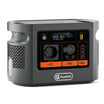
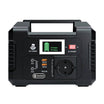
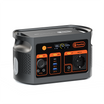
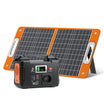
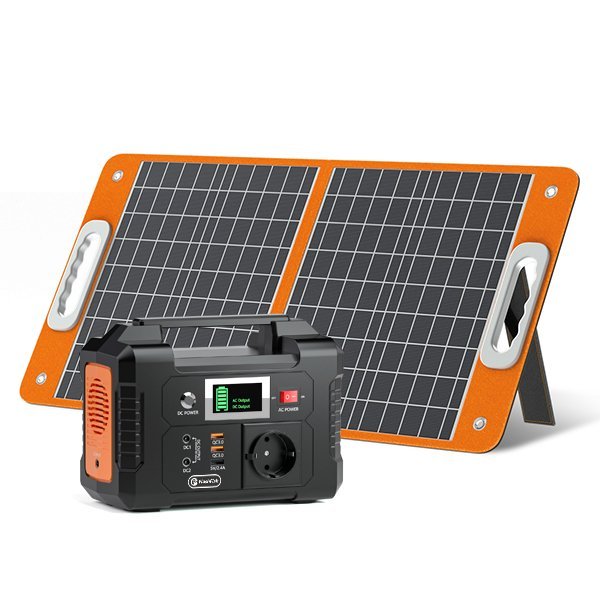
For light camping electronics, the FlashFish E200 and FlashFish E103 are the compact starting points verified as ACTIVE in FlashFish Europe product listing on 2026-06-12. The E200 product title lists 200W and 151Wh; the E103 product title lists 300W and 179.2Wh LFP.
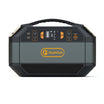
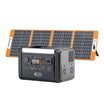
Move to the FlashFish T1200S when the campsite includes more AC devices, a longer weekend plan or more reserve. Keep the FlashFish T2000 for larger backup or tool-like loads, not for a simple lantern-and-phone trip.
Solar top-up for fans and lights
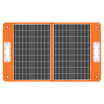
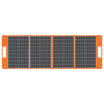
The FlashFish TSP60 and FlashFish TSP100 are relevant when the campsite has daytime sun and the station input supports the panel. JRC PVGIS documentation shows why solar planning depends on location and solar radiation over time; a shaded campsite or low winter sun can change the result completely.
Common planning mistakes
- Buying by peak wattage only and ignoring watt-hours.
- Assuming a fan uses the same power at every speed setting.
- Using a laptop charger without checking USB-C PD or AC output needs.
- Counting on solar as if every day were clear and unshaded.
- Running cables through wet grass, tent doors or trip paths without inspection.
Safety and cable notes
Electrical Safety First warns that outdoor electricity is higher risk because of damp conditions and ground contact. Keep the power station and connections dry, visible and raised from wet ground. Do not daisy-chain extension leads, do not use damaged cables and do not backfeed home or campsite wiring.
When FlashFish fits
- The user wants an affordable, practical camping power plan for low-to-moderate electronics.
- The load list is known and avoids heavy heating or cooking appliances.
- The buyer wants a Europe-store product link and clear limitations.
- The article can recommend a smaller product when that is more honest than upselling.
When FlashFish does not fit
- The campsite plan depends on medical devices, food-safety cooling or uninterrupted backup.
- The total load approaches or exceeds the station output rating.
- The buyer needs a tested runtime guarantee instead of a sizing method.
- The weather or campsite layout makes solar top-up unrealistic.
FAQ
Can a small power station run a camping fan all night?
Possibly, but only after checking the fan wattage and planned hours. Do not rely on a generic runtime claim.
Is E200 enough for lights and phones?
Often it can be a good fit for light electronics, but the final decision depends on the number of devices, charging hours and reserve margin.
Should I choose E103 instead?
Choose E103 when you want an LFP compact station and a little more output headroom than the smallest setup.
Do I need a solar panel?
No, but a compatible panel can help if you have good sun and realistic expectations. It is a top-up tool, not a guaranteed refill.
Practical guidance: verify live product specs, stock, image rendering and cable-safety wording before use.



Zostaw komentarz
Ta strona jest chroniona przez hCaptcha i obowiązują na niej Polityka prywatności i Warunki korzystania z usługi serwisu hCaptcha.