

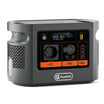
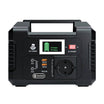

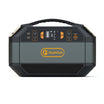
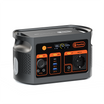


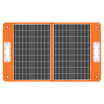
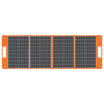


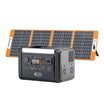

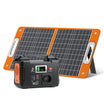


Short answer: Choose A201 when low carry weight is the first constraint and every device fits its documented 18W USB-C or 200W AC paths. Choose E103 when a verified 60W USB-C path, 300W pure-sine AC output and LiFePO4 record matter more than the extra weight. Their nominal energy is close—172.8Wh versus 179.2Wh—so capacity alone should not decide.
The hidden decision is evidence confidence. The authoritative A201 record leaves chemistry, AC waveform and frequency blank, while E103 documents those fields more completely. Verify the delivered regional label before AC use.
Use PATH instead of comparing Wh alone
PATH means: Power route, Appliance ceiling, Travel burden and Hardware-evidence confidence. Start with the device input, not the station headline. Then choose the model whose documented port, output and regional evidence match that device.
A201 vs E103 evidence table
| Decision field | FlashFish A201 | FlashFish E103 |
|---|---|---|
| Nominal energy | 172.8Wh | 179.2Wh |
| Continuous AC | 200W | 300W pure sine wave |
| Peak or surge | 400W | 600W |
| USB-C | 18W PD | 60W PD |
| Weight | Approximately 1.7kg | Approximately 3kg |
| Battery chemistry | Unknown in authoritative local record | LiFePO4 |
| Regional evidence issue | Waveform and frequency also blank locally; public page adds claims that require delivered-label review | Current local and Europe-page core fields are more complete; still verify the delivered plug and label |
Why similar Wh does not mean similar capability
Watt-hours describe nominal stored energy. Watts describe the output ceiling, and USB-C wattage describes one negotiated path. A201 and E103 sit close in nominal energy, but E103 documents 60W USB-C and 300W pure-sine AC while A201 documents 18W USB-C and 200W AC. That can change which cables, adapters and devices are practical even before runtime is considered.
Do not infer equal runtime from the 6.4Wh nominal difference. Delivered energy depends on the chosen output path, load, conversion losses, battery state, temperature and cycling.
Three concrete buyer examples
- Phone, camera batteries and an 18W-class tablet: A201 can be the carry-first option when every charger fits its documented ports and the 1.7kg pack matters more than extra output.
- A USB-C laptop that requests up to 60W: E103 is the clearer paper fit when the laptop and cable support a matching PD profile. A 60W label still requires source-cable-sink verification.
- A checked AC device between 200W and 300W: E103 has the higher documented continuous ceiling. Starting surge, waveform sensitivity and the exact device label still need review; the number alone is not compatibility proof.
The PATH worksheet
| Step | Question | Evidence to keep |
|---|---|---|
| Power route | Can the device use USB-C, 12V or only its AC adapter? | Device input profile, original adapter and cable rating |
| Appliance ceiling | What are continuous and starting demands? | Exact label/manual plus a measured use cycle when practical |
| Travel burden | Does saving about 1.3kg change the trip? | Station, cables, adapters and case weighed together |
| Hardware evidence | Are waveform, voltage, frequency and chemistry actually documented? | Current regional manual and delivered-unit label |
When A201 fits
- Your verified devices stay within its documented 18W USB-C, 200W continuous AC and other individual port limits.
- Low carry mass is the deciding constraint and you accept the need to verify unresolved regional waveform and frequency evidence before AC use.
- You are not buying on a fixed runtime, chemistry or universal laptop-compatibility assumption.
When A201 does not fit
- Your laptop needs a USB-C profile above 18W and you do not want to use and count its original AC adapter.
- Your checked AC load needs more than 200W continuous, or waveform and regional-frequency confidence are important to the device.
- The delivered label or current regional manual cannot resolve the evidence gaps for your intended use.
When E103 fits
- Your laptop and cable support a matching USB-C PD profile within the documented 60W port limit.
- You need a documented 300W pure-sine AC ceiling for a checked small load and accept the roughly 3kg carry mass.
- You value the local LiFePO4 record and more complete output documentation, without turning it into a reliability prediction or runtime promise.
When E103 does not fit
- Your trip is strongly weight-limited and every required device already fits a smaller documented path.
- Your appliance exceeds 300W continuous, has an unsupported starting requirement or needs a capability not stated in the current record.
- You need a fixed runtime, charging time, price advantage or tested compatibility. This comparison supplies none of those results.
How this comparison was built
The model specifications come from the manual-derived FlashFish product bundle. Fresh Europe Admin discovery verifies that both products are ACTIVE with public Europe URLs, but Admin status does not override technical evidence. The public pages were checked for current presentation and conflicts, and USB-IF was used only for the general USB PD negotiation model. No unit was weighed, connected or discharged for this draft.
FAQ
What is the main difference between FlashFish A201 and E103?
A201 is much lighter, while E103 has the stronger documented USB-C and AC paths. Their nominal energy is similar, so capacity alone is a poor decision rule.
Which is better for a USB-C laptop?
E103 is the stronger paper fit when the laptop can use a matching profile up to 60W. A201's authoritative record lists 18W USB-C, which may suit smaller devices but not every laptop.
Which is easier to carry?
The local records list A201 at about 1.7kg and E103 at about 3kg. Carry weight favours A201, but only if its lower output paths fit the actual equipment.
Do A201 and E103 have almost the same runtime?
Nominal capacities are close, but that does not prove equal delivered runtime. Output path, load, conversion losses, temperature and device cycling change the result.
Is A201 pure sine wave?
The authoritative local A201 record does not provide an AC waveform, so this comparison treats it as unknown and requires the current regional manual or delivered label before waveform-sensitive use.
Sources and evidence limits
- FlashFish A201 Europe page and the manual-derived local A201 record, checked 4 October 2026.
- FlashFish E103 Europe page and the manual-derived local E103 record, checked 4 October 2026.
- USB-IF Power Delivery overview, used for source-cable-device negotiation logic.
- FlashFish Europe Support Center, used as the regional manual and support route.
No price, runtime, reliability, charge-count or universal-winner claim is made. Choose E103 when the verified 60W USB-C and 300W pure-sine path matters. Choose A201 only after confirming its delivered regional label and your lighter-load path.




Zostaw komentarz
Ta strona jest chroniona przez hCaptcha i obowiązują na niej Polityka prywatności i Warunki korzystania z usługi serwisu hCaptcha.