

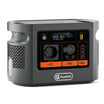
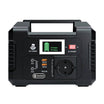

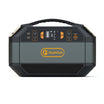
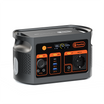






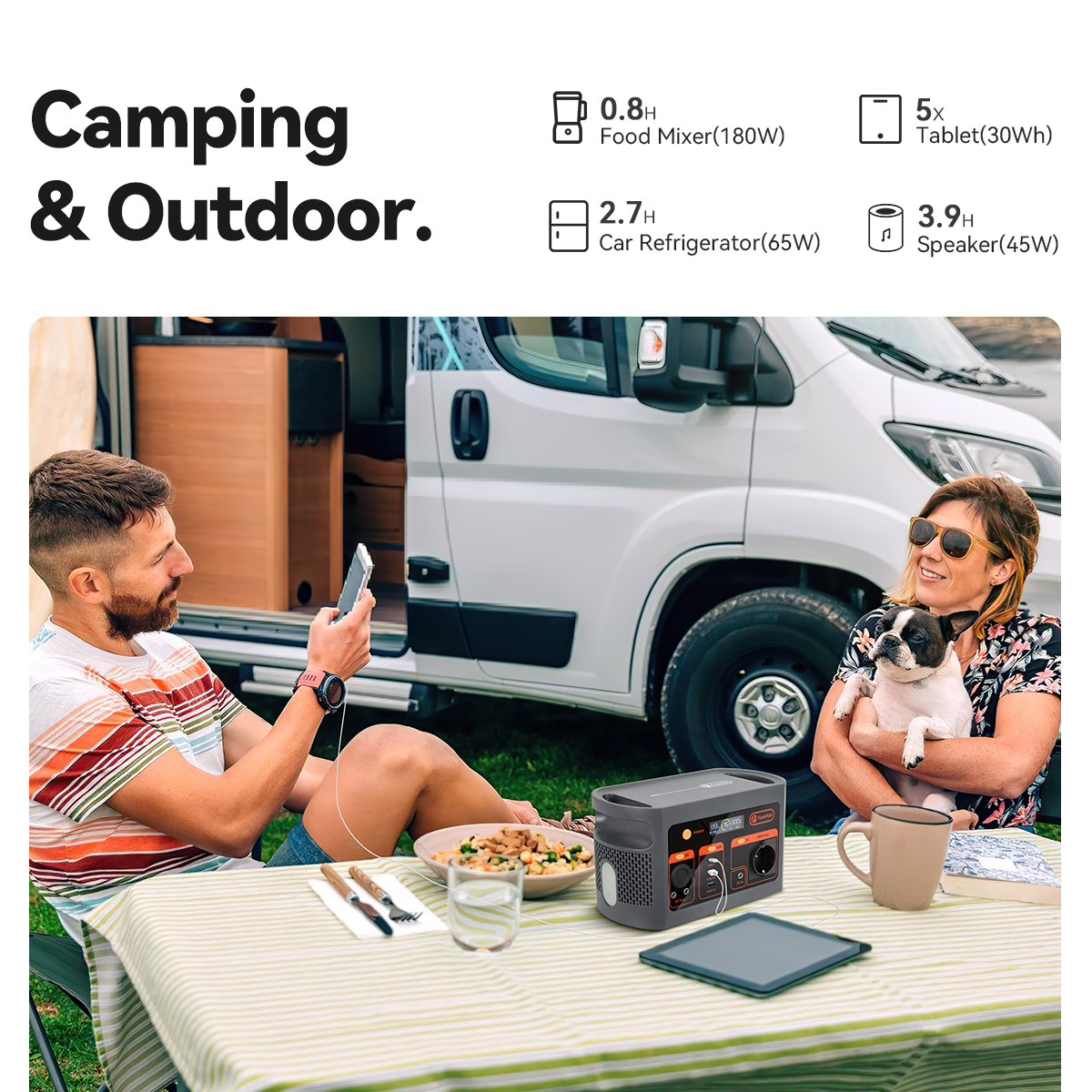
Short answer: both exact European records list 300W continuous AC output. Jackery Explorer 240 v2 has more nominal energy at 256Wh versus 179.2Wh, while FlashFish E103 is lighter at about 3.0kg versus 3.6kg. Those are real differences, but the better light-camping fit depends on measured loads, trip energy, connections and carry priorities.
PACK comparison from exact regional records
| Decision field | FlashFish E103 | Jackery Explorer 240 v2 | What it means |
|---|---|---|---|
| Continuous AC output | 300W | 300W | Tie on labelled continuous watts; not a matched load test |
| Nominal energy | 179.2Wh | 256Wh | Jackery has 76.8Wh more labelled capacity; usable energy remains untested |
| Mass | approximately 3.0kg | 3.6kg | E103 is about 0.6kg lighter before cables and accessories |
| AC outlets | 1 | 1 | Plan one direct AC load or a documented setup |
| USB-C | 60W output in the local E103 record | Europe product page presents 100W Type-C input/output | Verify the exact regional function, cable and device profile |
Compare your camping load list with the current E103 specification. Use the exact delivered European label and current manual as the final product-side check.
The useful trade-off is energy versus carry mass
Explorer 240 v2 leads on labelled capacity. E103 leads on documented station mass. For a short walk-in campsite with phone, camera and light charging, 0.6kg may matter. For longer stationary use, the extra 76.8Wh of nominal energy may matter more. Neither number alone establishes hours because conversion, station overhead, temperature, device behaviour and reserve affect the result.
Both list 300W continuous AC output. Treat that as an eligibility screen, not proof of identical surge response, inverter noise, efficiency or compatibility. The E103 record lists 600W surge; Jackery lists 600W instantaneous output. Those labels are not a matched transient test.
Why the USB-C row still needs an exact-device check
The E103 local record lists one 60W USB-C output. Jackery's current Europe product page presents USB-C input/output with a 100W Type-C claim. A port headline still does not establish that a particular laptop, camera battery or cable negotiates the needed profile, so verify the exact regional unit and device chain.
This comparison excludes EPS or UPS performance. Neither product is recommended here for a critical uninterrupted-power role without separate, application-specific evidence.
Three light-camping profiles
- Walk-in photography camp: mass and verified DC charging may dominate. E103's lower documented weight is useful, but check every battery charger and the total kit rather than the station alone.
- Car-access tent with longer evening use: Jackery's higher nominal energy may be useful when loads remain below 300W, but measure the actual devices and preserve reserve.
- USB-C laptop and camera workflow: port function can decide the system. E103 documents 60W USB-C output; Jackery's Europe page presents 100W Type-C input/output, but confirm the exact device profile and cable directly.
Build a trip energy sheet
| Load | Exact supply or measured watts | Measured session Wh | Priority |
|---|---|---|---|
| Phone and navigation | Record exact charger | Measure a normal recharge | Essential |
| Camera batteries | Record charger input | Measure the planned number | Trip-specific |
| Laptop | Confirm required USB-C profile or AC adapter | Measure the intended work session | Optional or work-critical |
| Lighting | Record every lamp | Measure evening use | Safety-related |
Add the measured watt-hours, conversion and station overhead, and a reserve. Then compare the result with usable energy measured under your own setup; do not convert nominal Wh directly into promised nights.
What this desk comparison cannot tell you
- Usable AC watt-hours under a matched load.
- Fan behaviour, acoustic noise, conversion efficiency or standby draw.
- Transient response, waveform quality under load or sensitive-device compatibility.
- Charging time under the same source and temperature.
- Long-term reliability, weather resistance, service outcome or value at a changing price.
Decision card
| Choose E103 for the shortlist when | Choose Explorer 240 v2 for the shortlist when |
|---|---|
| Lower documented station mass matters more than extra labelled energy | More nominal energy matters more than the 0.6kg mass difference |
| A documented 60W USB-C output suits the exact device | The exact USB-C function is verified and suits the device |
| 179.2Wh nominal energy passes the measured plan with reserve | The plan needs more than that but fits within 256Wh nominal before real-world validation |
Keep either unit dry, ventilated and protected from trips and public access. Camping safety guidance supplies context, but the exact station manual and site rules remain decisive.
Frequently asked questions
Which has more nominal battery energy?
Jackery Explorer 240 v2 is listed at 256Wh versus 179.2Wh for E103. That is a labelled-capacity comparison, not a promise of usable AC energy or runtime.
Which is lighter to carry?
The exact records list E103 at approximately 3.0kg and Explorer 240 v2 at 3.6kg, so E103 is about 0.6kg lighter on the documented figures. Carry comfort still depends on the full kit.
Do both provide 300W AC output?
Both exact regional records list 300W continuous AC output. That common rating does not prove identical surge handling, noise, efficiency, waveform under load or device compatibility.
Which has the better USB-C port?
The E103 record lists 60W USB-C output. Jackery's current Europe product page presents USB-C input/output with a 100W Type-C claim. Verify the exact regional function, cable and device profile before declaring a winner.
Which is better for a weekend camping trip?
Choose from a measured load list and energy budget. Jackery provides more labelled energy; E103 is lighter. Neither advantage decides the trip without the devices, charging plan, carry distance and reserve.
Conclusion: choose the constraint that matches your trip
Jackery Explorer 240 v2 has the larger nominal-energy figure; FlashFish E103 has the lower documented mass; both list 300W continuous AC output. Use the Europe buying guide to compare the full camping system, then validate the exact loads and connections.
Sources and evidence limits
- FlashFish Europe E103 page and the local product database for bounded E103 fields.
- Jackery Europe Explorer 240 v2 product page for current first-party specifications and positioning.
- Camping and Caravanning Club camping-safety guidance for controlled campsite context.
Evidence checked 13 September 2026. This is a manufacturer-record comparison, not a purchase, lab test or field review; price, runtime, noise, efficiency, reliability, weather resistance and UPS performance are not ranked.



Zostaw komentarz
Ta strona jest chroniona przez hCaptcha i obowiązują na niej Polityka prywatności i Warunki korzystania z usługi serwisu hCaptcha.