
Short answer: the small DC polarity mark shows whether the centre contact or outer sleeve is positive. Follow the line from the plus sign to the centre dot or the outer C-shaped ring. But polarity is only one check: the exact device, voltage, current requirement, connector dimensions and manufacturer-approved source must also match. If the symbol or any decisive field is missing, do not connect the accessory.
How to read the polarity mark
IEC 60417 names symbol 5926 “polarity of d.c. power connector.” In the common barrel-connector drawing, the dot represents the centre contact and the broken C-shaped ring represents the outer sleeve. If the plus line reaches the dot, the connector is centre-positive. If the minus line reaches the dot, it is centre-negative.
Read the printed connections rather than the left-to-right order of plus and minus. Labels can be rotated, mirrored in layout or crowded by voltage and current text. The lines to the dot and ring carry the meaning.
Use the MATCH method before connection
- M — Model and source authority. Match the exact station, accessory, regional version and current manual. A related model or marketplace cable is not authority.
- A — Allowed electrical ratings. The accessory input voltage must match the source output, and the source must meet the device's documented current requirement without exceeding either product's limits.
- T — Tip and sleeve polarity. Confirm whether the centre contact and outer sleeve are positive or negative on both sides. Common is not universal.
- C — Connector dimensions. Match outer diameter, inner diameter, length and any locking feature. “5.5mm” by itself can hide a 2.1mm-versus-2.5mm inner difference.
- H — Halt on uncertainty. Stop for a blank, damaged or conflicting label; obtain the exact manual or written manufacturer confirmation. Do not improvise with reversible tips or altered wiring.
Five fields that must agree
| Field | Where to find it | Why shape alone fails |
|---|---|---|
| Exact model/region | Product label and matched manual | Similar housings can use different ports or limits |
| Voltage and DC marking | Source output and accessory input labels | The same barrel size can carry different voltages |
| Current requirement/limit | Accessory input and source-output documentation | A connector does not disclose available current or group limits |
| Polarity | Dot/ring symbol or explicit manufacturer statement | Centre-positive and centre-negative plugs may look identical |
| Dimensions and retention | Mechanical drawing or exact part number | 5.5x2.1mm and 5.5x2.5mm are not the same fit |
Three evidence-based examples
1. A documented centre-positive supply
The MEAN WELL GST60A datasheet identifies its standard P1J option as 5.5mm outer diameter, 2.1mm inner diameter and centre-positive. This is a complete connector example because a part number, mechanical dimensions and polarity assignment appear together. It does not mean every 5.5x2.1mm supply is interchangeable.
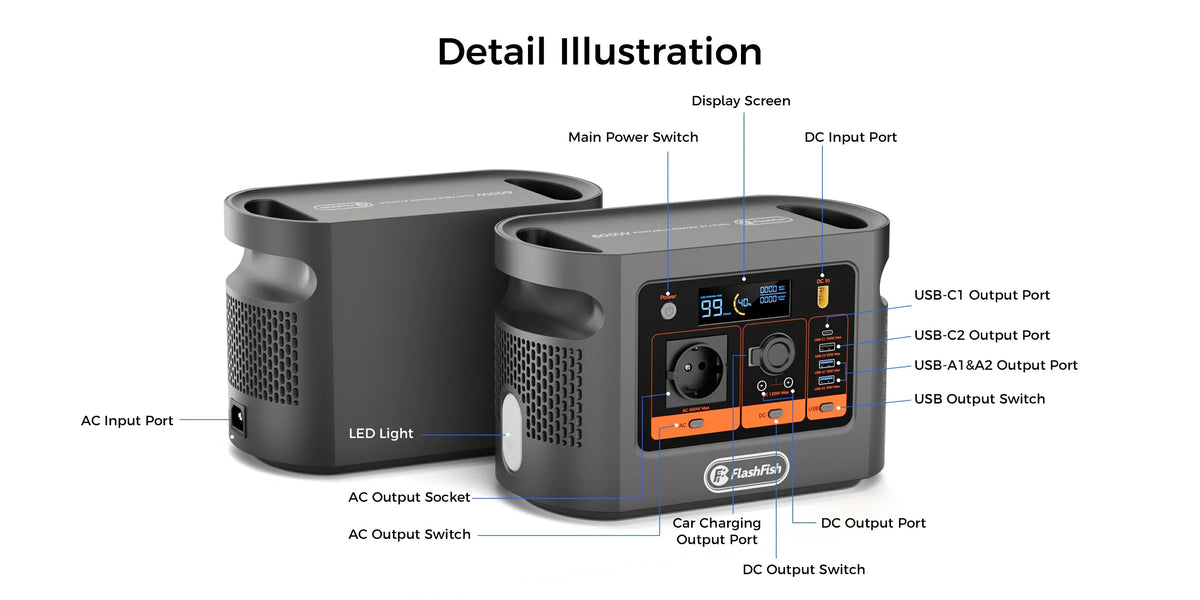
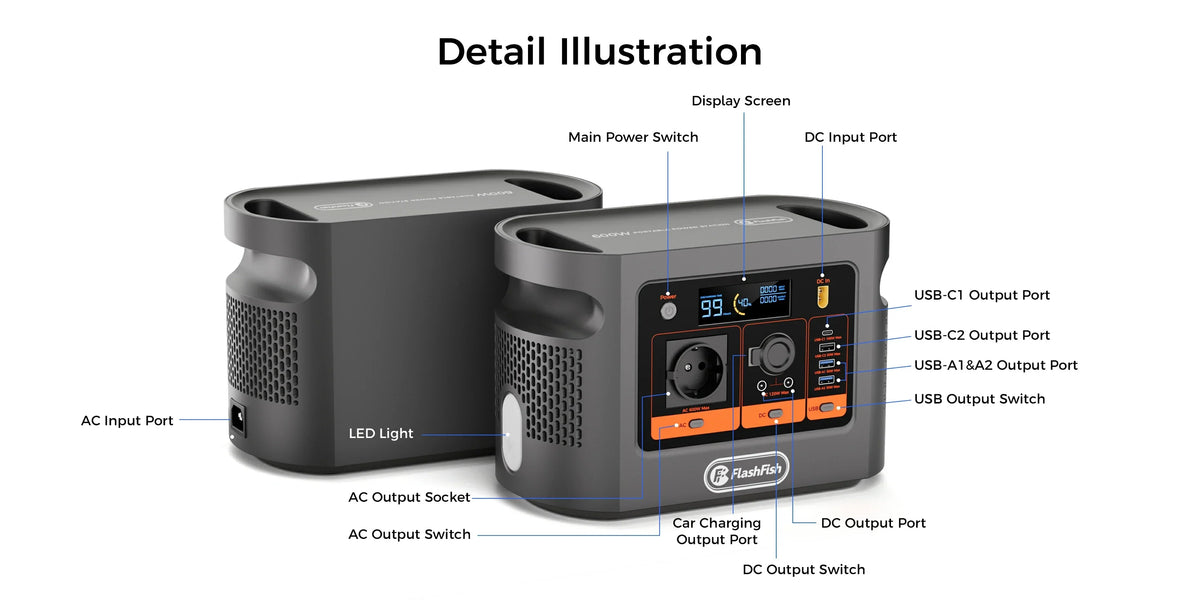
2. A FlashFish port with incomplete polarity evidence
The local E106B record documents two DC5521 outputs plus a car output at 12V/10A with a shared 120W maximum. It does not state the DC5521 polarity. That missing field matters. The correct action is to check the delivered label, exact regional manual or written support confirmation—not to assume centre-positive.
3. A plug that looks right but has the wrong inner diameter
Manufacturer plug tables show that 5.5mm outer barrels can use 2.1mm or 2.5mm inner dimensions. A loose or forced fit can give intermittent contact or damage the connector. Measure nothing by guesswork; use the exact documented plug designation for both sides.
Stop conditions
- The plus/minus symbol is missing, worn away or ambiguous.
- The station manual gives voltage and current but no polarity.
- The accessory and source labels disagree on voltage or polarity.
- Only “5.5mm” is given without the inner diameter and length.
- The cable is sold as universal, reversible or polarity-changing without explicit approval for both exact products.
- The plug feels loose, must be forced, becomes warm, sparks, smells burnt or causes repeated protection trips.
- The accessory is safety-critical, medical, wet-use or part of an installation requiring specialist approval.
When a FlashFish DC output can fit—and when it does not
It can fit only when the exact model's manual or label documents the output voltage, current/group limit, connector dimensions and polarity, and the accessory documentation matches every field. Use the original or expressly approved cable whenever possible.
It does not fit when polarity is absent, the voltage differs, connector dimensions are incomplete, the accessory expects a different current or communication function, or the user would need to alter wiring. Move to a manufacturer-approved AC adapter or another documented power path instead.
Common mistakes
- Assuming centre-positive because it is common.
- Reading the plus and minus positions instead of tracing their lines to the dot and ring.
- Treating DC5521 as proof of polarity.
- Ignoring a 2.1mm-versus-2.5mm inner-diameter difference.
- Matching voltage while overlooking current limits and shared output groups.
- Using a generic reversible-tip cable without exact product approval.
- Continuing after heat, looseness, arcing, smell or protection trips.
FAQ
What does the dot mean in a DC polarity symbol?
The dot represents the centre contact of the barrel connector. Trace the line from the plus or minus sign to that dot to identify centre polarity.
Is every barrel connector centre-positive?
No. Centre-positive is common, but centre-negative products exist. The exact label or manual must resolve the connector; appearance cannot.
Does DC5521 tell me the polarity?
No. DC5521 describes nominal connector dimensions, not voltage, current or polarity. All fields must be documented separately.
Can I reverse a cable if the polarity is wrong?
This guide does not recommend rewiring or polarity-reversal adapters. Use the manufacturer-approved cable or power supply for both exact products, or choose another documented path.
What should I do when the label is unreadable?
Do not connect it. Record the exact model and regional version, find the current manual or contact the manufacturer with clear label and connector photos. Keep the accessory isolated until the missing field is resolved.
Conclusion
The polarity symbol is a map, not a compatibility badge. Trace plus and minus to the centre dot and outer ring, then complete MATCH: model authority, allowed ratings, tip/sleeve polarity, connector dimensions and halt conditions. Find the exact Europe manual before connecting a DC accessory, and leave an undocumented DC accessory disconnected.
Sources and further reading
- IEC 60417 catalogue preview identifying symbol 5926.
- MEAN WELL GST60A datasheet for one documented centre-positive 5.5x2.1mm example and alternative plug dimensions.
- FlashFish Europe E106B listing and the local manual-derived record for documented port limits and the retained polarity gap.
- FlashFish Europe Support Center for exact regional manuals and escalation.
Safety note: this is label-reading and purchasing guidance, not an electrical test procedure. No adapter, cable, accessory or power-station port was measured or connected.




Оставить комментарий
Этот веб-сайт защищается hCaptcha. Применяются Политика конфиденциальности и Условия использования hCaptcha.