
Portable Power Station C-Rate Explained for Buyers
Short answer: C-rate compares battery current with rated amp-hour capacity. It is not the same as watt-hours, AC output watts, charging watts or runtime. For a buyer, C-rate becomes useful only when the manufacturer publishes the relevant charge or discharge rate and the conditions behind it.
Use the RATE method: Read the definition, Align the units, Treat the maximum as manufacturer-specific, and Evaluate the buyer-facing specifications that actually decide the load.
R: Read C-rate as a ratio
Natural Resources Canada defines C-rate as a normalized charge or discharge rate obtained by dividing current by capacity. If current is in amps and capacity is in amp-hours, the result has the practical unit of per hour. A 1C rate uses current numerically equal to the rated Ah value; C/2 means 0.5C, while 2C is twice the rated Ah current.
The familiar one-hour, two-hour or half-hour descriptions are rate references under defined conditions. They are not promises that a finished portable power station will deliver AC power for exactly that time. Cutoff voltage, temperature, state of charge, battery management, conversion losses and the load all matter.
Three unit examples—and only unit examples
| Generic 100Ah example | Current arithmetic | Rate reference |
|---|---|---|
| 0.5C, also written C/2 | 0.5 × 100Ah = 50A | Two-hour reference under defined conditions |
| 1C | 1 × 100Ah = 100A | One-hour reference under defined conditions |
| 2C | 2 × 100Ah = 200A | Half-hour reference under defined conditions |
These are not safe-current recommendations. A real battery must remain within the cell, pack, connector, thermal and BMS limits specified by its manufacturer. Higher current can also change available capacity, voltage behaviour, efficiency, temperature and ageing.
A: Align amps, amp-hours, watts and watt-hours
| Term | What it describes | Buyer mistake to avoid |
|---|---|---|
| Amp (A) | Electrical current at a moment | Treating it as stored energy |
| Amp-hour (Ah) | Charge capacity at stated conditions | Comparing Ah across different voltages without context |
| Watt (W) | Power at a moment; volts × amps in a simple DC relationship | Calling a watt rating runtime |
| Watt-hour (Wh) | Energy; power accumulated over time | Assuming every nominal Wh reaches an AC appliance |
| C-rate | Current relative to rated Ah capacity | Equating it to the AC inverter rating |
A portable station adds an inverter, DC converters, battery management, wiring, thermal controls and sometimes multiple voltage domains. The AC outlet watt rating is at the load side of that system. Battery C-rate is an internal electrochemical and current-rate concept. Converting between them requires more evidence than a product title supplies.
T: Treat every maximum C-rate as manufacturer-specific
A claimed maximum rate is incomplete unless it says whether it is charge or discharge, continuous or pulse, and under which temperature, state-of-charge, voltage and cutoff conditions. Cell-level data may also not transfer directly to a finished pack because pack design and BMS settings can impose lower limits.
The Victron battery-monitor manual shows that available capacity can depend on discharge rate, while Analog Devices treats C-rate as normalized battery current. That is why a buyer should resist an unsupported calculation from public capacity and AC watts. Arithmetic can explain units; it cannot create a missing manufacturer limit.
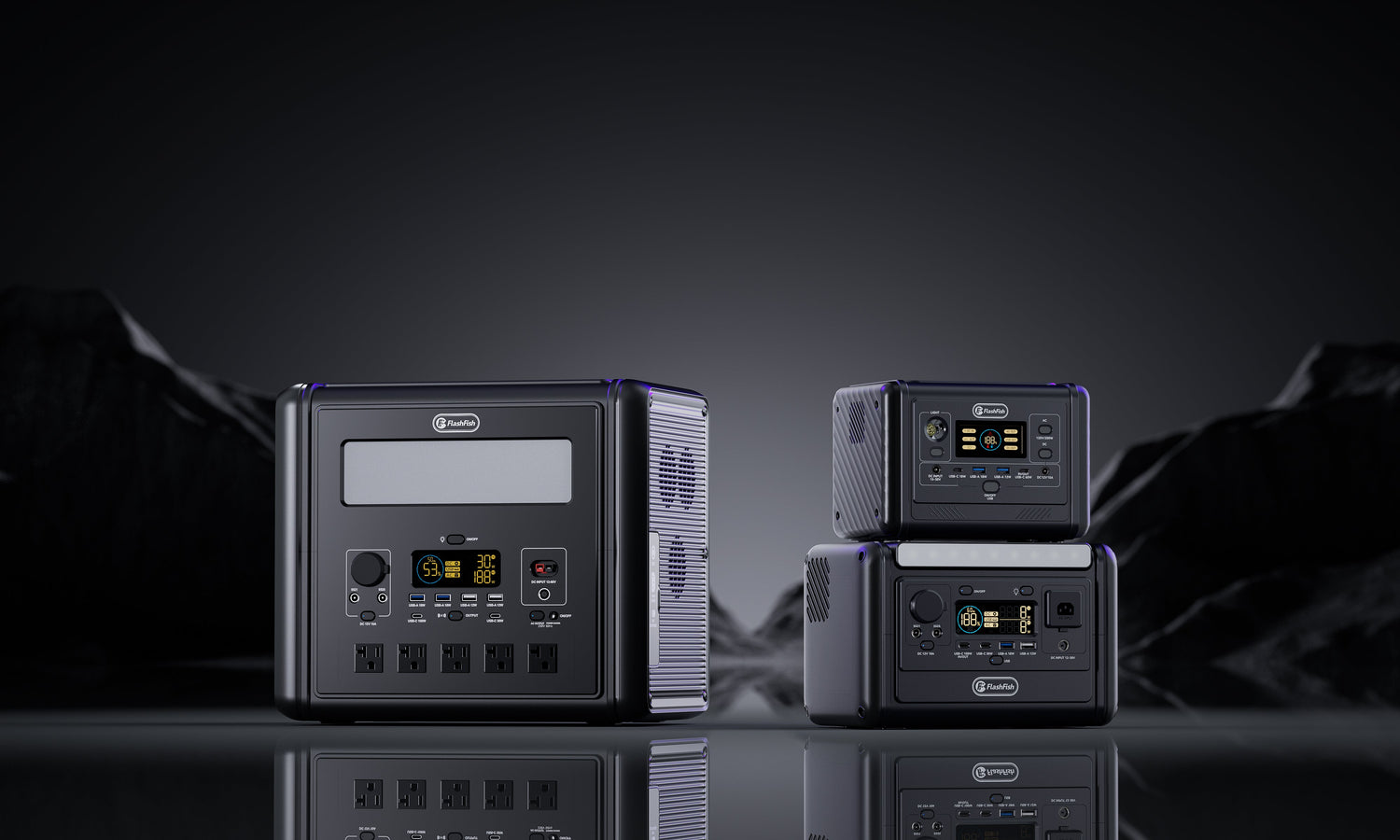
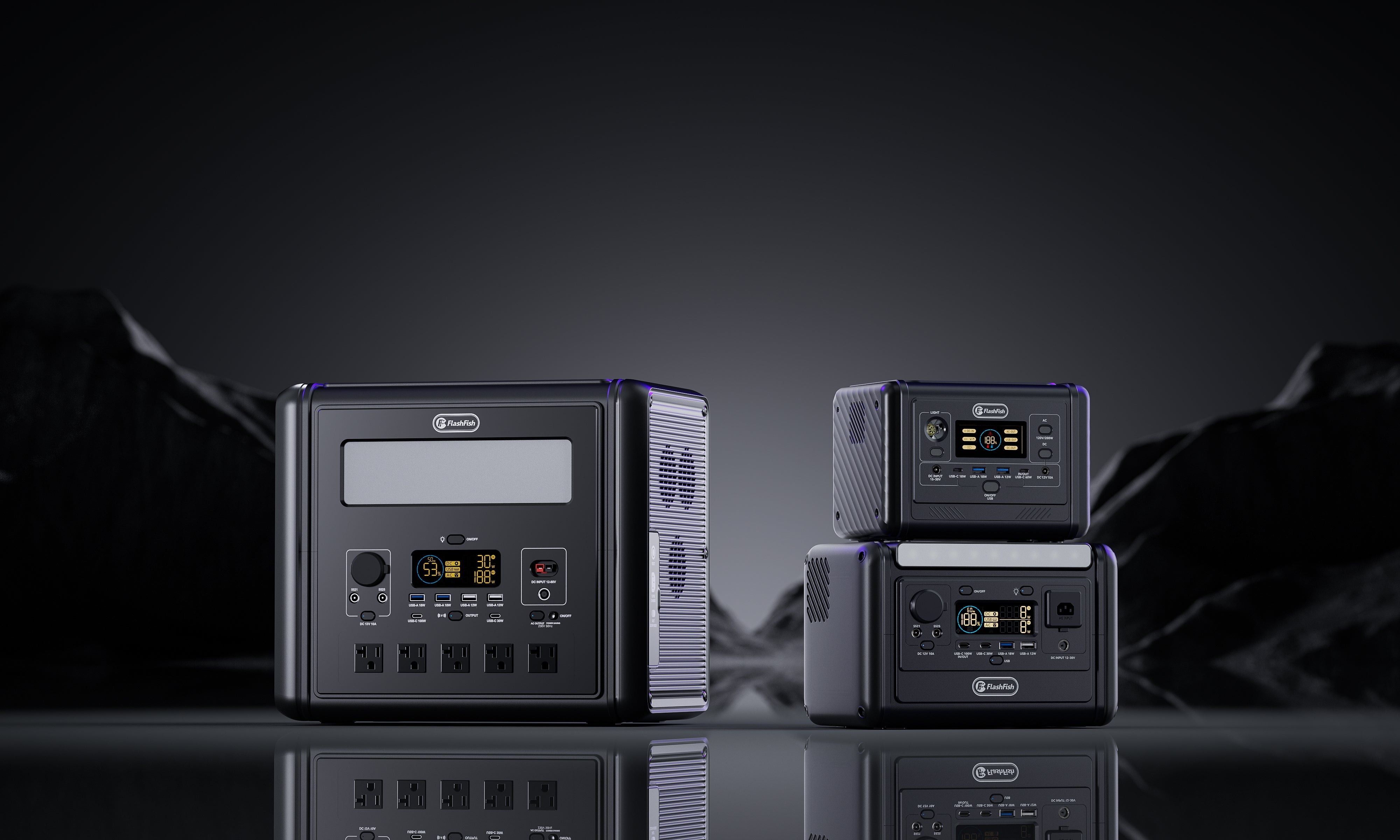
Two FlashFish examples show the evidence boundary
| Model | Published energy and charge capacity | Continuous AC output | Maximum charge/discharge C-rate |
|---|---|---|---|
| T1200S | 768Wh; 25.6V/30Ah | 1200W | Not provided in the authoritative local record |
| E106B | 384Wh; 25.6V/15Ah | 600W | Not provided in the authoritative local record |
It may be tempting to divide AC watts by nominal pack voltage, then divide by Ah and announce a C-rate. That would ignore inverter efficiency, internal voltage under load, system architecture, auxiliaries, BMS policy and the difference between an external AC rating and battery current. This guide does not make that inference.
E: Evaluate the specifications that answer the buying question
For appliance fit, verify continuous AC output, regional voltage and frequency, pure-sine evidence where relevant, startup behaviour and the combined load. For duration, build a watt-hour ledger and retain conversion and environmental reserve. For charging, match input voltage, current and power limits to the exact source. For carrying, compare mass and the full cable or panel kit.
A practical buyer checklist
- List every device and its exact running and starting evidence.
- Choose a station with verified continuous output and useful headroom.
- Estimate or measure watt-hours for the planned period and keep reserve.
- Verify the regional socket, voltage, frequency, ports and input window.
- Use C-rate only if the manufacturer publishes the relevant value and conditions.
- Do not infer an internal limit from AC watts, Wh or marketing terms.
Use the Europe buying guide to compare verified buyer-facing specifications.
When FlashFish model facts help
- T1200S and E106B records provide nominal Wh, voltage/Ah, continuous AC, ports, inputs and mass for bounded buyer decisions.
- The current Europe catalogue confirms active product URLs and regional shopping context.
- The missing C-rate field can be stated honestly instead of filled with an estimate.
When those facts do not answer the question
- They do not publish model-specific maximum charge or discharge C-rate.
- They do not reveal cell configuration, internal current or BMS limits.
- They do not turn nominal Wh or AC watts into a fixed runtime, safe current or degradation result.
FAQ
What does 1C mean?
Current equal to rated Ah capacity: 100A for a generic 100Ah example. The one-hour wording is a rate reference, not promised station runtime.
Is C-rate the same as AC watts?
No. C-rate describes battery current relative to Ah capacity; AC watts describe inverter output to connected loads.
Can I calculate C-rate from Wh alone?
No. Wh describes energy. A C-rate calculation needs current and rated Ah at defined conditions, while a safe limit needs manufacturer evidence.
What are the T1200S and E106B C-rates?
The authoritative local records do not publish maximum charge or discharge C-rates for either model, so this guide does not infer them.
Should a buyer prioritize C-rate?
Only when it is published with useful conditions. Start with continuous output, energy, regional AC, ports, inputs, mass and the exact device load.
Decision
C-rate is valuable battery language, but it is often misused as a shortcut for finished-product performance. Use it to understand current relative to capacity, not to replace an appliance load plan or manufacturer limits. Compare current models without inventing a missing C-rate.
Sources and evidence boundaries
- Natural Resources Canada battery ecosystem benchmark — normalized C-rate definition and time references.
- Victron BMV-700H manual — manufacturer explanation of Ah, C-rate and rate-dependent capacity.
- Analog Devices Battery Fundamentals — normalized-current examples.
- FlashFish Europe product collection plus local product records — current buyer-facing model fields and the explicit missing-C-rate boundary.



Оставить комментарий
Этот веб-сайт защищается hCaptcha. Применяются Политика конфиденциальности и Условия использования hCaptcha.