
Short answer: a connector that looks like DC5521—or even one that physically fits—is not enough. Confirm size, voltage, current, polarity and direction for the complete source-to-destination path before connecting a portable power station, solar source or adapter cable.
Use SIZE-VOLTAGE-CURRENT-POLARITY-DIRECTION. Every check must pass; an adapter changes a connector interface but does not automatically convert voltage, increase current capacity, correct polarity or make two devices bidirectional.
The five-check compatibility table
| Check | Evidence to collect | Stop when |
|---|---|---|
| Size | Outer diameter, inner diameter and insertion length for plug and jack | A label, drawing or careful measurement does not match. |
| Voltage | Source output and destination accepted input range, including DC notation | The source is outside the destination range or either value is unknown. |
| Current | Source limit, destination maximum and cable/connector rating | The lowest-rated part cannot safely support the intended path. |
| Polarity | Centre-positive/centre-negative symbol or documented pinout at both ends | The symbols conflict or are missing. |
| Direction | Named source output, cable path and named destination input | The plan relies on an output as an input, assumes bidirectionality or reverses an undocumented cable. |
Accessory check: review the DC5521-to-Anderson adapter details, but approve it only as one documented part of a matching end-to-end path.
Why “5.5mm” is still ambiguous
ASME/CUI notes that common barrel plugs can share a 5.5mm outer diameter while using a 2.1mm or 2.5mm inner diameter. A plug may feel close, make intermittent contact or fit the wrong jack; the exact drawing or measurement must agree at both ends.
Three concrete compatibility examples
- Correct shape, wrong inner diameter: a 5.5mm plug is described without the centre-pin measurement. Stop and identify 2.1mm versus 2.5mm; do not use physical force as a measurement method.
- Correct connector, wrong direction: a cable is proposed between a station's DC output and another device also labelled as an output. Stop: the plan lacks a documented destination input and the adapter does not create one.
- E106B output accessory: E106B has two DC5521 outputs in a DC group shared with the car output at 12V, 10A, 120W. Count the group as one shared ceiling, verify the accessory voltage/polarity/current and do not treat each port as a separate 120W source.
A worksheet for the full DC path
| Path element | Record | Reviewer decision |
|---|---|---|
| Source output | Model, port name, voltage, current, polarity | Documented and within limits |
| First connector | Outer/inner dimensions and pinout | Exact mechanical and electrical match |
| Cable/adapter | Part identity, conductor/current rating, direction and both ends | No unknown conversion or improvised splice |
| Destination input | Accepted voltage/current range, polarity and input purpose | Matches the source path |
| Shared limits | Other active ports and group ceiling | Total stays within the lowest shared limit |
When the FlashFish adapter may fit
- The exact DC5521 side and Anderson-style side match the documented dimensions and pinout.
- The named source voltage/current/polarity and the named destination input range agree.
- The cable rating and every shared-output ceiling cover the intended load.
- The current product instructions explicitly support the proposed direction.
When it does not fit
- Only the connector appearance or a marketplace title supports the match.
- The plan expects the adapter to regulate or convert an undocumented voltage.
- Polarity, pinout, direction or cable rating is missing.
- The connection needs a forced fit, improvised splice, polarity reversal or an output-to-output path.
Frequently asked questions
Does a 5.5mm barrel plug always mean DC5521?
No. Common plugs can share a 5.5mm outer diameter while using different inner diameters, including 2.1mm and 2.5mm. Confirm the exact drawing, label or measurement for both sides.
If the plug fits, is the connection safe?
No. Voltage range, current rating, polarity, cable capacity and source-to-destination direction must also match. Physical fit alone is insufficient.
Can I use a DC5521 adapter in either direction?
Do not assume so. Treat the source and destination as explicit parts of the documented path. An adapter changes the interface; it does not make every device bidirectional.
Do E106B DC5521 ports each provide 120W?
No. The authoritative E106B record identifies two DC5521 outputs and the car output as a shared 12V, 10A, 120W DC group, not 120W per port.
Can I reverse polarity by modifying a cable?
This guide does not provide rewiring instructions. Use a correctly documented cable or adapter, and stop for qualified help when polarity or pinout is unclear.
If any field remains unclear: ask FlashFish Europe to verify the full DC path before connecting equipment.
Sources and evidence limits
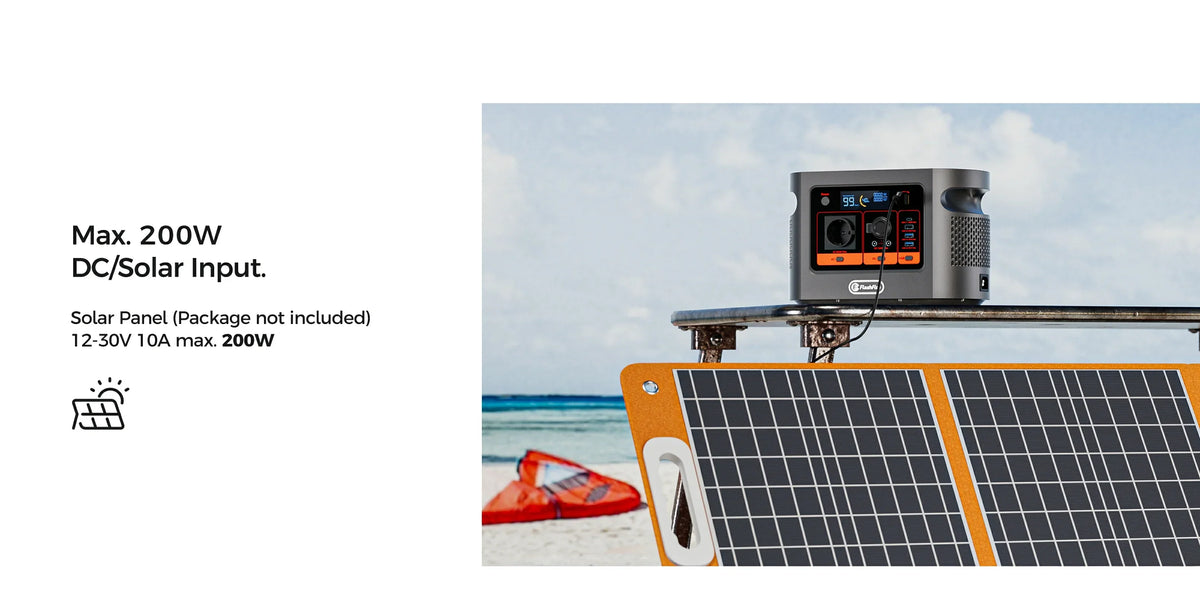
Checked 13 October 2026. The adapter and E106B facts come from the current Europe pages and authoritative local product record. ASME/CUI supplies general connector-engineering context. FlashFish publishes this guide. No arbitrary station, panel, adapter or cable combination was electrically tested for the article; the contextual solar image does not prove a connector match or charging result.




Оставить комментарий
Этот веб-сайт защищается hCaptcha. Применяются Политика конфиденциальности и Условия использования hCaptcha.