
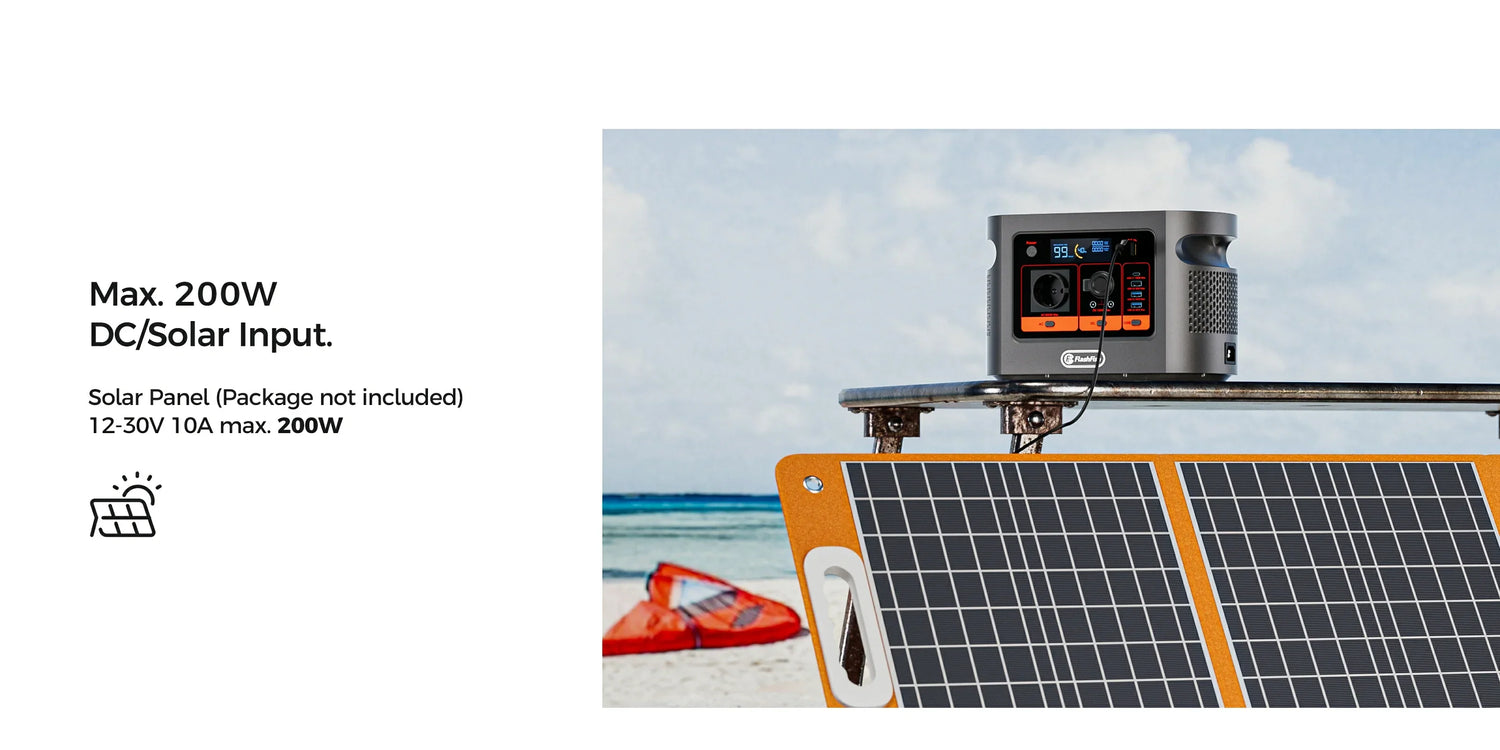
Short answer: the FlashFish product database documents the E106B solar/DC input as 12–30V, 10A and 200W maximum. A panel is not matched by watts alone: verify its voltage and current data, exact connector and polarity, cable condition and configuration before connecting. Do not infer compatibility or a fixed recharge time from a “200W” badge.
The three E106B input ceilings
| E106B input field | Documented value | What it does not prove |
|---|---|---|
| Voltage window | 12–30V DC | That every “12V” marketing-labelled panel stays within the window. |
| Current ceiling | 10A | That any higher-current panel or parallel array is approved. |
| Power ceiling | 200W maximum | That the station will receive 200W continuously or accept any 200W panel. |
The current FlashFish E106B Europe page is ACTIVE. The manual-derived product record also lists 384Wh stored energy and a 600W pure-sine AC output, but those output facts do not change the DC input limits.
Read the panel label before the marketing name
Find the manufacturer datasheet or rear label for the exact panel. Record maximum-power voltage and current plus open-circuit voltage and short-circuit current. Fluke explains that open-circuit voltage and short-circuit current are endpoint measurements; they do not describe the full under-load performance curve. Do not short-circuit or probe a panel unless you are qualified and following the instrument and panel instructions.
| Panel field | Question for E106B matching | Boundary |
|---|---|---|
| Voc (open-circuit voltage) | Can documented voltage remain inside the station limit in the intended conditions? | Do not use a nominal “12V” label as a substitute. |
| Vmp / operating voltage | Is the working voltage within the supported input window? | It does not replace the Voc check. |
| Isc and Imp | Does the exact current configuration follow manufacturer guidance? | Do not assume the controller makes any array safe. |
| Pmax | Is the proposed power within an explicitly supported setup? | Panel nameplate power does not promise the observed input. |
| Connector and polarity | Are both explicitly documented for the E106B and cable? | Physical fit alone is not electrical compatibility. |
The LIMIT decision table
- Lead with 12–30V, 10A and 200W: write all three on the worksheet.
- Identify the exact panel: use its model-specific label or datasheet, not a marketplace title.
- Match the connection: confirm connector, polarity and any adapter through the manual or FlashFish Europe support route.
- Include variability: shade, orientation, cloud, temperature and cable loss mean observed input changes. The European Commission's PVGIS can provide location and configuration context, not a charger-time promise.
- Test only as documented: place the station dry with ventilation clear and stop if the cable, plug, station or panel shows damage, abnormal heat, smell or repeated faults.
Three common bad shortcuts
- “The panel is 200W, so it fits.” This ignores voltage, current, connector and polarity.
- “It has the same plug, so it fits.” Mechanical fit does not verify electrical polarity or limits.
- “200W into 384Wh means a fixed charge time.” Input varies and charging is not a constant division problem.
When E106B fits — and when it does not fit
E106B may fit when the exact panel and connection are explicitly documented within the 12–30V, 10A and 200W limits, the regional manual agrees, and the planned environment keeps the equipment dry, ventilated and undamaged.
It does not fit the available evidence when the decision rests only on panel watts, a connector photograph, a generic adapter listing, an uncertain series/parallel arrangement or a fixed recharge claim. This article intentionally does not name an unverified third-party panel or provide a wiring recipe.
Frequently asked questions
What is the E106B solar input range?
The local manual-derived FlashFish record lists one solar/DC input at 12–30V, 10A and 200W maximum.
Is a 200W panel automatically compatible with E106B?
No. Panel watts alone are insufficient. Voltage, current, connector, polarity and the exact panel configuration must also match documented guidance.
Can the panel voltage exceed 30V?
Do not connect a panel whose documented voltage can exceed the E106B 30V input limit. Obtain exact manufacturer guidance when any value is uncertain.
Will a 200W panel always deliver 200W?
No. Irradiance, temperature, angle, shade, cable loss and controller behaviour affect input. The rating does not promise the observed value.
How long will solar charging take?
This guide does not promise a time. Starting charge, actual input over time, temperature, losses and station behaviour all affect the result.
Sources and evidence limits
- FlashFish E106B Europe page and the local manual-derived product database — current product and input limits.
- Fluke on Voc/Isc and I–V curves — PV terminology and measurement boundaries.
- European Commission JRC PVGIS — solar-resource variability by place and configuration.
Original regional manual verification is required before publication. No adapter, panel pairing, series/parallel layout, observed input or recharge time is approved here.



Оставить комментарий
Этот веб-сайт защищается hCaptcha. Применяются Политика конфиденциальности и Условия использования hCaptcha.