
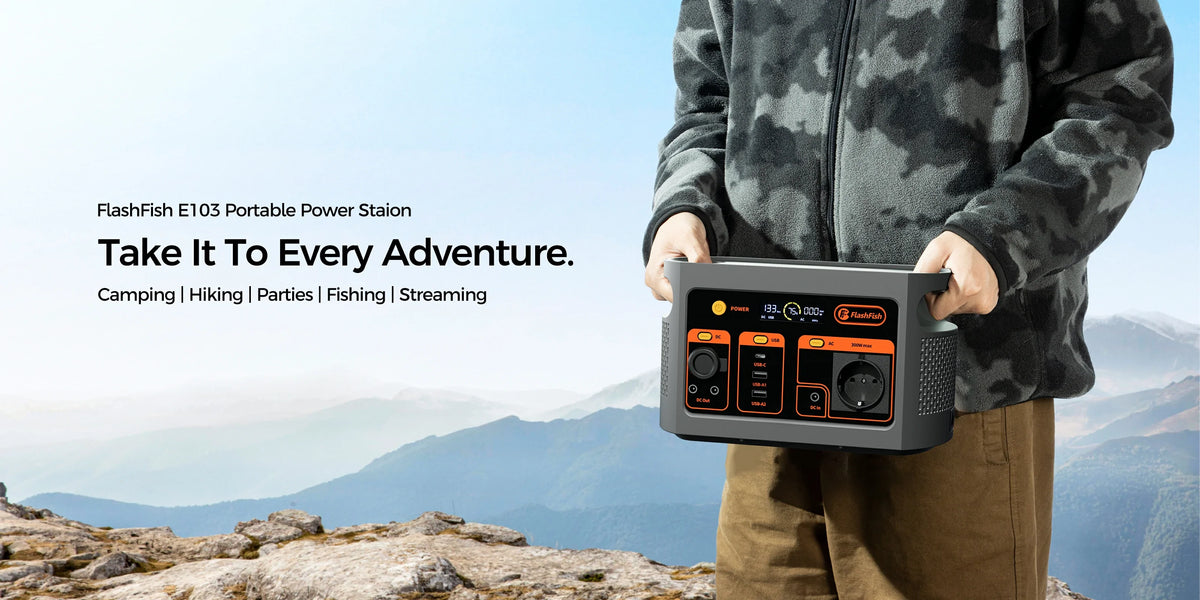
Quick answer: The FlashFish E103 is the lighter choice for a modest weekend charging list. The E106B provides more nominal battery capacity and a higher continuous AC output for a heavier load plan, at the cost of extra carrying weight. Choose from your energy budget and the power your devices actually need, rather than the number of days printed on your itinerary.
This comparison covers the power stations sold through the FlashFish Europe store. It is based on product specifications and reference data, not a hands-on camping endurance test.
E106B vs E103: the differences that change a camping plan
| Specification | FlashFish E103 | FlashFish E106B |
|---|---|---|
| Nominal battery capacity | 179.2Wh | 384Wh |
| Continuous AC output | 300W | 600W |
| Approximate unit weight | 3kg | 5.2kg |
| Battery chemistry | LiFePO4 | LiFePO4 |
| Highest listed USB-C output | 60W | 100W on USB-C1; USB-C2 is listed at 30W |
Source references: the current E103 product specifications and options and the current E106B product specifications and options, checked against the manufacturer's product reference data.
The E106B has about 2.14 times the E103's nominal energy capacity and weighs approximately 2.2kg more. That is a useful trade-off when a car is nearby and charging demand is substantial. For a walk from public transport to a campsite, the E103's lower weight may matter more. The capacity ratio is not a measured runtime ratio.
Keep the two units separate: watts (W) describe power at a moment; watt-hours (Wh) describe energy over time. An appliance can be below a station's output rating yet still use too much energy for the whole trip.
Three weekend plans to compare before choosing
The numbers below are hypothetical planning inputs, not typical consumption claims for a named phone, laptop or appliance. Replace them with your own measured or documented values. Device energy is calculated as average watts multiplied by operating hours. Charging and conversion losses, station consumption and a reserve must be allowed for separately.
1. A small phone-and-light charging list
Suppose one phone needs 12Wh per day for two days, and a light averages 4W for four hours on each of two evenings. The phone budget is 24Wh; the light budget is 32Wh; together they require 56Wh at the devices.
This is a modest starting budget relative to either station's nominal capacity. The E103 is the lighter option to investigate first if these are your main loads. Add every other device, the energy overhead and your reserve before deciding that one charge is enough.
2. Add two days of laptop work
Now add a hypothetical laptop load averaging 45W for two hours per day over two days. That adds 180Wh, bringing the same phone, light and laptop plan to 236Wh at the devices.
That demand already exceeds the E103's 179.2Wh nominal battery capacity before losses. It cannot cover this complete plan from one full charge without reducing demand or recharging. The E106B's 384Wh nominal capacity provides more room to assess the plan, but the usable energy and reserve still need checking.
Check the laptop's charging requirements against the specific USB-C port and cable, or assess its AC adapter as an AC load. A port's maximum rating is not a promise that every laptop will charge at that rate.
3. A single appliance drawing 450W continuously
A hypothetical appliance drawing 450W continuously exceeds the E103's 300W continuous AC rating. A short-duration peak rating does not make it a 450W continuous supply.
The same 450W running load is below the E106B's 600W continuous rating, considered alone. This power comparison does not establish compatibility: any startup requirement and the total simultaneous load must be checked separately. At 450W, just 30 minutes represents 225Wh at the appliance, so even a load that passes the power check can dominate the trip's energy budget.
Build your own weekend load list
- List each device and its charging route. Separate USB-C, USB-A, DC and AC requirements. Record the relevant connector and input requirements.
- Calculate energy for the whole trip. Record average watts and total hours, or use a documented energy-per-charge figure. Add the devices together, then allow for losses and a reserve.
- Check power separately. Compare continuous and simultaneous requirements with the station's ratings. Resolve any startup requirement before treating an appliance as a match.
- Write down the recharge opportunity. If the plan depends on a campsite power point or a solar panel, confirm that opportunity and the required equipment before relying on it. Do not count unverified solar energy as guaranteed weekend supply.
Choose E103 when the complete budget is modest and lower carrying weight is the priority. Choose E106B when a verified load list justifies its extra capacity or output and you can accommodate the heavier unit. If neither passes both checks, change the load plan or compare another appropriately specified station.
Buying questions
Does the product link include a solar panel?
Check the selected option on the product page. The Europe store lists standalone stations and solar-kit options; the equipment in the selected configuration is what matters. This comparison is about the stations themselves and does not assume a panel is included.
How much energy reaches my devices?
Nominal battery capacity is not a measured amount delivered through every output. The usable amount depends on the charging route and operating conditions. This comparison does not supply a tested efficiency figure, so it does not turn nominal Wh into a guaranteed number of phone charges or laptop hours.
Review the E103 and E106B options alongside your completed load list. For a device-specific question, send its power and connection requirements to FlashFish support. You can also compare the portable power station range.



Оставить комментарий
Этот веб-сайт защищается hCaptcha. Применяются Политика конфиденциальности и Условия использования hCaptcha.