
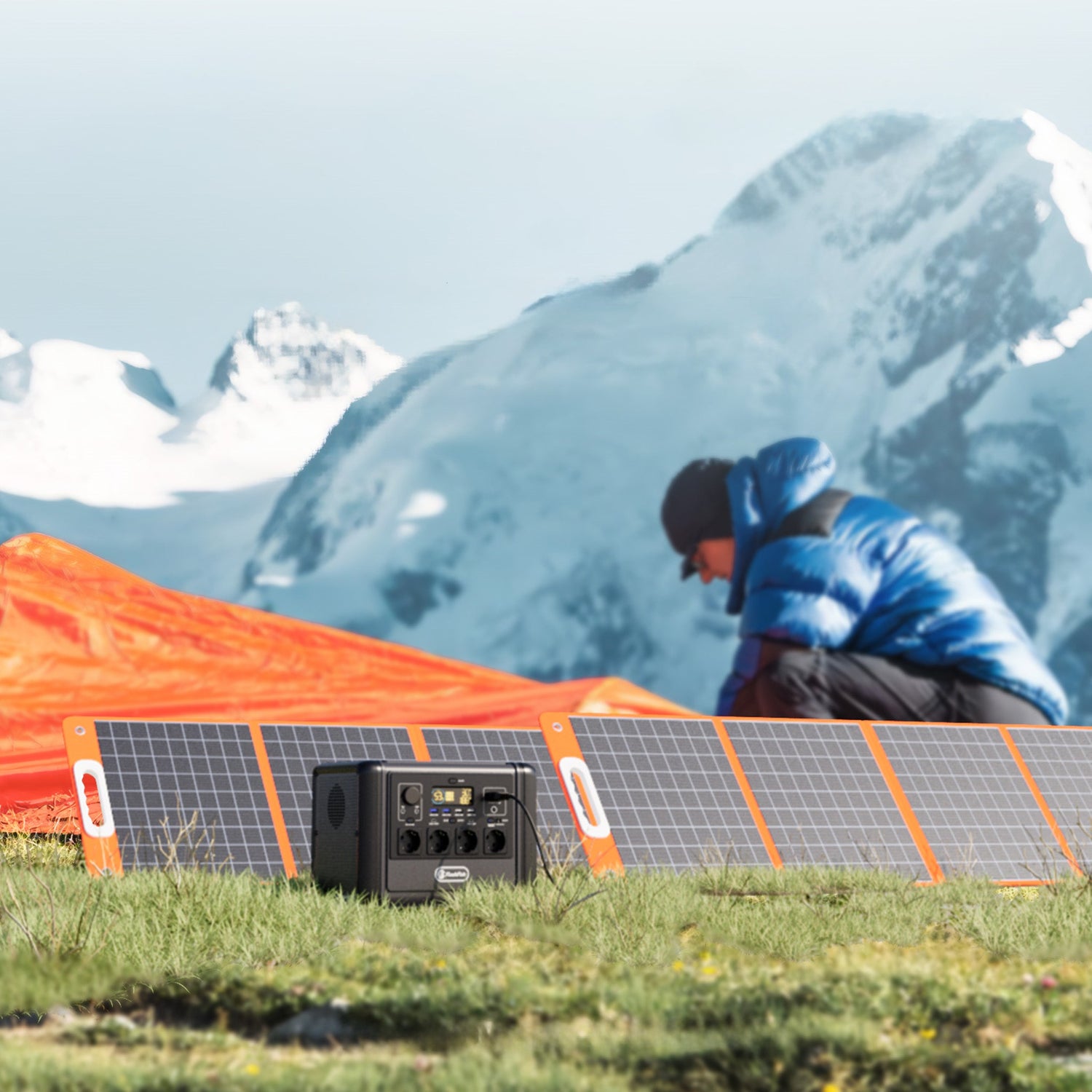
One or Two TSP100 Panels for T1200S Weekend Camping?
Short answer: choose one TSP100 when measured daily loads are modest, the trip starts with stored reserve and 2.8kg of panel plus one deployed footprint is the better packing trade-off. Consider two only when the daily watt-hour gap and usable sun window justify another 2.8kg and twice the nominal panel area—and only after the exact two-panel connection is verified.
The decision is not 100W versus 200W in isolation. Use the PANEL card: Power needed each day, Available usable sun, Nameplate versus delivered input, Electrical evidence, and Luggage and layout.
The PANEL decision table
| Question | One TSP100 tends to fit | Two TSP100s may fit | Stop and resolve first |
|---|---|---|---|
| Daily energy gap | Small measured top-up | Larger measured gap after load reduction | No load worksheet |
| Sun window | Open basecamp with useful exposure | Long open window and room to reposition | Heavy shade or solar-dependent essentials |
| Carry cost | 2.8kg panel plus cable/case | 5.6kg panels plus cable/case | Walking or space limit is already tight |
| Deployed area | About 1.56m x 0.40m nominal panel area | Twice the nominal area | No protected, supervised placement |
| Electrical proof | Exact one-panel path verified | Exact supported two-panel path verified | Missing Voc, polarity, cable or topology evidence |
What the current FlashFish evidence says
The Europe T1200S and TSP100 kit page currently offers one-panel and two-panel configurations. Fresh 29 August Shopify discovery lists the kit ACTIVE with a live Europe URL and available inventory in both variants.
The local product database records T1200S at 768Wh with a 12-50V, 10A, 400W maximum solar/DC input. It records each TSP100 as 100W nominal, 18V/approximately 5.6A, 2.8kg, 415 x 402mm folded and about 1562 x 402mm deployed.
These facts create a comparison, not a wiring instruction. The panel record leaves open-circuit voltage and short-circuit current blank. The current support centre says a kit uses the component manuals and does not provide a separate kit manual. Exact connector, polarity, cable and supported two-panel topology therefore remain human-review gates.
P — Measure the daily energy gap
Start the trip plan with watt-hours, not panel count. For each device, multiply measured watts by planned hours, then add conversion loss and reserve. Subtract the stored energy you are willing to use before the next reliable charging opportunity.
| Load row | Evidence | Daily Wh | Priority if solar is weak |
|---|---|---|---|
| Phones and navigation | Charger or measured session | Fill in | Essential |
| Laptop or camera chargers | Exact input and measured duration | Fill in | Task-dependent |
| Lights | Rated/measured watts x hours | Fill in | Essential after dark |
| Cool box or fan | Measured cycling over a representative period | Fill in | Use-case dependent |
| Reserve | Loss, weather and departure margin | Fill in | Do not spend casually |
If stored T1200S energy already covers the weekend with a sensible reserve, a panel may be optional rather than essential. If the plan fails without a specific solar harvest, improve the load plan or charging fallback before adding hardware.
A — Estimate usable sun, not daylight hours
The European Commission's PVGIS resource shows why one Europe-wide sunlight assumption is weak: solar resource changes with location and time. At a campsite, trees, tents, vehicles, horizon, cloud and the ability to move the panel add more uncertainty.
Record the hours when the actual pitch is likely to give direct, supervised exposure. A forested afternoon or a mobile sightseeing day can leave a long daylight period but a short usable panel window.
N — Keep nameplate watts separate from delivered energy
One TSP100 is 100W nominal. Two provide 200W of nominal panel capacity. The Camping and Caravanning Club explains that ratings under standard test conditions help compare panels but do not mean the rated watts arrive in every hour of real use.
Two panels can increase the opportunity to collect energy when the system is correctly configured, but they do not automatically produce twice the daily watt-hours. Shade, angle, heat, controller behaviour, cable loss and battery state all matter.
E — Close the electrical evidence gate
- Confirm the current regional T1200S input range and limits.
- Confirm each panel's operating and open-circuit voltage for the expected conditions.
- Confirm current, connector, polarity and cable.
- Confirm the manufacturer-supported two-panel topology and any required adapter.
- Stop if the manuals, labels, kit contents or support answer do not align.
This article deliberately gives no series or parallel recipe. A watt ceiling cannot close missing voltage, polarity or topology evidence.
L — Count weight, bulk and supervised ground area
One TSP100 adds 2.8kg before cables or a protective case. Two add 5.6kg. One deployed panel is roughly 1.56m by 0.40m; two require twice the nominal surface area plus spacing and a cable route.
For car camping at one open pitch, the second panel may be manageable. For rail travel, frequent pack-downs, small tents or shaded pitches, the handling cost can outweigh the additional nameplate power.
When one TSP100 fits
- Your measured daily top-up need is modest.
- The trip starts with enough T1200S reserve if solar is weak.
- You have one clear, supervised panel area.
- 2.8kg plus cables fits the travel plan.
- The exact one-panel connection is verified.
When two TSP100 panels fit
- Your measured daily energy gap remains meaningful after reducing optional loads.
- A long, open sun window is plausible for the actual campsite.
- Another 2.8kg and a second deployed footprint are acceptable.
- The exact current manuals or FlashFish support confirm the complete two-panel path.
- You retain a non-solar fallback for essential loads.
Compare the current one- and two-panel T1200S kit variants after completing the PANEL card.
When neither panel choice solves the plan
- Essential loads require a fixed daily refill.
- The pitch is shaded, wet, insecure or unavailable during the usable sun window.
- The connection evidence is incomplete.
- The travel plan cannot carry and protect the panels.
- The real issue is an oversized or unmeasured load list.
FAQ
Will two TSP100 panels charge T1200S twice as fast?
Do not assume that. Two panels provide 200W of nominal nameplate capacity, but real input depends on sunlight, shade, angle, temperature, battery state, controller limits and the approved connection method.
Is one TSP100 enough for a weekend?
It can be enough when the measured daily load is modest, the trip starts with adequate stored energy and a useful sun window exists. It is not enough when essential loads depend on an unverified daily refill.
How much extra weight does a second TSP100 add?
The database lists one TSP100 at 2.8kg, so a second adds another 2.8kg before cables or cases. It also doubles the nominal deployed panel area.
Can I connect two TSP100 panels in series or parallel?
This guide does not provide a wiring recipe. Open-circuit voltage, current, connector, polarity, cable and supported topology must come from current regional component manuals or FlashFish support.
Does the 400W input limit mean four 100W panels always fit?
No. Maximum watts are only one limit. Voltage, open-circuit voltage, current, connector, polarity, cable and the supported topology all have to fit.
Decision
Choose the smallest verified configuration that closes the daily energy gap while leaving reserve. If the PANEL card points to another station/panel balance, Compare current FlashFish solar generator kits if your load and packing plan point to another configuration rather than buying a second panel to repair an unmeasured load plan.



Оставить комментарий
Этот веб-сайт защищается hCaptcha. Применяются Политика конфиденциальности и Условия использования hCaptcha.