
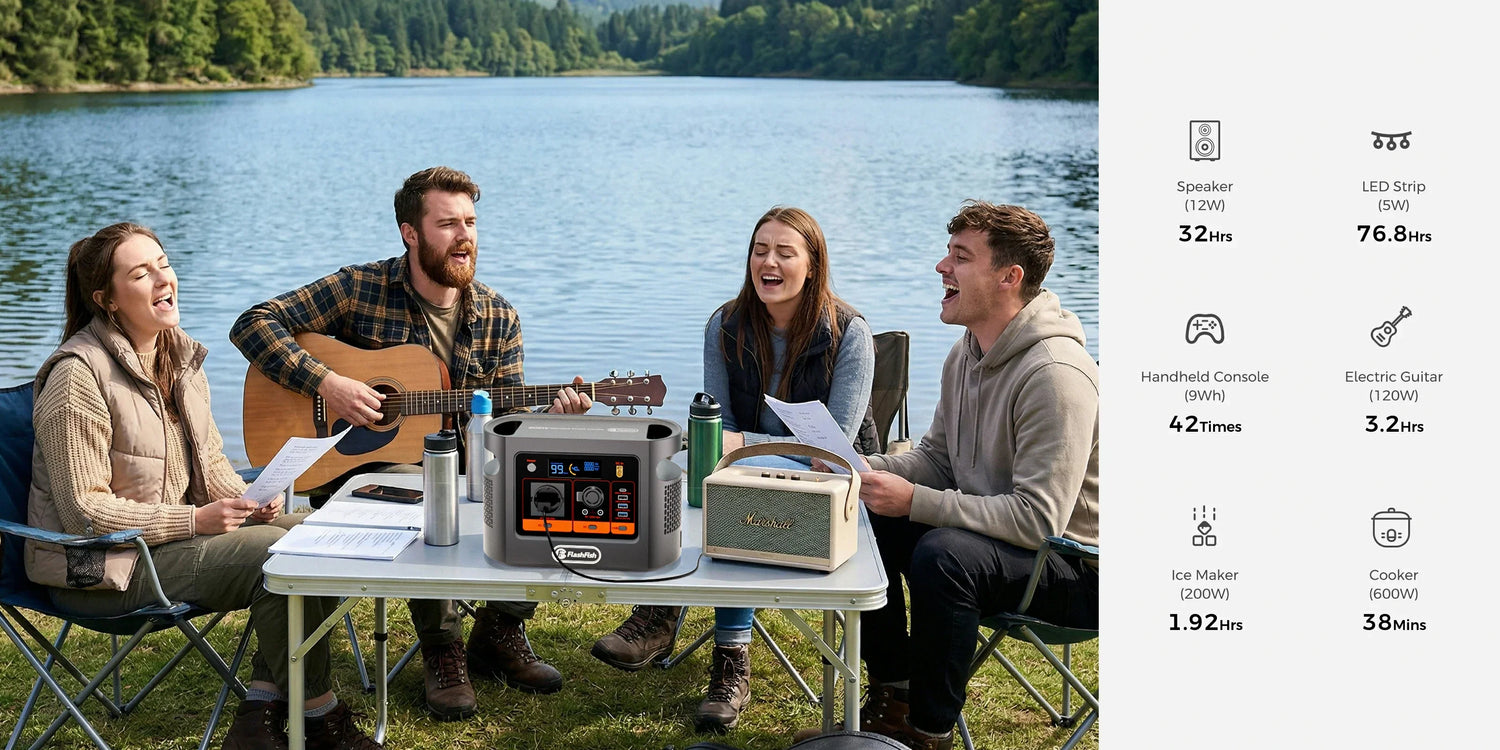
Evidence boundary: no market stall or device bundle was tested. SumUp Solo and Brother QL-820NWBc appear only as manufacturer-documented examples of a USB-C card reader and an adapter-powered label printer.
Use SALE before opening the stall
| SALE step | Record | Stop or fallback condition |
|---|---|---|
| S — Sales-critical chain | Card reader or till, phone/tablet, network path, printer and the minimum lighting needed to transact safely. | The plan treats decorative or comfort loads as more important than transactions and communication. |
| A — Adapters and access | Every device and adapter label, required port, cable, shared-output group and venue power rule. | Unknown adapter, plug conversion, damaged cable or public route that cannot be protected. |
| L — Load and length of day | Measured charging watts, print-cycle watts, idle states, active minutes, event hours and reserve. | The plan uses a generic printer watt value or divides 384Wh by one headline load. |
| E — Environment and escape plan | Dry covered position, ventilation, weather stop rule, fully charged device batteries, connectivity fallback and venue contact. | Rain or condensation risk, heat, public trip hazard, no payment fallback or unapproved equipment. |
Decision step: Compare E106B with your completed SALE load sheet. The station has one documented AC outlet, so the connection plan matters as much as total watts.
Three device examples—and the evidence each needs
1. Card reader or till
SumUp's Solo support section describes an independent card reader with Wi-Fi or mobile-network connectivity and supported printer options. That identifies transaction-system dependencies, not charger watts or market-day continuity. Photograph the exact reader and charging labels, start with its own battery full and keep a provider-approved connectivity or payment fallback.
2. Label printer
Brother documents an AC-adapter supply for the QL-820NWBc family. Treat that as a device-type example only. Read the delivered printer and adapter input/output labels, measure printing and idle states and bring pre-printed essentials in case power, media or connectivity fails.
3. Phone or tablet
Use the exact charger or direct USB-C requirement, not the phone's retail name. Decide whether the device must run POS software, tether data, photograph products and communicate with the organiser; those simultaneous roles determine reserve and fallback.
Build a selling-day energy budget
| Device | Measured state | Watts | Hours or cycles | Planned Wh | Fallback |
|---|---|---|---|---|---|
| Reader/till | Charging while transacting | Measure exact setup | Record event need | W × h | Full internal battery and provider-approved process |
| Label printer | Print cycle and idle | Measure both states | Labels expected plus margin | State totals | Pre-printed critical labels |
| Phone/tablet | Screen, app and hotspot active | Measure charger draw | Critical hours | W × h | Charged spare device or approved venue option |
Add the measured states, then allow for AC conversion, cable and charger losses, temperature, battery condition and a deliberate reserve. Keep the answer as a range. Do a normal-length rehearsal with the exact devices before the event, but do not present that one rehearsal as a guarantee.
Stall layout is part of the electrical decision
- Ask the organiser whether portable batteries, extension devices and public cable crossings are allowed.
- Keep the station dry, stable, ventilated and inaccessible to customers, children and liquids.
- Use only correctly rated, undamaged cables; fully unwind cable reels and never daisy-chain extension devices.
- Stop for rain or condensation risk, heat, burning smell, sparks, damage or repeated trips.
- Do not back-feed a venue circuit or treat a travel adaptor as voltage conversion.
When E106B fits—and when it does not
When FlashFish fits
- The measured transaction-device set stays within the exact regional output and shared-port limits.
- The 5.2kg class and connection plan suit a supervised, dry, venue-approved stall position.
- The energy sheet leaves reserve and every critical device has an independent fallback.
When FlashFish does not fit
- The stall includes high-watt heating, cooking, production tools or other loads outside the documented limits.
- The event forbids portable batteries, exposes equipment to weather or cannot provide a protected public cable route.
- The business plan depends on guaranteed transactions, uninterrupted network service or a fixed runtime.
FAQ
Can E106B guarantee card payments all day?
No. Payment continuity also depends on the card reader battery, network, account, service availability and fallback process. This guide only helps plan device power from measured inputs.
Should I plug the label printer into AC or USB?
Follow the exact printer and adapter labels. Many desktop label printers use a manufacturer AC adapter, while portable printers vary. Do not substitute a USB connection unless the manual explicitly supports it.
Can I use a multi-socket strip at a market stall?
Only if the exact station manual, venue rules and regional safety requirements allow the setup, and the strip is correctly rated, undamaged and not daisy-chained. Keep public cable routes protected and reels fully unwound.
How do I estimate energy for a full selling day?
Measure each device while charging or printing, record active and idle minutes, multiply watts by hours, then add conversion loss and reserve. Keep the result as a range and test the actual device set before the event.
What fallback should a seller prepare?
Start with fully charged device batteries, a venue-approved mains option if available, spare compliant cables, an independent phone or hotspot plan and a payment process allowed by the provider when connectivity or power is unavailable.
Sources and evidence notes
- FlashFish Europe E106B page and the local product database — current product identity, capacity and port limits; the local chemistry field remains blank.
- SumUp Solo support section and Brother QL-820NWBc official specifications — illustrative device dependencies and power paths only.
- Electrical Safety First extension guidance and ratings guide — cable safety and the limit of generic watt estimates.
Editorial viewpoint: a market power plan should protect the sale before it powers the stall. SALE ranks the transaction chain, preserves adapter evidence and makes fallback part of the buying decision.
Next step: Compare FlashFish capacity classes for a larger stall plan if measured production or lighting loads exceed the E106B plan.
Evidence checked . Human review is required for venue and jurisdiction rules, regional manuals, electrical wording, author/reviewer credentials, links, metadata, image context and rendered FAQ/schema parity before publication.



Оставить комментарий
Этот веб-сайт защищается hCaptcha. Применяются Политика конфиденциальности и Условия использования hCaptcha.