

Short answer: choose FlashFish E200 when low weight and simple phone, camera, light and low-watt charging matter most. Choose FlashFish E103 when you need more AC-output headroom, pure-sine AC and a manual-listed 60W USB-C port for compatible laptops. Neither model is a high-watt appliance station.
The useful difference is not 151Wh versus 179.2Wh alone. The better choice depends on the highest-watt device, AC waveform needs, charging connector and how far you will carry the unit.
E200 vs E103: verified comparison
| Decision point | FlashFish E200 | FlashFish E103 | Buyer implication |
|---|---|---|---|
| Capacity | 151Wh | 179.2Wh | E103 has modestly more stored energy, but neither figure predicts runtime by itself. |
| Continuous AC output | 200W | 300W | E103 accepts a broader low-watt device list; both exclude typical heating appliances. |
| AC waveform | Modified sine wave | Pure sine wave | Check sensitive equipment requirements; E103 is the clearer AC choice when a device specifies pure sine. |
| USB-C | Not listed in the manual-derived port record | 60W maximum listed | E103 is better positioned for a compatible USB-C laptop or tablet. |
| USB-A | Two 18W QC3.0 ports plus one 12W USB-A port | Two 18W USB-A ports | E200 offers an extra ordinary USB-A connection; E103 adds USB-C. |
| DC input | 11-24V, 40W maximum | 12-30V, 90W maximum | E103 accepts more input power in the manual record, but actual charging still depends on the source and conditions. |
| Weight | 1.85kg | About 3.0kg | E200 saves about 1.15kg for hikers or short-carry trips. |
| Dimensions | 208 x 110 x 158mm | 274 x 147 x 163mm | E200 is easier to fit in compact gear storage. |
Why the 28.2Wh capacity gap does not decide the winner
E103 stores 28.2Wh more than E200 in the manual-derived records, but that difference is too small to replace device-level planning. Runtime changes with AC or DC conversion, standby use, temperature, battery condition and the load itself. A buyer who needs 60W USB-C or pure-sine AC can benefit from E103 even before capacity is considered. A buyer carrying only phones, lights and camera chargers may value E200's 1.15kg weight advantage more than the extra watt-hours.
Use capacity as one input, not the verdict. The decisive question is whether the lighter station supports every connection and load you will actually bring.
Choose E200 for the smallest practical load list
E200 fits a buyer whose list is mostly phones, camera batteries, rechargeable lights, a radio, a small fan and checked low-watt chargers. Its 1.85kg weight and smaller case are useful when the station must be carried from a car park to a pitch or moved between picnic and campsite use.
The limit is the 200W continuous AC output and modified-sine waveform. Do not assume every laptop adapter, audio device, motor or compressor is a good match. Read the device requirements. The FlashFish product specifications specifically cautions that E200 is not suitable for long-term AC-motor loads such as refrigerators and compressors.
Choose E103 for USB-C and more AC headroom
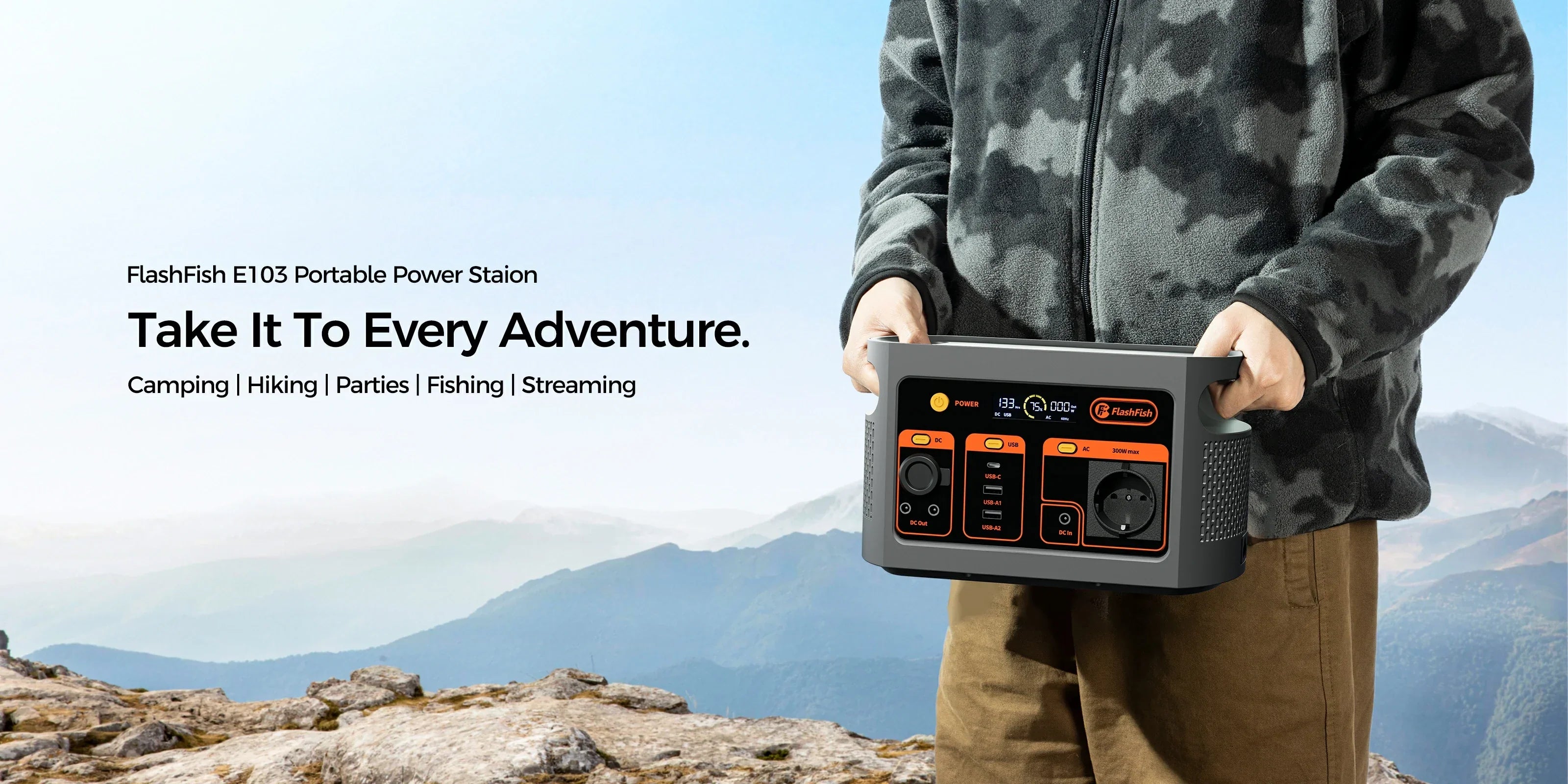
E103 is the better fit when the device list includes a compatible USB-C laptop charger up to the manual-listed 60W port limit, or when a device specifically requires pure-sine AC. Its 300W continuous AC output also provides more headroom than E200 for low-watt mains chargers.
That extra capability comes with more size and weight. If every planned device already charges from ordinary USB-A and the station will be carried for a long distance, E103 may be more equipment than the trip needs.
Three realistic camping profiles
| Profile | Likely fit | Why | Check before buying |
|---|---|---|---|
| Solo camera day: phone, LED light, two camera batteries | E200 | Low carry weight and enough ports for a simple electronics list. | Battery-charger watts and AC waveform needs. |
| Weekend remote work: phone, 60W-class USB-C laptop, light | E103 | Manual-listed 60W USB-C and pure-sine AC fallback. | Laptop USB-C charging profile, cable rating and total energy need. |
| Cool box, kettle, heater and several laptops | Neither | The load list has motor/startup or high-watt heating demands beyond this compact comparison. | Rebuild the load plan and consider a larger station only after checking labels. |
The five-step decision framework
- List every device and copy its input watts or supported charging profile.
- Identify the highest continuous AC load and any motor startup demand.
- Check whether USB-C can replace an AC adapter for the laptop or tablet.
- Estimate energy conservatively; watt-hours are not fully usable runtime and conditions vary.
- Decide whether E200's lower weight or E103's port and output advantages solve the larger problem.
When FlashFish fits
- You want a compact camping power station for light electronics with a clearly checked device list.
- You value the E200's lower carry weight or the E103's pure-sine AC and USB-C port.
- You accept that solar charging, temperature and conversion losses make runtime variable.
- You will keep the station dry, ventilated and within its manual limits.
When FlashFish does not fit
- Your trip depends on a compressor fridge, heater, kettle, hair dryer or other high-watt appliance.
- You require a fixed number of laptop charges or assured operating hours.
- You need medical, emergency-service or professionally installed backup.
- You need product values that the FlashFish product specifications leaves blank; missing values must be reconciled before purchase claims.
Solar-kit option
Both models have active Europe-store kit pages with TSP60, but a panel does not make either station unlimited. Compare the E200 + TSP60 kit and E103 + TSP60 kit only after checking the station input limit, cable compatibility, weather and expected sunlight. No fixed recharge time is promised here.
Safety note
Keep the station and connectors dry and ventilated. Use intact cables and do not daisy-chain extension leads. The Camping and Caravanning Club advises checking appliance ratings in outdoor electrical setups, and Electrical Safety First recommends replacing damaged leads and fully unwinding cable drums.
FAQ
Is E103 simply a larger E200?
No. E103 has more capacity and continuous AC output, a pure-sine AC output and a 60W USB-C port in the FlashFish product specifications. E200 is lighter and uses modified-sine AC output.
Which is easier to carry for light camping?
E200 is lighter at 1.85 kg versus about 3.0 kg for E103 in the manual-derived records. Weight is only one factor; check your device watts and charging ports too.
Which model is better for a USB-C laptop?
E103 is usually the clearer fit because its manual-derived data includes a 60W USB-C output. Confirm that the laptop and cable support that profile. E200's database record does not list a USB-C output.
Can either model run a kettle, heater or hair dryer?
Do not plan those loads. E200 is rated at 200W continuous AC and E103 at 300W; common heating appliances often exceed those limits.
Why does this comparison omit E103 battery chemistry and peak output?
The local manual-derived product database leaves those E103 fields blank. This guide does not fill missing product values from memory or inference; they require original-manual reconciliation before use.
Sources and data boundaries
- FlashFish product specifications, accessed 2026-06-29: primary source for E200 and E103 capacity, output, waveform, ports, inputs, size, weight and limitations.
- FlashFish Europe product listing on 2026-06-29: both products and both TSP60 kits were ACTIVE with non-empty Europe-store URLs.
- FlashFish Europe E200 page and FlashFish Europe E103 page, used for current product availability context, not to override blank manual-derived fields.
- Camping and Caravanning Club: campsite electricity and Electrical Safety First: extensions and leads, used for outdoor load and cable precautions.
Start with the device list. If E200 or E103 does not fit that list, choose a different class rather than forcing the smaller station to do appliance work.




Оставить комментарий
Этот веб-сайт защищается hCaptcha. Применяются Политика конфиденциальности и Условия использования hCaptcha.