
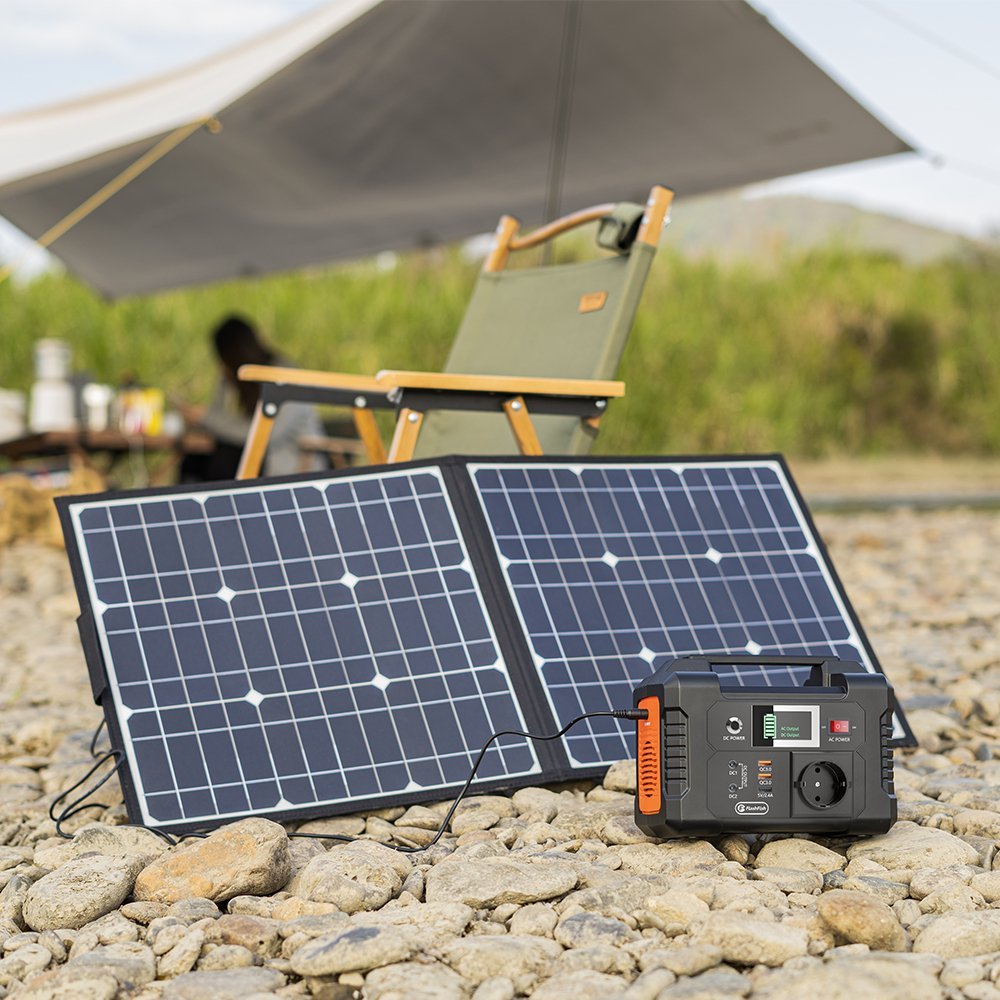
Short answer: for most weekend camping trips in Europe, choose a portable power station by the devices you actually bring, not by the biggest battery number on the box. A compact 150-300Wh unit can cover phones, lamps, cameras and small USB-C gear; 300-600Wh is a better fit for coolers, laptops, fans and longer stays; 700Wh and above starts to make sense for campervan-style trips or backup use where weight matters less.
Portable power has become a normal part of camping because the gear we take outdoors has changed. Navigation, phones, cameras, LED lights, air pumps, portable fridges and laptops all need predictable charging. But a camping power station still has to behave like camping gear: it should be easy to carry, simple to recharge and quiet enough not to spoil the place you came to enjoy.
Start with your real camping load
A useful way to shop is to list each device, its wattage or battery size, and how many hours or charges you need. Then add a buffer for conversion losses and colder evenings. This keeps the decision grounded. A 2,000Wh station looks reassuring online, but it may be the wrong tool if you only need phones, headlamps and a mirrorless camera for two nights.
| Camping style | Typical gear | Practical battery range | FlashFish fit |
|---|---|---|---|
| Light tent camping | Phones, LED light, camera, small speaker | 100-250Wh | FlashFish A101 or FlashFish E200 |
| Weekend comfort camping | Phones, lamps, laptop, fan, small DC devices | 250-600Wh | FlashFish P56, FlashFish P63 |
| Solar-assisted camping | Weekend gear plus solar recovery on day two | 150-600Wh with panel input | E200 + TSP60 kit or P63 + TSP100 kit |
| Campervan or basecamp | Fridge, laptop, lights, several people | 600Wh+ | Portable power station collection |
Weight is a feature, not a footnote
Recent portable power reviews keep pointing to the same trade-off: small stations are easier to live with, while large stations are better for home backup, work sites or RV use. TechRadar's 2026 guide highlights compact models for travel and camping, while larger units move into RV and home-backup territory. That mirrors what many European campers feel once the car is parked and the pitch is a short walk away.
If your campsite routine includes moving the battery between a tent, table and wash area, keep the unit compact. If it will stay in a campervan or under an awning, capacity can matter more than carry weight.
Solar charging helps most on day two
A solar panel does not make a small power station infinite. Weather, angle, shade and season all matter in Europe. The realistic value is recovery: topping up during daylight so your lamps, phone and camera are ready again in the evening.
For small stations, a 60W panel such as the FlashFish TSP60 is a practical pairing. For higher-capacity stations, a 100W panel such as the FlashFish TSP100 gives more useful daytime recovery, especially when clouds roll through.
Check output before capacity
Capacity tells you how much energy is stored. Output tells you what the station can actually run. Before buying, check the wattage of your highest-demand device. A kettle, heater or hair dryer is usually a poor match for compact camping power. USB-C laptops, camera chargers, phones and LED lights are a better fit.
A simple campsite checklist
- Choose capacity from your device list, then add a buffer.
- Check the continuous AC output against the highest-watt device you plan to use.
- Prefer USB-C output if you carry modern laptops, tablets or cameras.
- Match solar input to the panel you intend to use.
- Keep the station dry, shaded and ventilated.
- Use the original charger and follow the manufacturer's charging guidance.
Which FlashFish setup fits?
For light travel, the FlashFish A101 is the smallest fit in the current EU range. For a more flexible weekend setup, the P56 and P63 offer more headroom while staying campsite-friendly. If you want solar included from the start, the solar generator kit collection is the better place to compare pairings.
FAQ
Is a 300Wh portable power station enough for camping?
For many weekend campers, yes. It is usually enough for phones, lights, camera batteries and some laptop use. It is not the right size for high-heat appliances or long fridge runtime without careful calculation.
Can I use solar panels at a European campsite?
Usually yes for portable panels used with your own power station, but campsite rules vary. Keep panels secure, avoid blocking paths and do not connect anything to campsite electrical infrastructure unless permitted.
Should I buy the biggest power station I can afford?
Not for normal camping. Bigger capacity adds weight and cost. Buy the smallest setup that covers your real devices with a sensible reserve.
Sources used for editorial context: TechRadar's 2026 portable power station testing and WattMatch's camping power guidance.



Оставить комментарий
Этот веб-сайт защищается hCaptcha. Применяются Политика конфиденциальности и Условия использования hCaptcha.