
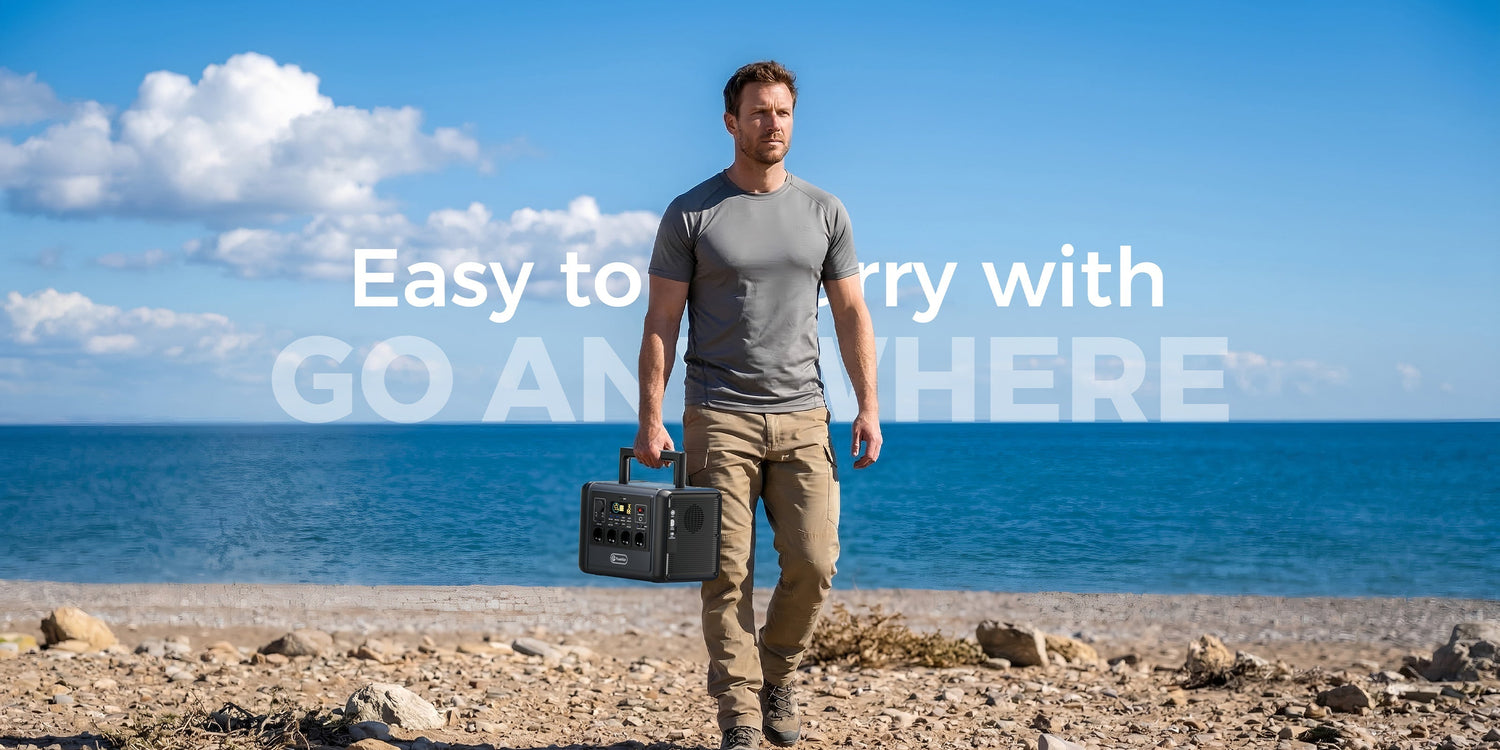
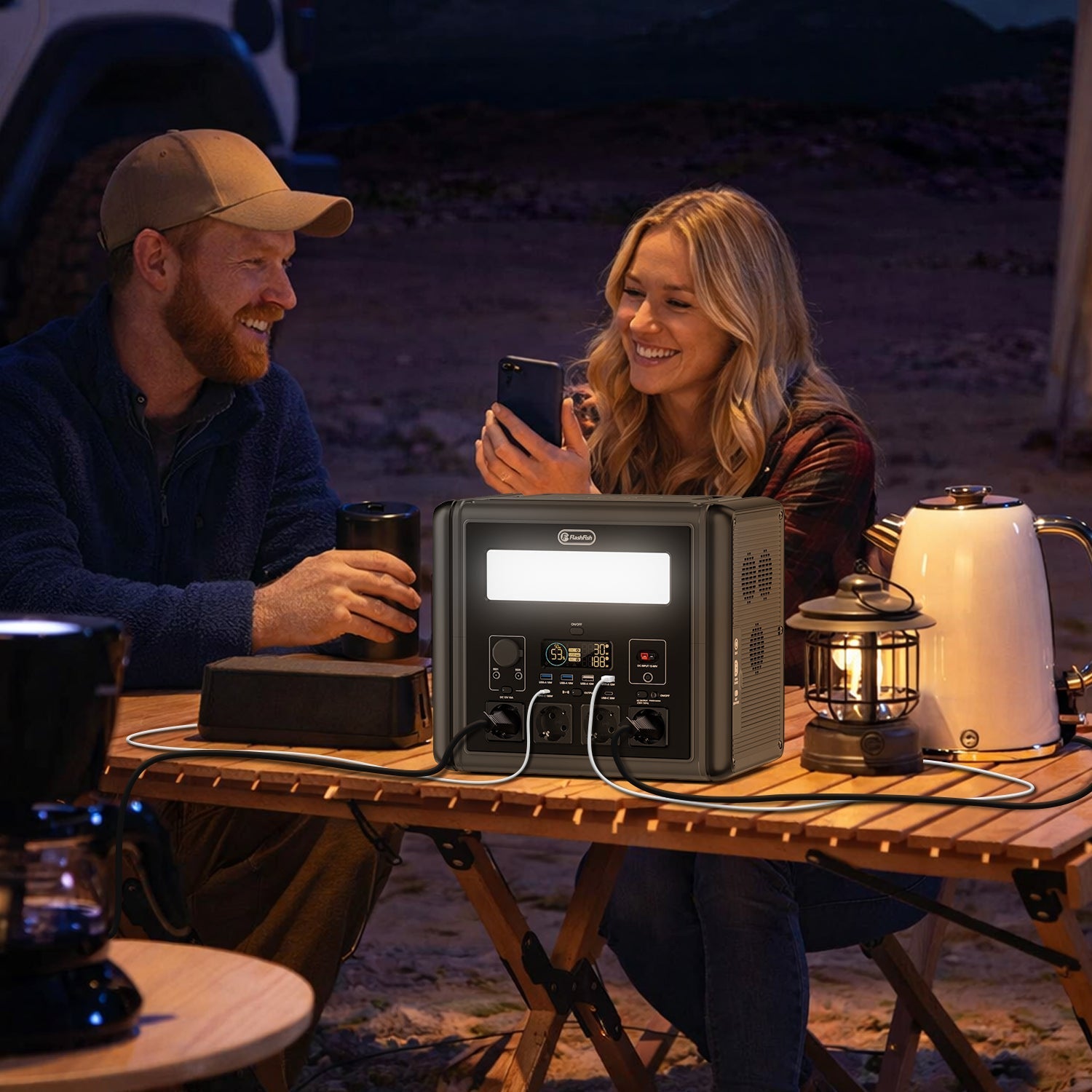
Short answer: the FlashFish T1200S can be a practical camping power station for phones, LED lights, small electronics and a cool box only when the cool box label and the total simultaneous load fit the station's output ratings. Plan from device labels, not from fixed runtime guesses.
What this setup can and cannot do
The T1200S is listed in the FlashFish product-source bundle as a 768Wh LiFePO4 portable power station with 1200W continuous AC output, 2400W peak output, 400W max solar input, 100W max USB-C output and a 13V DC output group sharing 130W max. Those figures make it more capable than a compact phone charger, but the cool box still decides the plan.
A thermoelectric cool box, compressor cool box and household mini fridge may behave differently. Some run steadily at a modest wattage; others have startup demand or long duty cycles. The label, manual and plug type matter more than the product nickname.
Camping planning table
| Item | What to check | T1200S relevance | Decision |
|---|---|---|---|
| Cool box | AC watts, DC watts, startup demand and duty cycle | Must fit the AC or 13V DC output rating, including startup behavior | Use only if the label and connector match |
| Phones | USB-C or USB-A charging needs | T1200S has 100W max USB-C and additional USB outputs in the product-source bundle | Good low-risk load when cables are correct |
| LED lights | Total watts and hours used | Usually a low-draw load, but still part of the energy budget | Group with phone charging before comfort loads |
| Campsite hook-up | Site amps, cable type and site rules | Useful context if you are mixing site power and battery charging | Follow site instructions and avoid overloaded leads |
| Solar top-up | Panel output, connector, weather and angle | T1200S accepts up to 400W solar input, but actual input varies | Treat solar as a top-up, not a fixed refill schedule |
Step-by-step checklist
- Write down the cool box model and its input rating before the trip.
- Decide whether you will use AC or DC. Do not assume both ports have the same limit.
- Add the watts of every device that will run at the same time.
- Keep phone charging, lights and essential electronics ahead of comfort loads.
- Leave a margin for inverter loss, heat, cool-box duty cycle and battery ageing.
- Pack only cables and adaptors with visible ratings and no damage.
- If using a campsite hook-up, check the site amp limit and cable requirement first.
- If adding a solar panel, check connector fit and expect weather-dependent input.
Campsite electricity context
The Camping and Caravanning Club explains that campsite hook-up is a nominal 230V single-phase supply and that Club sites commonly use 10A or 16A limits, with lower limits possible elsewhere. It also notes that campers need to keep total rated wattage below the power supplied. That same label-first thinking applies when you use a portable power station instead of a bollard.
Electrical Safety First also warns against overloaded extension leads and plugging one extension lead into another. For a battery setup, keep the cable path simple: one properly rated lead, fully checked plugs and no daisy-chain workaround.
When FlashFish fits
- You want a portable power station for phones, lights, laptops and a checked cool box.
- The cool box rating fits the T1200S output port you plan to use.
- You understand that 768Wh is the rated battery capacity, not a fixed runtime result.
- You can keep the station dry, ventilated and away from cable trip hazards.
- You are using solar as a weather-dependent top-up, not as the only plan for food cooling.
When it does not fit
- The cool box label is missing or the startup demand is unknown.
- The load plan depends on running several high-draw appliances together.
- You need assured food-temperature control but have not planned ice packs, shade or a backup method.
- You need to power campsite equipment through damaged, underrated or chained extension leads.
- You are expecting a fixed solar recharge result in cloudy or shaded conditions.
A practical packing order
- First: phones, headlamps, small LED lights and a power cable set.
- Second: the cool box label or manual, plus the correct AC or DC lead.
- Third: a simple watt-hour worksheet so everyone knows which loads matter.
- Fourth: shade, pre-chilled contents and ice packs, because battery power should not be the only cooling strategy.
- Fifth: optional solar panel and connector checks if the pitch has enough open sky.
Frequently asked questions
Can T1200S run every camping cool box?
No. It depends on the cool box label, connector, startup behavior and how long it needs to cycle. Check the exact device before relying on it.
Should I use AC or DC for the cool box?
Use the option that the cool box maker supports and that fits the station rating. DC may reduce conversion steps for some gear, but compatibility still needs checking.
Can I charge phones while running the cool box?
Usually phones are a small load, but add all simultaneous loads before deciding. Keep essential communication power ahead of comfort devices.
Does a solar panel make the setup self-sufficient?
Not by itself. JRC PVGIS exists because solar radiation and PV performance vary by location and season. Clouds, shade, angle and panel temperature all matter.
Can I use a campsite hook-up cable with this plan?
Follow the campsite's own instructions. Use the correct cable, keep it unwound where required, and do not overload the supply or extension leads.
Sources and evidence notes
- FlashFish product-source bundle, accessed 7 July 2026, for T1200S specifications.
- Shopify discovery cache, accessed 7 July 2026, for active T1200S and TSP60 Europe URLs.
- Camping and Caravanning Club: Expert Guide to Campsite Electricity, accessed 7 July 2026, for campsite hook-up limits and cable safety context.
- Electrical Safety First: overloading sockets, accessed 7 July 2026, for extension-lead safety boundaries.
- European Commission JRC PVGIS, accessed 7 July 2026, for solar radiation and PV performance variability context.




Оставить комментарий
Этот веб-сайт защищается hCaptcha. Применяются Политика конфиденциальности и Условия использования hCaptcha.