

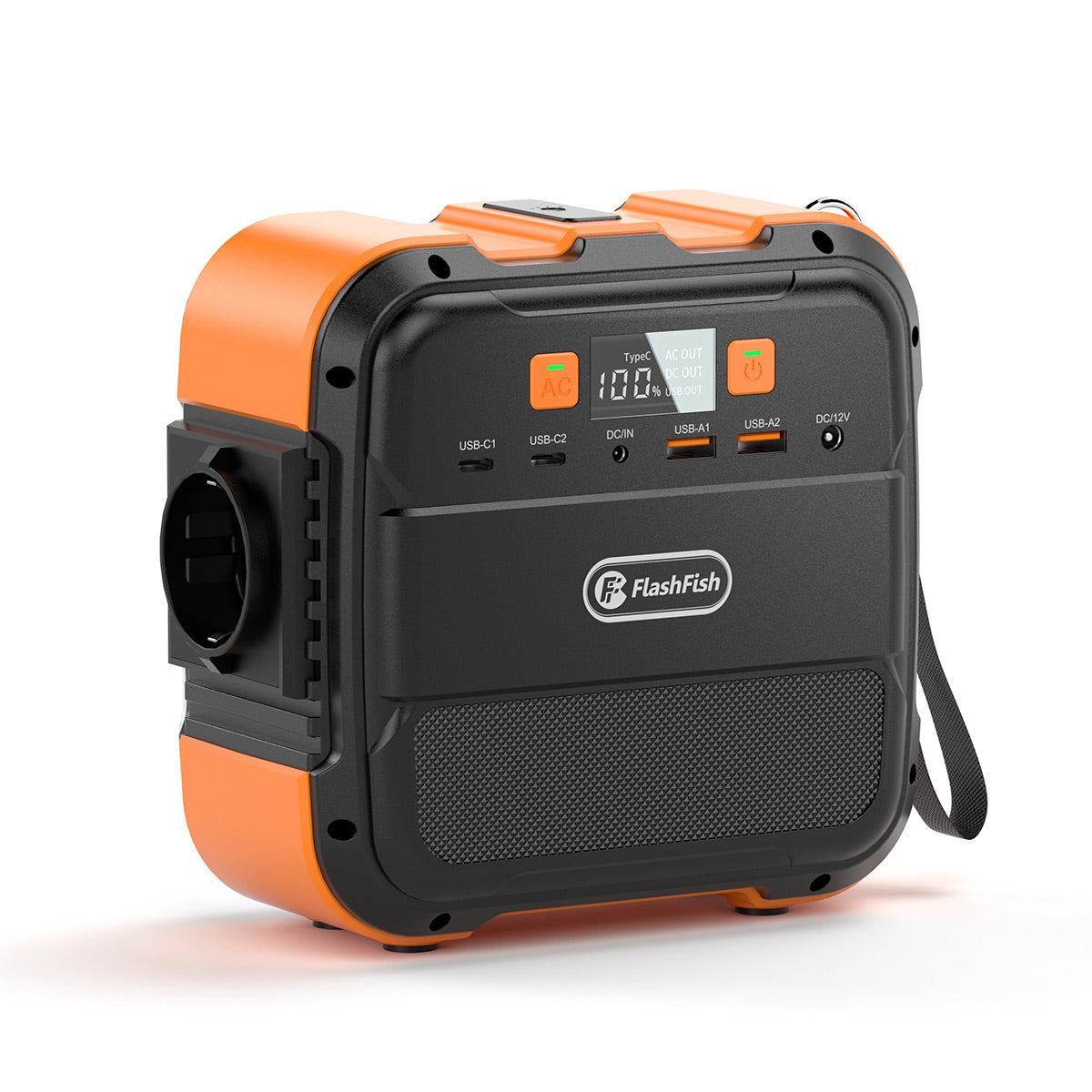
Short answer: choose FlashFish T300PRO when its 230Wh nominal energy, 100W USB-C ceiling and broader input options solve a real need and the extra 1.5kg is acceptable. Choose E103 when 179.2Wh, 60W USB-C and a roughly 3kg carry weight fit the device list. Both are documented as 300W continuous pure-sine stations, so the decision is not simply about headline AC watts.
Use SAME-300 to compare what changes
- S - Same continuous AC class. Both records list 300W continuous pure-sine AC; do not award either model a win for the same ceiling.
- A - Available energy. T300PRO lists 230Wh and E103 179.2Wh. The 50.8Wh difference is nominal, not delivered runtime.
- M - Match the output path. T300PRO lists 100W and 30W USB-C; E103 lists one 60W USB-C. Source, cable and device must negotiate a supported profile.
- E - Evaluate carry and evidence. E103 is about 3kg versus 4.5kg for T300PRO. Also weigh document quality: T300PRO's regional manual conflict must be resolved for the delivered unit.
E103 vs T300PRO equal-field table
| Field | FlashFish E103 | FlashFish T300PRO | Decision meaning |
|---|---|---|---|
| Nominal energy | 179.2Wh | 230Wh | T300PRO lists 50.8Wh more; no fixed runtime follows |
| Continuous AC | 300W pure sine | 300W pure sine | Tie on the documented continuous class |
| Peak or surge field | 600W | 600W | Not blanket motor, compressor or heater approval |
| Highest USB-C output | 60W | 100W | T300PRO has the stronger paper fit for devices needing more than 60W |
| Solar/DC input ceiling | Up to 90W | Up to 120W | Electrical compatibility and real sunlight still control charging |
| Listed mass | About 3kg | 4.5kg | E103 is 1.5kg lighter before chargers, panels and cables |
| Dimensions | 274 x 147 x 163mm | 256 x 169 x 169mm | Different shapes; measure the real packing space |
| Regional AC evidence | Local and Europe evidence support 230V-class output | Local manual 120V/60Hz; Europe page 230V/50Hz | T300PRO buyer must verify delivered EU label and current manual |
Exactly three buyer cases
Example 1: a 65W USB-C laptop, phone and camera
T300PRO's 100W USB-C ceiling creates more headroom than E103's 60W ceiling for a laptop that genuinely requests above 60W. E103 may still fit if the laptop supports a 60W-or-lower profile. In both cases, verify the cable and device profiles; connector shape is not enough.
Example 2: the lightest verified weekend kit
E103 is 1.5kg lighter by listed station mass. If 179.2Wh, 300W AC and 60W USB-C cover the measured kit, carrying the larger T300PRO may add burden without solving a problem. Pack the charger, panel and cables before deciding.
Example 3: a longer small-device plan with no need above 300W AC
T300PRO's extra 50.8Wh nominal energy can be useful when every device stays within the same 300W class. Do not convert that difference into a promised number of hours. Measure the device energy and keep a reserve.
When each FlashFish model fits - and when it does not
| Choose E103 when | Choose T300PRO when | Choose neither from this evidence when |
|---|---|---|
| Lower carry mass is important and 179.2Wh is enough | The extra 50.8Wh nominal energy solves a measured need | The device needs more than 300W continuous AC |
| A 60W USB-C ceiling matches the exact laptop or device profile | A verified device benefits from USB-C above 60W and up to 100W | The decision depends on an unverified cable, waveform, startup or regional variant |
| You prefer the narrower 274 x 147 x 163mm shape | The 256 x 169 x 169mm shape and 4.5kg mass fit the packing plan | A fixed runtime, noise, efficiency or charging-speed result is required |
| The exact E103 ports and regional label match the load | The delivered T300PRO EU label and current manual resolve the document conflict | The T300PRO regional evidence remains unresolved for the delivered unit |
Seven checks before buying
- Write every device model, input label and required connector.
- Total continuous AC and identify any startup behaviour; keep margin below 300W.
- Map laptops and other USB-C devices to exact negotiated profiles, not connector shape.
- Estimate energy in Wh and retain a practical reserve instead of promising runtime.
- Pack the station, charger, panel and cables and compare complete-kit mass.
- Verify the delivered plug, voltage, frequency and current regional manual, especially for T300PRO.
- Recheck current price, stock, returns and warranty at checkout; they are outside this specification comparison.
Choose T300PRO when its extra energy and 100W USB-C solve the verified load. Otherwise, choose E103 when lower carry mass and 60W USB-C are sufficient.
Frequently asked questions
Do E103 and T300PRO have the same AC output?
Both local records list 300W continuous pure-sine AC and a 600W surge or peak field, but that does not make every 300W device compatible.
Which has more battery capacity?
T300PRO lists 230Wh versus E103 at 179.2Wh, a nominal difference of 50.8Wh before conversion losses, standby use and reserve.
Which is lighter?
E103 is listed at about 3kg, while T300PRO is 4.5kg. The 1.5kg difference is meaningful only after the required energy and ports fit.
Which is better for a USB-C laptop?
T300PRO lists USB-C up to 100W and E103 up to 60W. The laptop and cable must support the same negotiated profile; the higher ceiling alone is not compatibility proof.
Why must the T300PRO regional version be checked?
The authoritative local manual-derived record is 120V/60Hz, while the current Europe page says 230V/50Hz. Verify the delivered label and current EU manual before connecting AC equipment.
Sources and evidence limits
- FlashFish E103 Europe page and the authoritative local E103 record.
- FlashFish T300PRO Europe page and the authoritative local TELLUS-T300Pro record, including the regional-manual conflict.
- USB Implementers Forum Power Delivery overview - negotiated source, cable and device context.
- FlashFish Europe Support Center - current regional-document route.
No side-by-side test, price ranking, delivered-energy result, runtime, efficiency, noise, reliability, charging-speed or universal winner is claimed.
Conclusion
E103 and T300PRO share a 300W continuous class, but they solve different carry and charging-path problems. Choose T300PRO when its extra energy and 100W USB-C solve the verified load. Choose E103 when lower carry mass and 60W USB-C are sufficient. The final choice is valid only after the exact load and regional variant are verified - especially the T300PRO delivered EU label and current manual.



Оставить комментарий
Этот веб-сайт защищается hCaptcha. Применяются Политика конфиденциальности и Условия использования hCaptcha.