

Short answer: choose FlashFish E106B when your measured light-camping loads fit within 600W, your energy worksheet supports a 384Wh class and carrying less mass matters. Choose DJI Power 1000 V2 when you genuinely need its manufacturer-stated 1024Wh, 2600W continuous-output envelope, dual 140W USB-C ports or expansion platform enough to accept about 14.2kg.
Disclosure: this is a FlashFish-authored comparison of current manufacturer specifications and evidence gaps. No side-by-side runtime, charging, noise, weather, drop, app, UPS or reliability test was performed, and no universal winner is declared.
Use SCALE before comparing brand headlines
| SCALE check | Question | Why it changes the choice |
|---|---|---|
| Simultaneous loads | What is the exact maximum and startup demand of everything used together? | One required load above 600W can eliminate E106B even if daily energy is small |
| Capacity | How many measured watt-hours are needed between reliable recharges, including reserve? | 384Wh and 1024Wh are different nominal energy classes, not runtime promises |
| Access | Which AC, USB-C, DC, drone and charging paths are documented end to end? | A headline port wattage is useful only when the device, protocol, cable and sharing rules match |
| Lifting | Who carries the full station, cable and solar kit, and how far? | The published station masses differ by 9.0kg before accessories |
| Expansion and evidence | Do you need app, UPS, expansion or named accessories, and which claims are manufacturer-only? | Platform features can outweigh a small station only when the trip actually uses them |
Compare your light-camping load card with the E106B specifications. Keep every missing field unknown and verify the exact regional unit before purchase.
Specification and evidence comparison
| Decision field | FlashFish E106B | DJI Power 1000 V2 | Buyer implication |
|---|---|---|---|
| Nominal energy | 384Wh | 1024Wh | DJI begins with 640Wh more nominal energy, but neither figure is delivered AC energy or trip runtime |
| Continuous AC output | 600W pure sine | 2600W manufacturer-stated maximum continuous output | DJI supports a much larger verified-load envelope; E106B is for selected lower-power loads |
| Listed station mass | About 5.2kg | About 14.2kg | E106B is 9.0kg lighter before accessories |
| USB-C evidence | One 100W plus one 30W output | Two 140W outputs; maximum requires PD 3.1 and suitable EPR cables | Match every device and cable instead of adding headline watts |
| Solar/DC input | 12-30V, 10A, 200W max | Multiple accessory-dependent solar paths, including DJI MPPT modules | Neither brand name nor MPPT wording proves a panel or connector match |
| App, UPS and expansion | Not documented in the authoritative local record | DJI documents app controls, UPS mode and up to five expansion batteries | Count only features that the trip needs and that the exact regional setup supports |
| Chemistry comparison | Not compared because the local record is blank | DJI states LFP | Do not fill the E106B gap from a conflicting source just to complete a row |
The DJI page also states that its 2600W result applies under controlled indoor conditions at 25°C until discharge. That is useful source context, not a result reproduced here. Similarly, E106B values are product-record facts, not evidence of a matched field test.
Why the smaller specification can still be the better fit
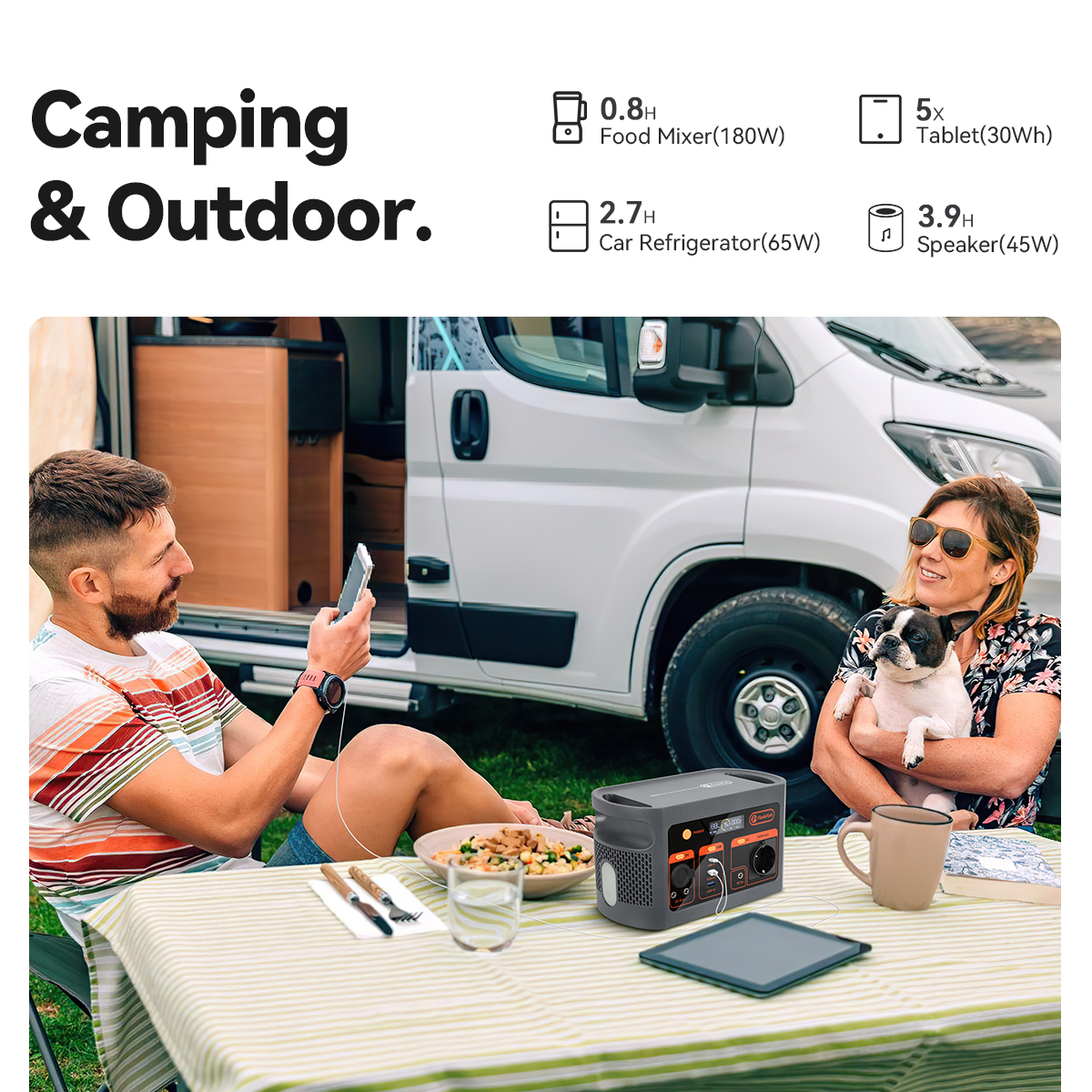
If every device fits the E106B's documented outputs and a measured energy worksheet leaves reserve, carrying about 5.2kg instead of 14.2kg may matter more than unused output. Light camping often fails from packing friction, cable complexity and unmeasured accessory loads rather than from a shortage of headline watts.
The reverse is equally important. Do not choose E106B because it is easier to carry when one essential appliance exceeds 600W, the trip needs more energy between reliable charges, or two 140W USB-C paths and the DJI ecosystem are real requirements. Compactness cannot compensate for a failed electrical or energy gate.
Three light-camping cases
- Carry-sensitive electronics kit: a measured laptop, camera-charger, lights and phones remain within E106B port limits and the energy budget includes reserve. E106B's lower mass can be decisive; verify USB profiles and do not infer charge counts.
- One required load above 600W: the exact regional appliance label and startup evidence rule out E106B. DJI's higher stated output may pass the next screen, but appliance instructions, total load and campsite rules still decide.
- DJI-drone-heavy workflow: named SDC accessories, compatible aircraft batteries and fast-turnaround needs can make the DJI platform materially useful. Confirm every battery, cable and accessory; do not transfer DJI's laboratory charge-time claims to another setup.
Solar, recharge speed and cycle claims need matched methods
E106B documents a 12-30V, 10A, 200W maximum solar/DC input. DJI documents several charging paths, some requiring separately purchased modules or cables. Compare a complete, electrically matched kit rather than a station headline. Cloud, shade, panel temperature, orientation and cable loss can move harvested energy for either product.
Do not compare bare cycle counts or convert them into years without matched cycle definition, temperature, rate, depth and retained-capacity endpoint. This article therefore leaves cycle life outside the decision table instead of rewarding whichever marketing number appears larger.
When each product fits—and when it does not
| Choose E106B when | Choose DJI Power 1000 V2 when | Choose neither when |
|---|---|---|
| All verified loads fit 600W with margin | A required verified load or combined load exceeds the smaller envelope | The exact load and startup evidence are missing |
| A measured 384Wh-class plan leaves reserve | The measured energy budget genuinely needs the larger class | The plan depends on a promised runtime from nominal Wh |
| About 5.2kg materially improves travel | About 14.2kg plus accessories is acceptable | The complete kit cannot be carried or stored safely |
| One 100W and one 30W USB-C path are sufficient | Two documented 140W paths or DJI accessories matter | Protocol, cable, connector or sharing rules are unknown |
| No undocumented app, UPS or expansion feature is required | The documented platform features solve a real trip need | Weather, campsite or continuity constraints remain unresolved |
Common comparison mistakes
- Calling the product with the largest numbers the best light-camping choice.
- Ignoring the 9.0kg station-mass difference and accessory burden.
- Adding USB-C headline watts without checking protocol, cable and simultaneous rules.
- Treating manufacturer laboratory claims as matched independent test results.
- Claiming a price or availability winner without same-country, same-day checkout evidence.
Frequently asked questions
Is E106B better than DJI Power 1000 V2 for light camping?
Neither is universally better. E106B is the lighter, smaller-envelope option when measured loads fit 600W and 384Wh planning is sufficient. DJI Power 1000 V2 offers much more stated energy and output when those needs justify the extra mass and platform complexity.
Which station is lighter to carry?
The published figures are approximately 5.2kg for E106B and 14.2kg for DJI Power 1000 V2, a 9.0kg difference before cables and accessories. Carry comfort still depends on route, handling and the complete kit.
Which has more USB-C output?
The E106B record lists one 100W and one 30W USB-C output. DJI lists two 140W USB-C outputs and requires PD 3.1 support plus suitable EPR cables for each maximum. Verify the device, protocol, cable and simultaneous-use rules.
Can either station run every camping appliance?
No. Check each exact appliance's regional input, startup behaviour, complete simultaneous load, required energy and environmental instructions. A large watt rating does not override appliance restrictions or campsite rules.
Does this comparison include prices or measured runtimes?
No. Prices and availability vary by country and date, and no matched discharge test was performed. Compare current checkout totals separately and measure your own load before estimating trip energy.
Conclusion: buy the envelope your campsite actually uses
E106B is the stronger candidate when verified light loads, a 384Wh-class energy plan and lower carry mass define the trip. DJI Power 1000 V2 is the stronger candidate when its larger energy, output, USB-C or expansion evidence solves a requirement you can name. Compare other verified FlashFish power classes if neither envelope fits.
Sources and evidence limits
- FlashFish Europe E106B page and local product database for E106B specifications and gaps.
- DJI Power 1000 V2 Germany page for current manufacturer specifications, features and footnotes.
- Camping and Caravanning Club guidance for tent-electricity context.
- Electrical Safety First appliance guidance for label and condition checks.
Evidence checked 10 September 2026. This FlashFish-authored comparison contains no side-by-side test, price ranking, runtime, reliability result or universal recommendation.




Оставить комментарий
Этот веб-сайт защищается hCaptcha. Применяются Политика конфиденциальности и Условия использования hCaptcha.