
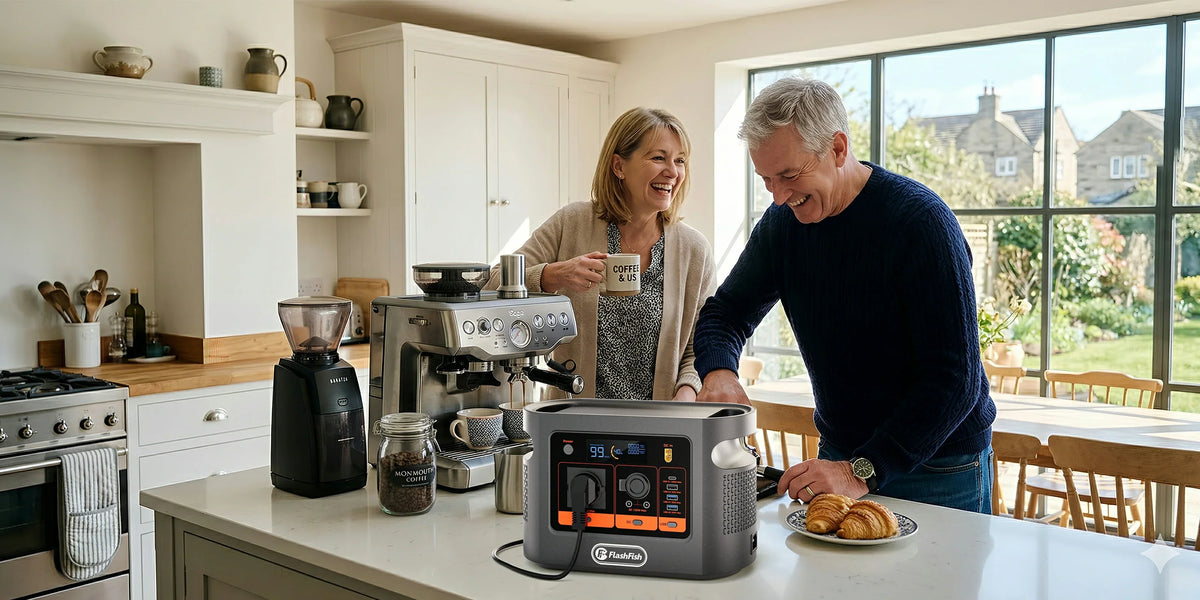
Short answer: choose the FlashFish E106B when the plan includes a USB-C laptop, several devices, more nominal energy or equipment that calls for pure-sine AC. Choose the lighter E200 when the declared kit is genuinely small, its USB-A and checked AC paths are enough, and 151Wh meets the measured session plan. Neither model can keep an internet provider or mobile network online, and neither should be the sole plan for life-critical communications.
Quick comparison for a declared outage kit
| Decision field | FlashFish E106B | FlashFish E200 |
|---|---|---|
| Nominal energy | 384Wh | 151Wh |
| AC output | 600W shared, pure sine, one EU outlet | 200W rated, 400W peak, modified sine, one EU outlet |
| Direct USB | USB-C1 up to 100W; USB-C2 up to 30W; two USB-A outputs up to 30W with documented sharing | Two USB-A QC outputs up to 18W; one 5V/2.4A USB-A; no USB-C documented in the local record |
| Lighting | Built-in 3W light documented | No built-in light is documented in the authoritative local record; plan a separate torch |
| Mass | About 5.2kg | About 1.85kg |
| Best first screen | Mixed USB-C, phone, router and light kit with more reserve | Small USB-A and checked low-power AC kit where carrying weight dominates |
| Main caution | Not a professional 0ms UPS; local chemistry and peak AC are not claimed here | Modified-sine AC, missing AC-frequency/USB-C/EPS evidence and smaller nominal energy |
Use the CONTACT method
- C — Communications chain. List the optical network terminal or modem, router, phone, laptop and any provider-side dependency. Powering local boxes cannot restore an upstream outage.
- O — Output path. Assign every device to USB-C, USB-A, DC or its original AC adapter. A connector that fits is not enough.
- N — Night lighting. Keep a separate battery or wind-up torch. Phone-flashlight use consumes the battery needed for calls.
- T — Total simultaneous demand. Use exact adapter input labels and measured wall demand; do not add unlike USB output and AC input figures as if they were the same.
- A — Available energy and reserve. Nominal Wh is not delivered Wh. Measure a representative setup and reserve energy for calls, alerts and shutdown.
- C — Carry and placement. E200 is far lighter; E106B offers more paths and energy. Keep either unit dry, ventilated and away from blocked exits.
- T — Test and fallback. Practise a controlled cutover, save emergency numbers on paper and keep a non-internet radio or other local-information route.
Three example kits
1. Phones plus a separate battery torch
Both models can be candidates when the phone charging profiles fit their documented USB outputs. E200's lower mass can matter for evacuation or moving between rooms. E106B has more nominal energy and USB-C options. A separate torch preserves phone battery and remains usable if the station is elsewhere.
2. Router or optical terminal, phones and a task light
E106B is the cleaner first screen when the original adapters require pure-sine AC or several paths are used together. E200 may fit only after the exact adapters are confirmed for its 230V modified-sine output and the total load is measured below 200W. Local power still does not establish ISP, cabinet or mobile-network service.
3. USB-C laptop, two phones and lighting
E106B has the stronger documented direct path because USB-C1 reaches 100W and a second USB-C output reaches 30W. The E200 record lists USB-A outputs but no USB-C, so a laptop may need its original AC adapter. That adds conversion loss and makes waveform and adapter checks decisive.
When each model fits
E106B fits better when: the kit uses a USB-C laptop; several devices need independent paths; pure-sine AC is required; 384Wh nominal energy better matches a measured plan; or the built-in light adds practical value. Accept the higher 5.2kg mass and do not treat it as automatic-transfer assurance.
E200 fits better when: the kit is light and USB-A-led; every AC adapter has been checked for 230V modified-sine use; 151Wh meets the measured plan with reserve; and carrying roughly 1.85kg matters more than higher USB-C and energy headroom.
Neither fits when: communication is life-critical, the router or telecare system requires an approved backup unit, the provider network has no backup, the AC adapter requirements are unknown, automatic seamless transfer is mandatory or no alternative contact method exists.
Buyer checklist
- List the modem or optical terminal separately from the Wi-Fi router.
- Record each phone, laptop, radio and light plus its exact charging path.
- Confirm original AC adapter input, output waveform needs and regional plug.
- Measure the complete chain during a representative session.
- Plan nominal Wh, conversion loss and a shutdown reserve without promising duration.
- Keep a battery or wind-up torch separate from the phone.
- Write emergency and network-operator numbers on paper.
- Test what still works when the local internet and mobile network are unavailable.
- Recheck current product status and delivered regional label before buying.
Evidence limits buyers should notice
The current E106B storefront describes battery chemistry, but the authoritative local manual-derived record leaves chemistry blank, so this comparison does not use chemistry to declare a winner. E106B peak AC is also unclaimed. For E200, the local record does not provide AC frequency, USB-C, EPS/UPS or a built-in-light field. Missing evidence is a stop condition for the affected decision, not an invitation to copy a related model.
FAQ
Which model is better for keeping a router online?
E106B is the stronger first screen because it has pure-sine AC and more nominal energy, but only after the exact router and optical-terminal adapters are checked. Neither model ensures that the provider's upstream network remains available.
Can E200 charge a USB-C phone?
Possibly through a suitable USB-A-to-device cable when the phone accepts one of E200's documented USB-A profiles. The local E200 record does not document a USB-C output, so do not promise USB-C Power Delivery.
Does E106B switch over like a UPS?
Do not assume that. The current product page states that it is not a professional 0ms UPS. Plan a controlled, tested changeover and keep communications fallbacks.
How long will either model run a router and lights?
No fixed duration is supported here. Measure the full chain, including all adapters, then use nominal energy, a realistic loss assumption and a reserve. Network availability can end before local battery energy does.
Can either station support medical or telecare equipment?
Do not use this comparison as medical-backup guidance. Follow the equipment provider and clinical or care plan, and use the approved backup solution for any life-critical service.
Conclusion
For most mixed outage communications kits, E106B offers the more flexible evidence-backed path; E200 earns its place when the kit is smaller and carry weight is the controlling constraint. Build the device list first, then Compare E106B and E200 against your CONTACT worksheet and Continue with the Europe buying guide. A powered router is only one link in the communications chain.
Sources and further reading
- FlashFish Europe E106B listing and the local manual-derived E106B record.
- FlashFish Europe E200 listing and the local manual-derived E200 record.
- UK Government Prepare: power cuts for communications-chain and separate-lighting guidance.
- FlashFish Europe portable power station collection for current public product paths.
Evidence note: this is a manufacturer-specification comparison and planning framework, not a side-by-side outage, router or runtime test.



Оставить комментарий
Этот веб-сайт защищается hCaptcha. Применяются Политика конфиденциальности и Условия использования hCaptcha.