
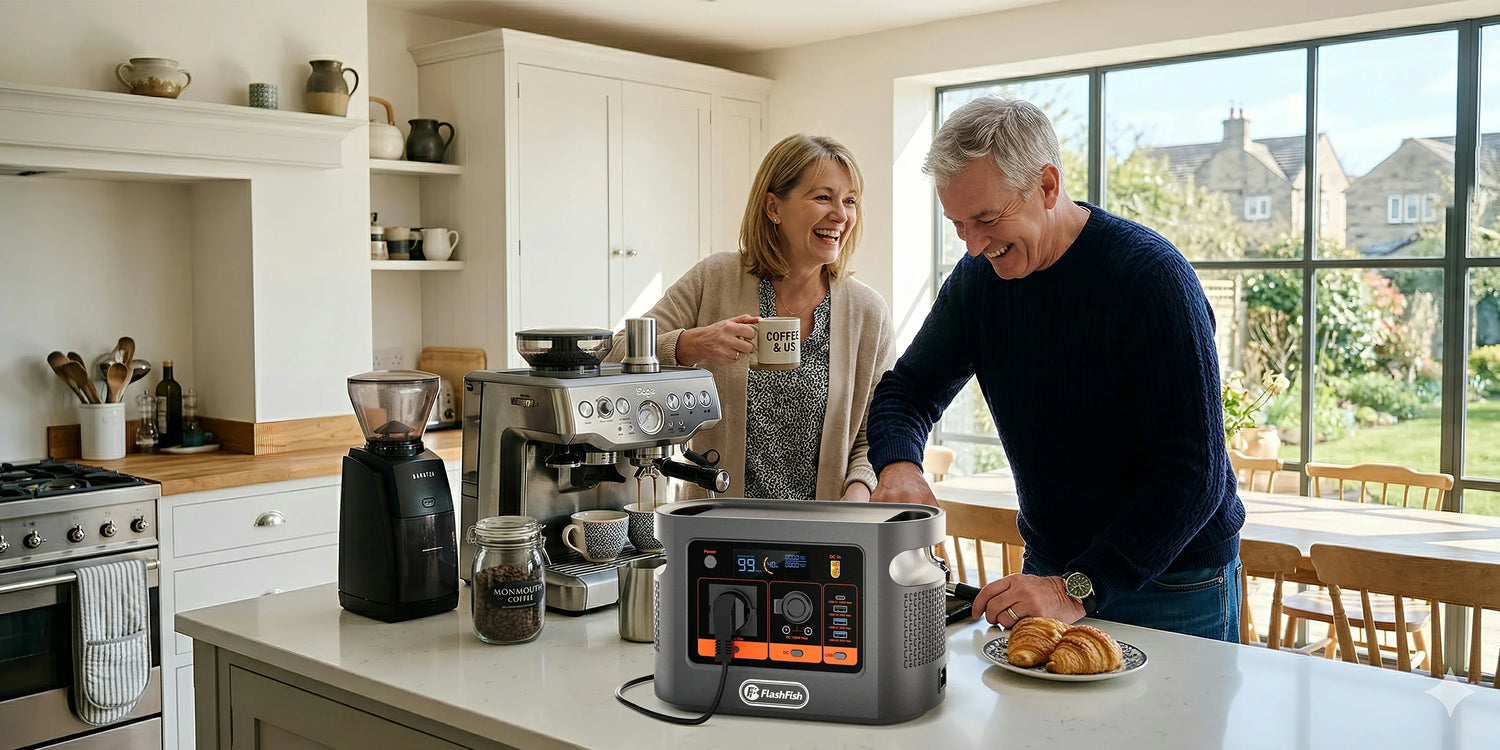
Disclosure: FlashFish authored this comparison. It uses current official pages and the FlashFish product database, not independent testing. No runtime, price, reliability, noise, transfer-time, safety or winner claim is made.
Use ROOM to define apartment backup
| ROOM gate | Question | Evidence needed |
|---|---|---|
| R — Required loads | What must stay powered, and what can remain off? | Exact device and adapter labels; criticality and fallback. |
| O — Output and energy | What runs together, for how long, with what startup behaviour? | Continuous watts, startup/duty cycle and watt-hours—not a brand promise. |
| O — Outlets, inputs and operation | Do the ports, cables, recharge routes and documented continuity features match? | Official port/input specifications and exact regional manuals. |
| M — Mobility and monitoring | Will you carry it upstairs, store it safely, or need app visibility? | Mass, dimensions, dry ventilation space and current first-party app evidence. |
Quick comparison: the trade-off is capacity versus output headroom
| Decision row | FlashFish E106B | EcoFlow RIVER 2 Max | What the row means |
|---|---|---|---|
| Rated capacity | 384Wh | 512Wh | EcoFlow has 128Wh more rated energy before conversion loss and reserve. |
| Continuous AC output | 600W | 500W | E106B has 100W more ordinary paper headroom; startup and exact-device fit remain unproven. |
| Listed mass | 5.2kg | Approximately 6kg | E106B is about 0.8kg lighter on published figures. |
| USB-C maximum | 100W output | 100W input/output | Both can serve a compatible 100W USB-C route; protocols and cables still matter. |
| Solar input ceiling | 200W | 220W | The 20W difference does not establish real solar yield or recharge time. |
| AC input ceiling | 250W | 660W | EcoFlow publishes the higher input ceiling; real charging depends on settings, temperature and source. |
| App/continuity evidence reviewed | No app or transfer-time value in the local database | Wi-Fi/Bluetooth app plus EcoFlow's AC Always-On positioning | EcoFlow documents the broader platform story; it remains a manufacturer claim, not an independent continuity result. |
| Important missing field | Chemistry, peak output and transfer time not provided by the local database | No independent test evidence used here | Missing evidence stays missing; it is not filled by inference. |
Comparison verdict
Choose the E106B class when the measured simultaneous load benefits from 600W continuous headroom, the 384Wh energy plan is sufficient and carrying 5.2kg is preferable. Choose the RIVER 2 Max class when the 512Wh rated-energy advantage, higher charging-input ceilings or EcoFlow's app platform solves a real requirement.
Do not call E106B the better budget alternative without a current price comparison, and do not call RIVER 2 Max the better backup product from a marketing continuity label alone. The winning row must match the apartment's measured job.
Next step: Check E106B against your completed ROOM load list, including every simultaneous device and the reserve you require.
Three apartment profiles
1. Router, phones and one LED light
Either station may pass continuous watts on paper, so energy need, port route, carry/storage and fallback decide the class. GOV.UK guidance warns that a powered router or phone does not guarantee the external internet or mobile network remains available during an outage.
2. Laptop, monitor, router and lights
Add the exact adapter and display labels, not typical values. E106B's 600W ceiling provides more continuous paper headroom; RIVER 2 Max's 512Wh provides more rated energy. A direct compatible USB-C route can matter more than a small headline-watt difference because it avoids another AC adapter conversion step.
3. Compressor, high-heat or critical equipment
A fridge, pump, heater, cooker or medical-critical device is not selected from this table alone. Startup, duty cycle, temperature consequences, earthing/RCD behaviour, regional manual and an approved fallback can outweigh capacity and output. For medical equipment, make a plan with the care team and equipment provider.
Where E106B may fit better
- Your measured load benefits from the 600W continuous class.
- The 384Wh energy class passes with reserve.
- A listed mass of 5.2kg materially helps with stairs or storage.
- You do not require a documented app platform or a comparable transfer-time value.
Where RIVER 2 Max may fit better
- The 128Wh rated-capacity advantage solves a real energy requirement.
- The published 660W AC or 220W solar input ceilings matter to the recharge plan.
- Wi-Fi/Bluetooth app control is part of the operating requirement.
- You prefer EcoFlow's documented platform and first-party AC Always-On positioning, subject to manual and load verification.
When neither is the right fit
- The load group approaches or exceeds the continuous ceiling, has unknown startup demand or lacks a compatible regional manual.
- The plan requires whole-home, hard-wired, back-fed or distribution-board operation.
- Success depends on guaranteed internet, medical, heating, refrigeration or life-safety continuity.
- The station cannot be kept dry, ventilated, stable and clear of exits and sleeping-space hazards.
- The buyer needs a field the evidence does not provide, such as E106B transfer time or independently tested runtime.
What this comparison deliberately excludes
It excludes price because no same-configuration, same-day comparison was required; runtime because neither model was tested with the reader's loads; noise and reliability because manufacturer pages are not independent evidence; and chemistry comparison because the authoritative FlashFish database leaves E106B chemistry blank. Those omissions make the decision narrower and more honest.
FAQ
Is E106B an EcoFlow RIVER 2 Max alternative?
Yes, as a narrower alternative for buyers who value a 600W continuous AC class and lower listed mass. RIVER 2 Max has more rated energy, higher listed AC and solar input ceilings, app control and clearer first-party continuity positioning, so it can be the better fit for those priorities.
Which station has more capacity?
EcoFlow lists RIVER 2 Max at 512Wh, while the FlashFish product database lists E106B at 384Wh. The 128Wh rated difference does not translate directly into a fixed runtime because conversion losses, load behaviour and reserve matter.
Which station has the higher continuous AC output?
E106B is listed at 600W continuous AC output and RIVER 2 Max at 500W. That 100W paper advantage does not prove startup or exact-appliance compatibility, and EcoFlow's X-Boost mode is not treated as ordinary continuous output.
Which station is easier to carry in an apartment?
The FlashFish database lists E106B at 5.2kg; EcoFlow lists RIVER 2 Max at approximately 6kg. The difference is modest, so stairs, storage footprint, handle comfort and the required energy class should decide whether it matters.
Can either station guarantee router or medical-equipment backup?
No such guarantee is made. A powered router does not guarantee the external network remains available, and medical-critical equipment requires a provider- and care-team-approved backup plan. Transfer behaviour, runtime and regional setup must be verified separately.
Sources and evidence notes
- FlashFish Europe E106B page and the local product database — current regional path and bounded FlashFish specifications with missing fields left explicit.
- EcoFlow Europe RIVER 2 Max page — current official competitor specifications and first-party platform claims.
- GOV.UK power-cut preparedness — communications and medical-planning boundaries.
- Electrical Safety First appliance ratings — indicative load examples only.
Editorial viewpoint: ROOM separates output headroom from energy, and product hardware from the broader operating platform. E106B and RIVER 2 Max are alternatives only when the row each wins solves the buyer's measured apartment job.
Compare the next class if needed: Compare other active FlashFish portable power stations rather than forcing an apartment load into E106B.
Evidence checked . Human review is required for both current official pages, exact regional E106B label/manual, competitor-claim framing, author/reviewer credentials, links, metadata, image crop and rendered FAQ/schema parity before publication.



Оставить комментарий
Этот веб-сайт защищается hCaptcha. Применяются Политика конфиденциальности и Условия использования hCaptcha.