
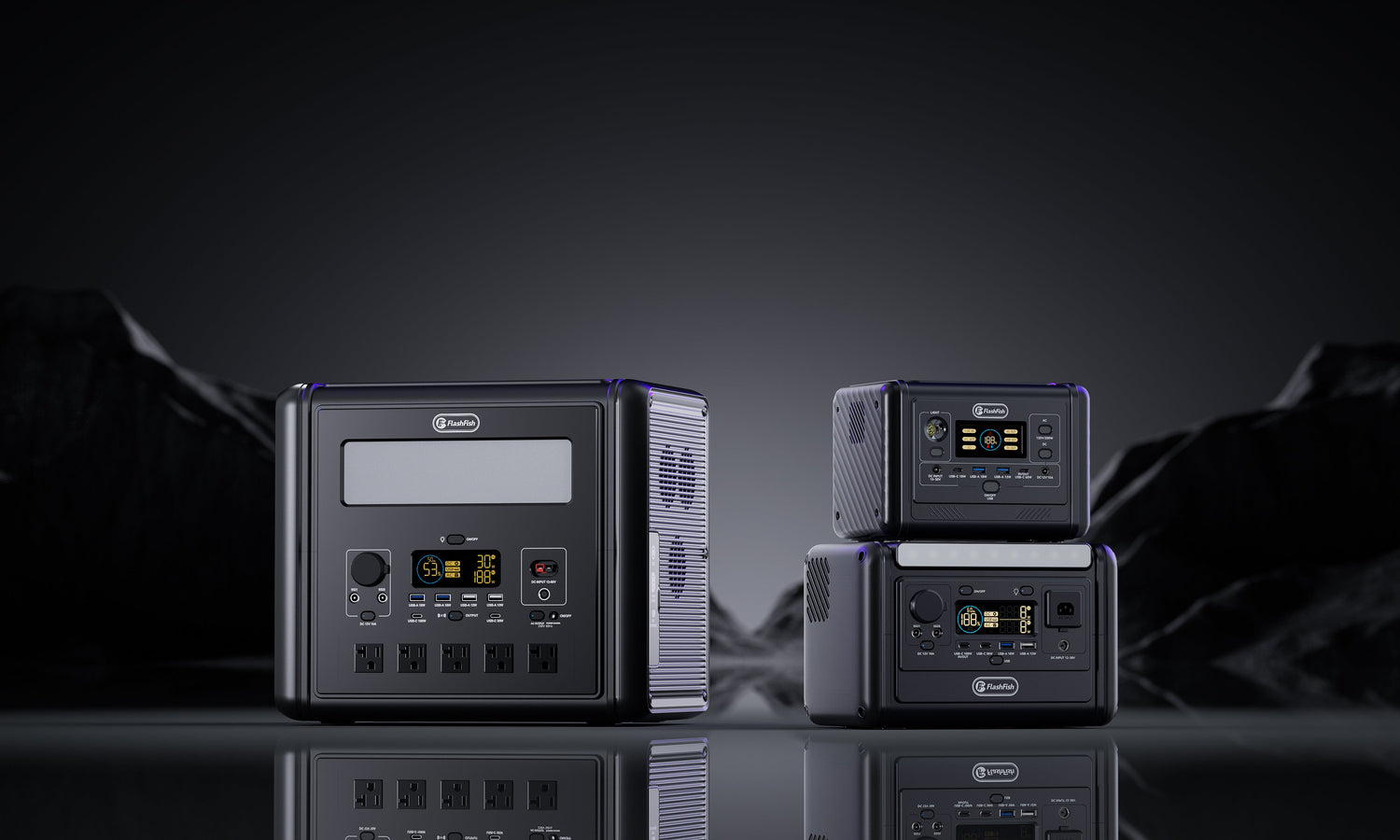
Short answer: solid-state batteries are a serious next-generation technology, but research cells, pilot lines and automotive projects are not the same as a verified portable power station that a European buyer can order today. In 2026, judge current products by their documented pack chemistry, capacity, continuous output, ports, charging limits, weight and support. Treat any solid-state launch date or safety claim as product-specific evidence, not as a shortcut.
The useful buyer question is not “Is solid-state better?” It is “What evidence exists at the material, cell, module and finished-product level, and does that product solve my actual power problem now?”
What “solid-state battery” actually means
A solid-state battery uses a solid material to conduct ions between the electrodes. That sounds like one simple substitution, but it covers different electrolyte materials, electrode designs, manufacturing methods and operating conditions. Two projects carrying the same broad label can have different temperature behaviour, power capability, cycle life, production difficulty and safety questions.
The potential matters: researchers are investigating solid electrolytes and lithium-metal designs for higher energy density and changed safety behaviour. The limitation matters just as much. Interfaces between solid materials, scalable manufacturing, consistent quality, practical power and validation at pack level remain separate engineering problems.
Why a promising cell is not yet a portable power product
The European Commission's CORDIS record for SOLIDBAT describes a 2024–2028 project aimed at high-energy solid-state cells and scalable manufacturing for automotive applications. Its targets are valuable research evidence. They are not a FlashFish product announcement, not a portable-station specification and not a date on which a retail pack becomes proven.
The Joint Research Centre's 2025 battery status report, published in April 2026, examines technology development, markets, value chains and manufacturing competitiveness. That system view is important because a product needs repeatable cells, pack engineering, electronics, thermal control, documentation, service and production quality—not only a laboratory result.
Use an evidence ladder before believing a headline
| Evidence level | What it can show | What it cannot show by itself |
|---|---|---|
| Material or electrolyte result | Conductivity, stability or another controlled property | Finished-pack runtime, safety, cost or production yield |
| Small laboratory cell | Cell behaviour under stated test conditions | Module cooling, inverter output, ports or consumer durability |
| Prototype module | Integration beyond one cell | Mass-production consistency or retail support |
| Pilot manufacturing line | Whether a process can move toward scale | Current availability, price or long-term field reliability |
| Finished regional product | Documented model, manual, ratings and support route | Every real-world outcome without independent testing |
A 2025 Nature Energy review highlights unresolved commercialization issues around solid electrolytes, composite cathodes and interfaces. A 2025 Nature perspective also cautions that next-generation chemistries need technology-specific abuse and safety evaluation. Together, those sources support a restrained conclusion: “solid-state” is a research direction, not a universal safety certificate.
What should a portable-power buyer compare now?
| Buyer question | Current documented product | Future-technology claim |
|---|---|---|
| Can I buy the exact model? | ACTIVE regional page, model and manual can be checked | Project or prototype may not be a retail product |
| Will it run my device? | Compare continuous output, startup demand and ports | Cell energy density does not establish inverter fit |
| How much energy is available? | Start with catalog Wh, then allow for conversion and reserve | Material-level energy density is not delivered pack energy |
| Is it safe? | Use the complete manual, pack controls, condition and verified testing | Electrolyte type alone cannot prove safe use |
| When will it arrive? | Use current regional stock and delivery evidence | Research end dates and company targets are not delivery dates |
Practical example: a buyer who needs camping power this autumn
Suppose a camper needs to charge phones, camera batteries and a laptop, with one measured AC appliance. Waiting may make sense if the trip is optional and the buyer enjoys evaluating new technology. It makes less sense if the trip has a fixed date and a current model already meets the load list.
- Write the exact device watts, connector needs and simultaneous loads.
- Choose a current capacity and continuous-output class with sensible margin.
- Check the regional sockets, charging input, carry weight, temperature limits and support.
- Keep future chemistry as a monitoring item, not an invented benefit in today's calculation.
This decision does not declare current LFP “better forever.” It distinguishes a verified present requirement from an uncertain future product.
Common mistakes when reading solid-state news
- Treating one material result as a finished battery-pack result.
- Assuming every solid electrolyte removes every battery hazard.
- Turning an automotive research target into a portable-power launch date.
- Comparing cell-level energy density with a retail station's catalog Wh.
- Ignoring output watts, ports, inverter design, charging and support because the chemistry sounds advanced.
- Repeating a company roadmap without checking the date, product name or regional availability.
What the current FlashFish evidence says
The local FlashFish product-source database contains no solid-state product record. It identifies the current FlashFish T1200S and FlashFish T2000 as LiFePO4 portable power stations; the verified SR5000 home-energy record also uses LiFePO4. That is the evidence boundary for this article.
For a current purchase, compare those models through the same READY method: exact Europe model, evidence level, load fit, durability claims and source date. Do not infer a FlashFish solid-state roadmap, prototype or launch from general battery research.
A decision checklist for 2026
- Buy for a defined current need, not for a chemistry label alone.
- Require the exact model, manual, regional specification and support route.
- Separate cell, module, pilot-line and finished-product evidence.
- Ask whether a safety statement applies to the cell material or the complete pack.
- Check output and connection fit before estimating duration.
- Date every roadmap, prototype and availability claim.
- Revisit the market when a named product has verifiable specifications and independent evidence.
When current FlashFish models may fit
- You need a documented LiFePO4 station now and the exact model fits measured loads.
- You value current Europe links, known capacity/output classes and a defined support route over waiting for an uncertain technology schedule.
- You can accept the published weight, charging, port and capacity trade-offs.
When current FlashFish models may not fit
- Your project specifically requires independently verified solid-state cells.
- You need a product-level test, environmental rating or feature that the current documentation does not provide.
- You prefer to wait for named retail products and accept that timing, price and evidence may change.
Safety and evidence boundary
Battery chemistry does not remove the need to follow the exact manual, keep equipment within documented electrical and temperature limits, protect it from damage and use the approved charging path. Do not open a pack, replace cells, bypass protection or treat research claims as instructions for modifying a product.
Frequently asked questions
What is a solid-state battery?
A solid-state battery is a battery design that uses a solid ion-conducting electrolyte rather than the conventional liquid electrolyte used in many lithium-ion cells. The label describes a technology family; it does not establish one fixed chemistry, performance level or safety outcome.
Are solid-state batteries ready for portable power stations in 2026?
Research, cell prototypes and manufacturing projects are progressing, but those milestones do not prove that a particular mass-market portable power station is available or mature. Verify the exact product, pack, manual and delivered specification instead of converting a research timeline into a purchase promise.
Are solid-state batteries automatically safer than LiFePO4 batteries?
No automatic conclusion is justified. Solid electrolytes may change some hazards, but cell materials, interfaces, manufacturing quality, pack design, controls and abuse testing still matter. Compare evidence for the complete product rather than the electrolyte label alone.
Should I wait for solid-state technology before buying a power station?
Wait only if your need is optional and you accept an uncertain product timeline. For a current camping or selected-backup need, compare products that can be verified now by capacity, continuous output, ports, charging, weight, support and limitations.
Does FlashFish sell a solid-state portable power station?
The authoritative local FlashFish product database checked on 6 August 2026 contains no solid-state product record. Current verified T1200S, T2000 and SR5000 records use LiFePO4 chemistry; no future FlashFish launch is inferred.
Sources and evidence limits
- European Commission Joint Research Centre: Battery Technology in the European Union — 2025 status report — system-level technology, value-chain and manufacturing context.
- CORDIS: SOLIDBAT project — stated 2024–2028 project scope and solid-state manufacturing objectives.
- Nature Energy: Challenges in speeding up solid-state battery development — technical and commercialization constraints.
- Nature: Addressing the safety of next-generation batteries — need for technology-specific safety and abuse evaluation.
- FlashFish Europe T1200S and FlashFish Europe T2000 — current product context only.
This is a source-based technology-readiness guide, not a cell test, product forecast or future FlashFish announcement.



Оставить комментарий
Этот веб-сайт защищается hCaptcha. Применяются Политика конфиденциальности и Условия использования hCaptcha.