









Short answer: use the output that matches the device's required connector, voltage, current and power. Use AC for a normal mains plug when the appliance fits the station's continuous AC rating. Use USB-C for compatible phones, tablets and laptops when the port supports the device's charging profile. Use a 12V DC outlet only for equipment designed for that DC supply. Do not choose a port only because an adapter happens to fit.
The practical objective is to avoid unnecessary conversions without bypassing compatibility checks. A direct USB-C or suitable DC path can sometimes avoid the station converting battery DC to AC and the device adapter converting it back to DC, but the exact energy difference depends on both products and should not be turned into a fixed efficiency claim.
Why the output choice matters
A portable power station stores energy in a battery as direct current. The U.S. Department of Energy explains that an inverter converts DC electricity into alternating current for standard AC loads. That makes AC output broadly useful, but it also adds a conversion stage. Phones, laptops, routers and many small electronics ultimately operate on DC internally, so their mains chargers convert AC back to a device-specific DC voltage.
This does not make DC automatically better. The correct port is the one the device manufacturer supports. Voltage, connector polarity, protocol and shared-port limits matter more than a theoretical efficiency advantage.
AC, USB-C and 12V DC decision table
| Output path | Use it when | Check first | Common mistake |
|---|---|---|---|
| AC outlet | The device uses its normal European mains plug and stays within the station's continuous AC rating. | Running watts, startup draw, plug condition and waveform needs. | Using peak watts as the normal operating limit. |
| USB-C Power Delivery | The device and cable support a profile available from the station's USB-C port. | Required watts, voltage profile and cable rating. | Assuming every USB-C cable carries the same power. |
| USB-A | The device is designed for ordinary USB charging within the port rating. | Port power and the device's supported charging standard. | Expecting laptop-class power from a low-power USB-A port. |
| 12V car or barrel DC | The appliance manual specifies the station's DC voltage range, connector and polarity. | Voltage, current, polarity, connector and any shared DC limit. | Connecting a look-alike plug without electrical compatibility. |
A useful rule: match the load before optimizing the path
- Find the device label or official power adapter specification.
- Record input voltage, current and watts. If watts are absent, calculate watts only when voltage and current are both known.
- Check whether the station port supplies the required voltage or USB-C charging profile.
- Check whether several ports share one power limit.
- Prefer the simplest supported connection, then test with non-critical equipment before relying on it outdoors or during an outage.
Practical example: laptop, camping light and cool box
| Device | First-choice question | Reasoning |
|---|---|---|
| USB-C laptop | Can the station's USB-C port and cable meet the laptop's stated profile? | If yes, USB-C may remove the need for the laptop's mains adapter. If not, use the approved AC charger within the station rating. |
| Rechargeable camping light | Does it charge from USB-A or USB-C? | Use the supported USB path and keep the light on a stable, dry surface. |
| 12V compressor cool box | Does its manual allow the station's 12V/13V car outlet and startup behavior? | Check the cool box label and the station's shared DC limit; do not infer compatibility from the plug shape alone. |
Common mistakes
- Calling every non-AC connector a universal DC outlet.
- Using an adapter that fits physically but has the wrong polarity or voltage.
- Ignoring shared power limits across several DC or USB ports.
- Assuming USB-C always means 100W charging.
- Leaving the AC inverter on for a tiny USB load when a supported USB port is available.
- Daisy-chaining extension leads or using damaged cables around a power station.
Output-selection checklist
- Device connector and approved charging method identified.
- Voltage, current, watts and USB protocol checked.
- Continuous output used for normal-load planning.
- Startup draw checked for motors and compressors.
- Shared-port limit included in the total.
- Cable and adapter ratings checked.
- Station kept dry, ventilated and away from damaged leads.
FlashFish product context
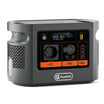
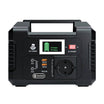
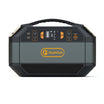
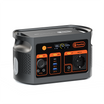
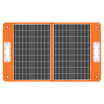
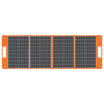
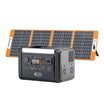
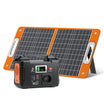
The same method applies across the FlashFish portable power station range. For example, the local product bundle records E103 with a 60W USB-C port, a 300W pure-sine AC output and a shared 120W DC output. T1200S records a 100W USB-C port, 1200W continuous AC output and shared 130W DC output. These are limits to check, not proof that every device in that wattage class is compatible.
Safety note
Use intact cables and connectors, keep the station within its manual limits and do not modify plugs or wiring. Electrical Safety First advises checking extension leads, plugs and sockets for damage, using correctly rated equipment and fully unwinding cable drums to reduce overheating risk.
FAQ
Is DC output always more efficient than AC output?
No. A supported direct DC or USB path may avoid one conversion stage, but actual energy use depends on the station, adapter, cable and device. Do not assume a fixed percentage.
Can I power any 12V appliance from a portable power station?
No. Check the appliance's allowed voltage range, current, connector and polarity, plus the station's DC rating and shared limits.
Should I use USB-C instead of a laptop's AC charger?
Use USB-C only when the station port, cable and laptop support the required charging profile. Otherwise use the laptop's approved mains charger within the AC limit.
Does peak output matter for phone and laptop charging?
Usually continuous port power and protocol compatibility matter more. Peak AC output is mainly relevant to short startup demand from certain motors or compressors.
Can I leave AC output on for a small USB device?
You can only follow the station manual, but a supported USB port is generally the simpler path for a USB device. Exact standby behavior varies by model.
Sources and further reading
- FlashFish product specifications, accessed 2026-06-28: manual-derived E103 and T1200S port and output records. The bundle leaves uncertain values blank.
- FlashFish Europe product listing cache dated 2026-06-26 and EU store Ping on 2026-06-28: active product URLs and Europe store identity.
- U.S. Department of Energy: balance-of-system equipment for the function of DC-to-AC inverters and load matching.
- Electrical Safety First: extensions and leads for cable, plug and extension-lead precautions.
Compare the output panel with your real device labels before choosing any model. The connection path should be supported, not improvised.





Yorum yazın
Bu site hCaptcha ile korunuyor. Ayrıca bu site için hCaptcha Gizlilik Politikası ve Hizmet Şartları geçerlidir.