







Short answer: charge-through means a power station may support output while it is being charged, and EPS means an emergency-power handoff feature on supported models. Neither term means every device will stay on without interruption, and neither removes the need to check load labels, cable ratings, ventilation and the product manual.
These feature names matter because backup shoppers often collapse three separate ideas into one: charging behavior, inverter output and transfer behavior. A useful buying decision keeps them separate.
The three-feature framework
| Term | Plain-English meaning | Buyer check | Boundary |
|---|---|---|---|
| Charge-through | The station may power selected outputs while charging. | Manual support, input source, heat, output load and whether the mode is recommended for long sessions. | It is not permission to overload the station or block ventilation. |
| EPS | Emergency Power Supply handoff on supported products. | Transfer-time wording, device sensitivity, load size and whether a reboot would matter. | It is not the same category as a dedicated UPS for interruption-sensitive equipment. |
| Continuous AC output | The watt limit the inverter is designed to supply steadily. | The highest device or combined device draw. | Peak watts are short moments, not a planning baseline. |
| Stored energy | Watt-hours available before losses and reserve margin. | How long your selected loads need to run. | It is not a fixed runtime promise. |
How FlashFish examples fit
| Model | Product-source facts | Storefront facts checked | Practical interpretation |
|---|---|---|---|
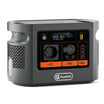
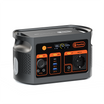
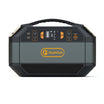
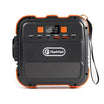
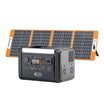
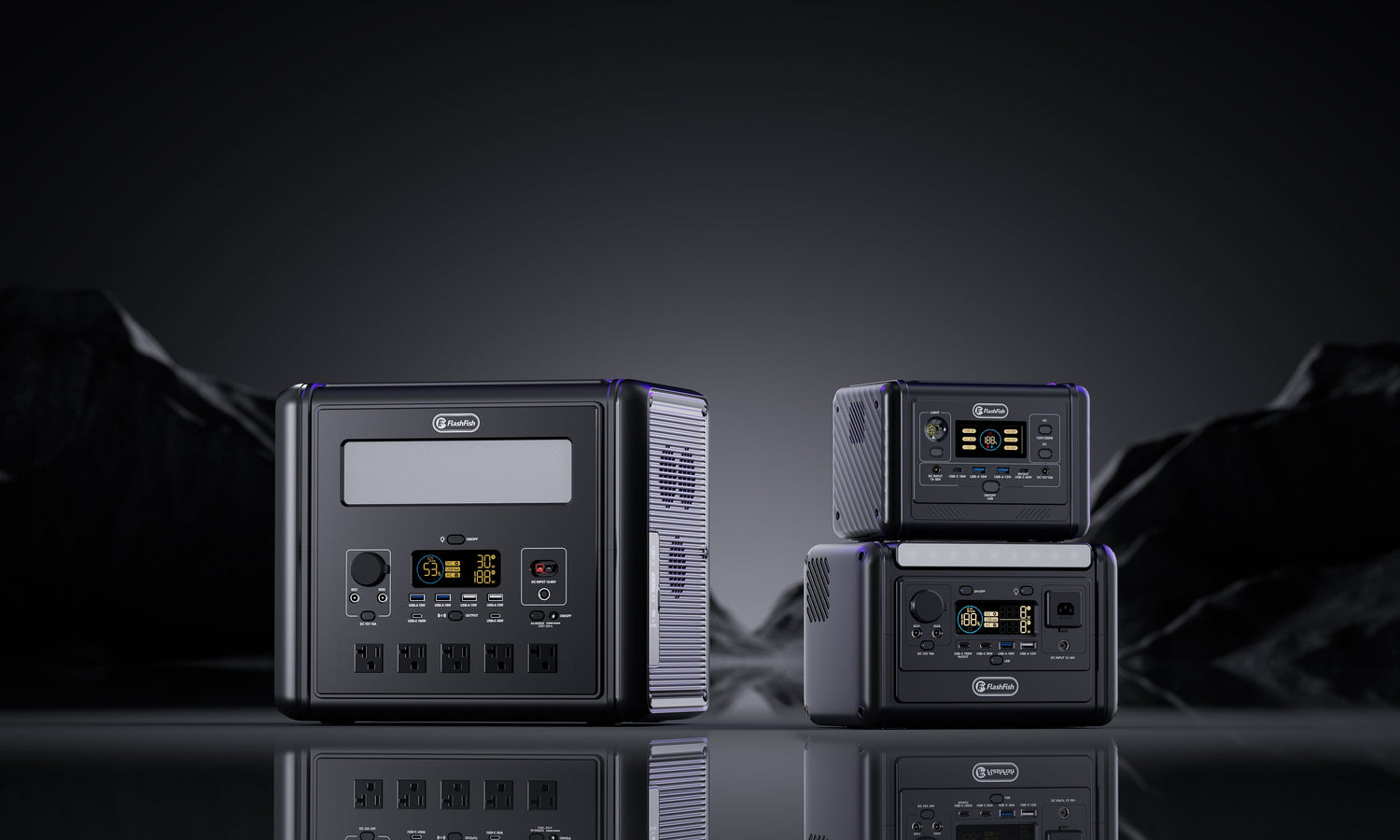
| FlashFish T1200S | 768Wh LiFePO4, 1200W pure sine AC, 2400W peak, 12.45kg; bundle notes power-saving behavior and protection categories. | Europe product page presents 400W max DC/solar input and EPS context. | A movable station for selected-load backup or camping where output and reserve are enough. |
| FlashFish T2000 | 1536Wh LiFePO4, 2000W pure sine AC, 4000W peak, 19.2kg; bundle notes power-saving behavior and protection categories. | Europe product page presents 600W max DC/solar input, 100W USB-C and EPS context. | A higher-capacity movable station for larger selected loads, shared use or longer backup sessions. |
| FlashFish SR5000 | 5120Wh LiFePO4, 2400W rated off-grid AC output, 59kg, grounding and qualified-technician boundaries. | Europe product page positions it as balcony solar storage. | A fixed-storage planning product, not a carryable charge-through/EPS station. |
When charge-through is useful
- You want to top up from a wall socket, vehicle input or solar input while keeping low or moderate loads available.
- The product manual supports the mode and the station has enough ventilation.
- The input source, output load and cable arrangement are all within rating.
- You are using the feature for convenience or selected-load resilience, not for critical interruption protection.
When EPS should be treated carefully
EPS is useful when a short handoff is acceptable and the connected load is within the model rating. It should be treated carefully when the device cannot reboot, when data loss matters, or when a manufacturer requires a dedicated UPS. Desktops, network storage, specialist equipment and safety-critical gear deserve a product-specific review rather than a generic blog answer.
For cables and extension leads, Electrical Safety First advises checking the rating, avoiding extension-to-extension chaining, fully unwinding cable reels when required and treating heat or burn marks as warning signs. That advice belongs in any backup plan because the safest battery is still part of an electrical system.
Decision checklist
- Write the loads down. Use watts from the device label or adapter label, not device names alone.
- Separate continuity needs. A router reboot is annoying; a desktop write operation may be more serious.
- Check the highest AC load. Compare it with continuous AC output, not peak output.
- Check the charging source. Wall, vehicle and solar inputs have different limits and heat behavior.
- Plan ventilation. Do not cover the station or place it on heat-trapping surfaces while charging or discharging.
- Run a non-critical test. Verify your own load combination before relying on it.
When FlashFish fits
- The load list is specific and within T1200S or T2000 output limits.
- The buyer wants a movable selected-load station rather than a permanently installed storage system.
- A short handoff or manual backup behavior is acceptable for the connected devices.
- The setup can be kept dry, ventilated and within cable ratings.
When it does not fit
- The connected equipment cannot tolerate any interruption and requires a dedicated UPS category.
- The plan depends on high-startup or high-heat appliances without checking labels.
- The station would be used under blankets, in a closed cabinet or beside heat sources.
- The requirement is fixed balcony storage, installer review or building permission; that belongs to SR5000-style planning, not a portable EPS article.
FAQ
What does charge-through mean on a portable power station?
It usually means the station can support selected outputs while being charged. The important word is selected: check the specific model manual, input source, load and heat conditions.
Is EPS the same as a UPS?
No. EPS can be useful for backup handoff, but a dedicated UPS is the safer category when connected equipment cannot tolerate interruption or rebooting.
Do T1200S and T2000 have the same backup role?
No. T1200S is the more portable 768Wh, 1200W class. T2000 is the larger 1536Wh, 2000W class. The better fit depends on selected loads, weight and reserve needs.
Can SR5000 be used like a portable EPS station?
No. SR5000 is balcony solar storage with grounding, placement and qualified-technician boundaries in the product-source bundle. Treat it as a fixed-storage planning product.
Can I connect several extension leads to reach the station?
Avoid chaining extension leads. Check the lead rating, fully unwind cable reels when required and stop using any hot, damaged or marked plug or cable.
Should I test a backup setup before relying on it?
Yes. Test the exact device list in a non-critical situation, then adjust loads or choose a different category if any device reboots or exceeds the station rating.
Sources and review notes
- FlashFish product-source bundle, accessed 13 July 2026, for manual-derived product facts and blank-field boundaries.
- FlashFish Europe T1200S product page, accessed 13 July 2026, for current storefront feature wording.
- FlashFish Europe T2000 product page, accessed 13 July 2026, for current storefront feature wording.
- Electrical Safety First overload guidance, accessed 13 July 2026, for cable and socket safety context.
- Health Canada battery safety, accessed 13 July 2026, for general battery handling and charging cautions.



Yorum yazın
Bu site hCaptcha ile korunuyor. Ayrıca bu site için hCaptcha Gizlilik Politikası ve Hizmet Şartları geçerlidir.