









Short answer: state of charge (SoC) estimates how much charge or energy remains on a defined basis; depth of discharge (DoD) describes how much of that defined basis has been removed. They can be complementary in a specified model, but a portable power station's displayed percentage does not automatically reveal cell-level DoD, hidden reserve, usable AC energy or battery health.
Use DEPTH: define the Display basis, identify the Energy basis, keep Protection boundaries intact, read the Test definition, and treat Hidden assumptions as open evidence. This keeps a helpful percentage from carrying claims it cannot support.
SoC and DoD answer different questions
| Term | Useful question | Evidence needed | What it does not prove |
|---|---|---|---|
| State of charge | How much remains on the stated basis? | Manufacturer definition, rated/configured capacity and estimator method | Exact cell voltage, delivered AC Wh, health or runtime |
| Depth of discharge | How much of the stated basis was removed? | Start/end points and capacity basis used by the test or product | A universal safe cutoff or hidden reserve |
| Usable delivered energy | How much energy reaches the chosen output in defined conditions? | Test load, port, temperature, cutoff and conversion path | Identical results for another device or environment |
| State of health | How has present capability changed from a defined reference? | Manufacturer or test method, reference and current measurement | Current SoC or one discharge event |
D — Define the display basis
EU Regulation 2023/1542 defines state of charge as available energy in a battery expressed as a percentage of rated capacity declared by the manufacturer. That gives buyers a useful regulatory anchor: SoC is a percentage tied to a capacity basis, not a direct cell inspection.
A portable station display is therefore best treated as an estimator for operation. Its precise mapping can depend on the manufacturer's sensors, model and reserve strategy. Without product-specific documentation, a displayed 20% should not be relabelled as an exact cell-level quantity.
E — Identify the energy or charge basis
Texas Instruments presents one battery-gauging model in which SoC equals remaining charge divided by maximum charge and DoD equals one minus SoC. On that same defined basis, the two quantities are complements. The simplicity is valuable, but the basis must travel with the equation.
Another document may define DoD for a cycle test, a warranty condition or a system control window. Those uses can share the words while using different starting points, capacity references and cutoff conditions. Compare like with like before converting percentages.
P — Keep protection boundaries intact
A battery management system may reserve capacity or stop discharge to protect cells and connected electronics. The user-visible zero does not, by itself, reveal the physical cell boundary. Never bypass protection, open a station or alter an undocumented cutoff to pursue more energy.
If a station exposes a user setting, follow the exact model and region manual and obtain manufacturer support where the consequences are unclear. Guidance for a configurable home storage system or external monitor is not automatically an instruction for a sealed portable power station.
T — Read the complete test definition
The EU Battery Regulation uses depth of discharge in cycle-life test information and separately refers to deep-discharge events in expected-lifetime information. That demonstrates why DoD matters, but the percentage alone does not establish cycle life. Chemistry, temperature, charge rate, discharge rate, endpoints and test termination all affect interpretation.
When a seller quotes cycles, ask for the exact retained-capacity threshold, DoD, temperature and charge/discharge conditions. Do not compare two cycle numbers if one test basis is missing.
H — Expose hidden assumptions
The Victron BMV-712 manual illustrates how an external battery monitor estimates SoC using configured capacity and charge accounting, including charge efficiency and Peukert-related behaviour. It also requires synchronisation conditions. The lesson is not to copy its settings; it is that an SoC number comes from a method.
For a portable station, hidden assumptions include the capacity basis, estimator update rules, reserve, temperature model, load history and output conversion. If the manufacturer does not publish one of these, record it as unknown instead of filling the gap with a generic percentage.
Three examples prevent common mistakes
| Observation | Tempting conclusion | Defensible reading |
|---|---|---|
| Display falls from 100% to 20% | The cells experienced exactly 80% DoD | The display moved 80 percentage points; cell-level DoD needs the manufacturer's basis and reserve mapping |
| A station is labelled 768Wh | Its AC sockets deliver 768Wh | 768Wh is nominal battery energy; delivered AC energy depends on defined test conditions and conversion |
| A cycle figure uses 80% DoD | Every daily discharge to displayed 20% matches that test | Only the full test protocol can establish whether the bases and endpoints match |
Why nominal Wh, SoC and runtime must stay separate
Nominal watt-hours describe a rated energy quantity. SoC estimates the remaining fraction on a defined basis. Runtime is an outcome of delivered energy and a changing load. A station can display the same SoC while two different devices produce different remaining time because their power paths, efficiency and operating cycles differ.
For purchase planning, measure the exact device's watt-hours over a representative cycle. Add every planned cycle and maintain reserve. Use the displayed SoC for operation, but do not substitute it for a controlled output-energy test.
What the FlashFish evidence does—and does not—publish
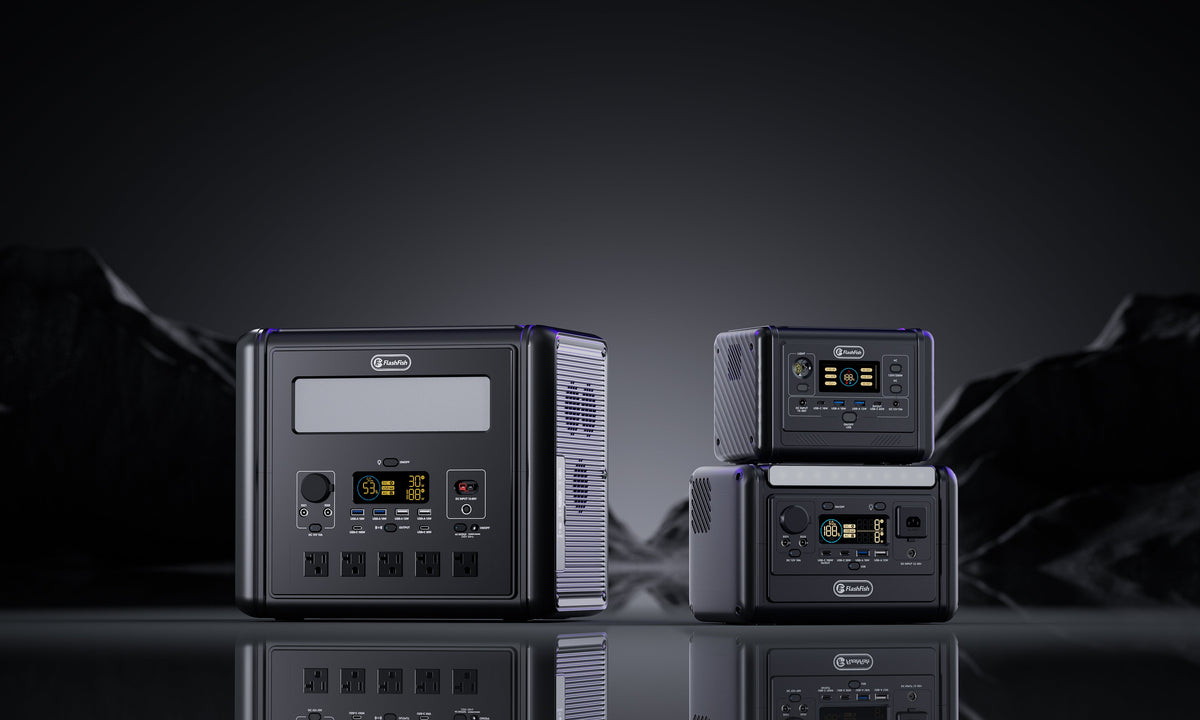
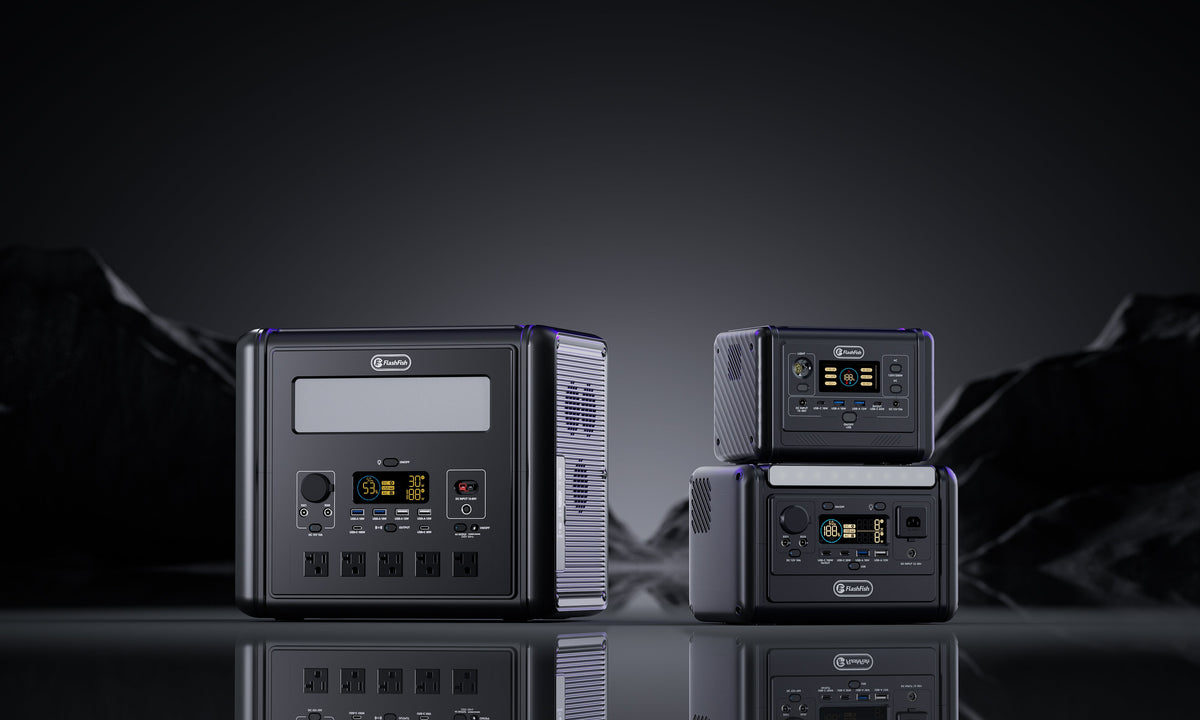
Current FlashFish product records publish model-level nominal energy and external output information that help buyers screen loads. They do not provide one universal cell-level DoD limit, display reserve, BMS cutoff mapping or user calibration method across the category. This article therefore makes none of those model-specific claims.
When comparing a specific model, use its exact Europe page, delivered label and regional instructions. A capacity or battery-chemistry statement from another model cannot fill an unpublished DoD field.
A buyer's DEPTH checklist
- Ask what the displayed SoC percentage is based on.
- Separate nominal battery Wh from measured usable energy at the intended output.
- Keep every manufacturer protection and cutoff intact.
- For cycle claims, record DoD, retained-capacity endpoint, temperature and charge/discharge conditions.
- Mark reserve, cell mapping or calibration as unknown when the exact manufacturer evidence is absent.
Compare published station energy and outputs after defining your load.
FAQ
Is DoD simply 100% minus SoC?
It can be on the same clearly defined basis, as in the TI example. Product displays, cell reserves and test protocols may use another basis, so keep the definition attached.
Does 20% on the display mean 80% cell-level DoD?
Not necessarily. It reports 20% on the display's estimator basis. Hidden reserve and cell mapping require manufacturer evidence.
Does 768Wh mean 768Wh from AC?
No. Nominal battery energy is not delivered AC energy; protection reserve, conversion, standby, temperature and load affect delivery.
Should I change a cutoff to use more capacity?
Do not bypass protections or alter undocumented settings. Follow the exact regional manual and manufacturer support.
Which number should buyers compare?
Compare nominal energy, published usable-energy test conditions, output limits and cycle definitions separately. No single percentage answers every battery question.
Decision
SoC is most useful as an operational estimate, while DoD is useful only when its capacity basis and endpoints are defined. Keep both separate from usable AC energy and state of health. For model selection, use the Europe buying guide without assuming a hidden DoD value.
Sources and evidence boundaries
- EU Regulation 2023/1542 — regulatory SoC definition and DoD test vocabulary.
- Texas Instruments SLUA422 — one defined battery-gauging model linking SoC and DoD.
- Victron BMV-712 Smart manual — an external-monitor example showing that SoC is estimated from configured inputs and accounting.
- FlashFish Europe portable power stations — bounded category and model-selection context; no inferred DoD value.



Yorum yazın
Bu site hCaptcha ile korunuyor. Ayrıca bu site için hCaptcha Gizlilik Politikası ve Hizmet Şartları geçerlidir.