








Short answer: an EU energy label can help estimate how much energy an appliance uses over a defined programme, year or 1,000 hours. It cannot, by itself, show whether a portable power station can start or run that appliance. Use the label for the energy estimate, then check the appliance rating plate and manual for continuous input, startup demand and operating conditions.
This distinction matters because buyers often compare a label in kWh with a battery in Wh and skip the power gate. A credible plan must pass both: enough energy for the intended task and enough output for every instant of operation.
What the EU label is designed to answer
The European Commission describes EPREL as the official EU database for products bearing an energy label. A label and its QR-linked product information sheet help consumers compare energy and environmental performance under the rules for that product group. The unit and test period therefore matter as much as the number.
The label is not a portable-power compatibility certificate. A refrigerator’s annual consumption, a washing machine’s energy per 100 eco cycles and a display’s kWh per 1,000 hours describe different standardised questions. None replaces the model’s electrical rating plate.
Three practical label examples
| EU label example | What it can help estimate | Safe conversion | What it cannot prove |
|---|---|---|---|
| Fridge or freezer: kWh/year | A long-period average energy screen | Label kWh ÷ 365 × 1,000 = average Wh/day | A particular hot day, compressor startup watts, cycling pattern or food-safe runtime |
| Washing machine: kWh/100 cycles | Energy for the labelled eco programme | Label kWh ÷ 100 × 1,000 = standard Wh/cycle | Maximum heater input, another programme, an unbalanced load or startup behaviour |
| TV or monitor: kWh/1,000h | Energy per labelled viewing-hour basis | Label kWh ÷ 1,000 × planned hours × 1,000 = planning Wh | Peak input, HDR/settings differences, attached devices or standby behaviour outside the label case |
These are conversion methods, not product results. Use the exact model’s current label and product information sheet. If the label refers to an eco programme or defined operating mode, carry that condition into the estimate.
A portable power station must pass two different gates
Gate 1: instantaneous power
Find the appliance input watts or current on its rating plate and in the manual. Add every device that may operate at the same time. For motors and compressors, find manufacturer or measured startup evidence rather than assuming a peak rating guarantees compatibility. If the continuous or startup requirement is unknown, the decision is unresolved.
Gate 2: task energy
Translate the energy-label unit into the planned task, then add a conservative reserve for conversion losses, battery-management limits, ambient conditions and uncertainty. Do not present rated battery Wh as measured usable AC energy. For a cycling appliance, one long-period average cannot promise performance in a specific session.
| Decision field | Evidence to collect | Stop condition |
|---|---|---|
| Standard energy | EU label and EPREL product sheet | Unit, programme or model cannot be identified |
| Planned use | Cycles, hours or days for the real task | The standard period does not map credibly to the use case |
| Continuous input | Appliance plate/manual | Combined running load is above the station’s applicable output |
| Startup demand | Manufacturer data or measured evidence | Unknown motor/compressor demand is essential to the plan |
| Available energy | Measured usable energy if available; otherwise a disclosed estimate | The plan needs rated Wh to equal delivered Wh |
The LABEL worksheet
- Scan the label QR code or search the exact model in EPREL.
- Write the energy number, unit, programme or operating mode and model identifier.
- Convert only the portion needed for the planned cycles, hours or days.
- Read the appliance rating plate and manual for watts, current, voltage and startup behaviour.
- Add the maximum combination of devices that can operate together.
- Compare that power with the station’s continuous-output limit using meaningful margin.
- Compare task Wh with a conservative usable-energy estimate and reserve.
- Test the exact setup in a safe, non-critical situation before relying on it.
Common mistakes
- Reading kWh/year as watts. Energy over time and instantaneous power answer different questions.
- Dropping the programme name. A washing-machine figure tied to eco 40–60 is not every cycle.
- Using an average to approve a compressor. Startup and cycling need separate evidence.
- Equating battery Wh with delivered AC Wh. Conversion and system limits intervene.
- Ignoring attached equipment. A screen, router, console or external speaker adds its own load.
- Turning a calculation into a guarantee. A worksheet is a screening tool until the exact setup is measured.
How the method applies to FlashFish models
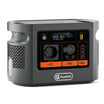
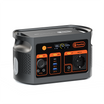
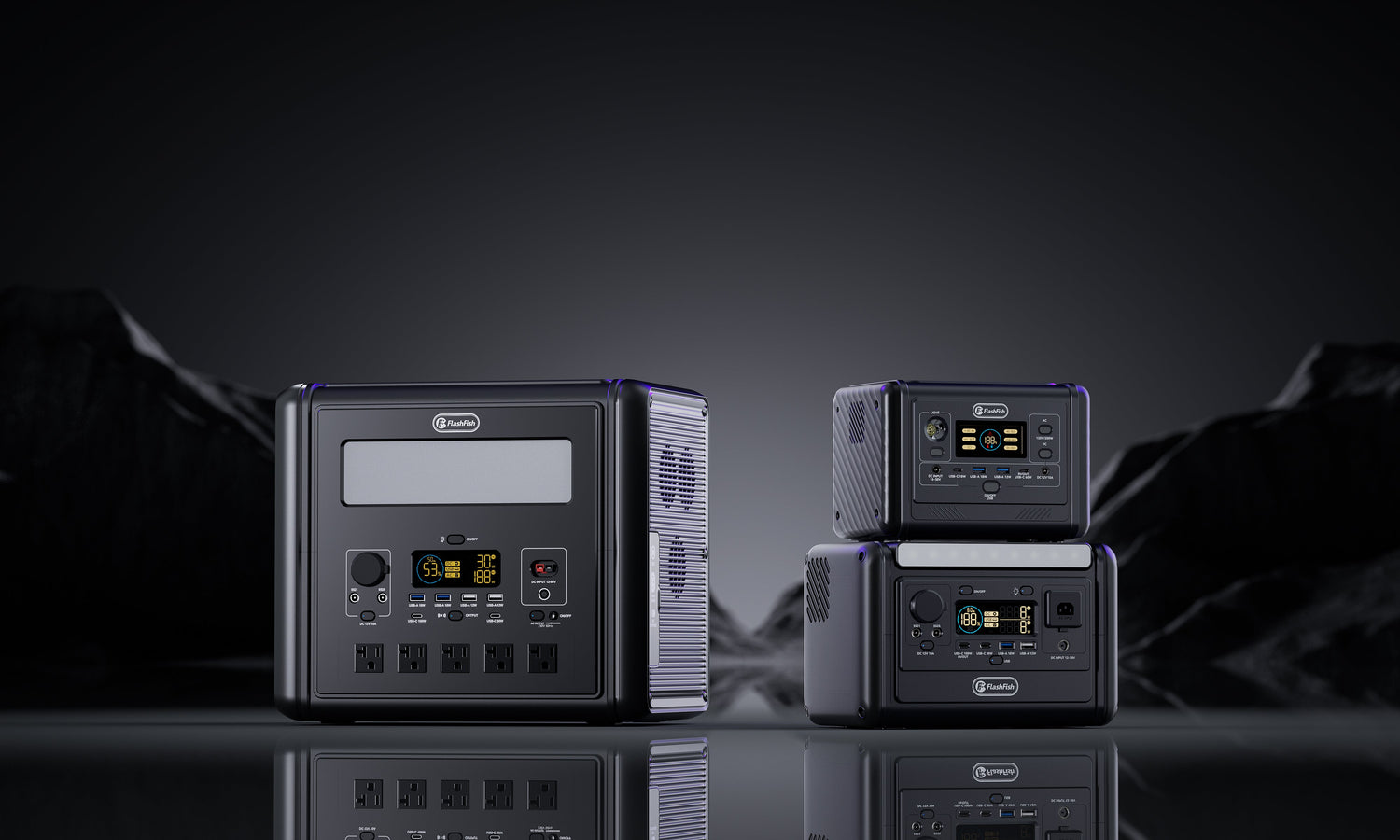
The current FlashFish T1200S is listed with 768Wh rated capacity and 1,200W continuous AC output; the manual-derived product database records the same capacity and continuous-output class. The larger T2000 is listed at 1,536Wh and 2,000W. Those values supply the battery and output sides of LABEL, but they do not replace the appliance evidence.
Use the FlashFish portable power station range only after the appliance passes the electrical ceiling and task-energy checks. The local T1200S manual record is a North American source for some regional fields, so a publication reviewer must confirm the delivered Europe label, sockets and current regional manual before adding voltage- or frequency-specific advice.
When FlashFish fits
- The appliance’s exact continuous and startup requirements are known and fit the selected model with useful margin.
- The energy-label period maps to a realistic task, with losses and reserve disclosed.
- The appliance manual permits the planned environment, cable route and operating method.
When FlashFish does not fit
- The plan depends only on annual or per-cycle kWh and lacks a watt/startup check.
- The load is safety-critical, fixed-wired, medically necessary or cannot tolerate an interruption.
- The calculation requires every rated battery Wh to reach the appliance or promises a fixed runtime.
Safety boundary
Do not connect an appliance when its label, plug, voltage, grounding, startup behaviour or manufacturer instructions are unclear. Never backfeed a household circuit, bypass protection or improvise a cable. Stop using equipment that is wet, damaged, scorched, unusually hot or producing an abnormal smell, and use the official support route.
Frequently asked questions
Does an EU energy label show an appliance’s maximum watts?
Usually not. It commonly reports energy over a defined period or programme. Check the appliance rating plate and manual for input watts, current and any startup demand.
Can annual refrigerator kWh predict one-day battery use?
It can provide a screening average when divided by 365, but it does not reproduce a particular day, room temperature, door-opening pattern, compressor cycle or startup event.
How do I convert kWh per 100 cycles into Wh per cycle?
Divide the label number by 100, then multiply kWh by 1,000. Keep the result tied to the specified programme; it is not a measured value for every cycle.
Why must I still check startup power?
Motor and compressor loads can demand more power when starting than while running. A period-based energy label cannot confirm that short event fits a power station.
Does a 768Wh battery provide 768Wh to an AC appliance?
Do not assume so. Rated capacity is not the same as measured usable AC energy; inverter losses, reserve, conditions and control limits reduce what reaches the load.
Sources and evidence limits
- European Commission: EPREL — official model database and product information sheets.
- European Commission: Fridges and Freezers — annual kWh label format.
- European Commission: Washing Machines — kWh per 100 eco cycles.
- European Commission: Electronic Displays FAQ — kWh per 1,000 hours.
- FlashFish T1200S Europe page and local product-source bundle — product context and manual-derived boundaries.
This article performs no appliance or battery runtime test and gives no compatibility guarantee.
Use LABEL to collect the right evidence first; then choose the smallest station that passes both the power and energy gates with honest margin.



Yorum yazın
Bu site hCaptcha ile korunuyor. Ayrıca bu site için hCaptcha Gizlilik Politikası ve Hizmet Şartları geçerlidir.