







Short answer: verify three things separately: the exact power-station model's documented waveform, the appliance manufacturer's accepted AC supply, and the version and date of both sources. A pure-sine or modified-sine label by itself is not a compatibility result.
Method and limits. FlashFish Miles prepared this guide from current exact-model records, Europe product pages and public manufacturer guidance. No oscilloscope trace, power station or appliance was tested. The E106B and E200 are examples of how to check records, not recommendations for a named appliance.
What the waveform label means
A power station creates AC from stored DC energy. A pure-sine inverter aims to reproduce the smooth alternating waveform associated with grid AC; a modified-sine inverter uses a stepped approximation. The Samlex technical FAQ explains this general distinction and why some loads can behave differently. It does not test FlashFish products or your appliance.
Step 1: identify the exact model and market
Record the full model code, the Europe product URL and any manual revision. Do not transfer a waveform statement from a similarly named station, a different plug version or a bundle page. A search result or marketplace title can be a lead, but the verification should finish on the exact specification or manual.
Step 2: separate waveform from wattage
| Field | Question it answers | What it cannot prove |
|---|---|---|
| Waveform | Pure sine or modified sine? | That the appliance will work correctly |
| Continuous output | What sustained load is documented? | That a motor or compressor will start |
| Peak or surge | What short-duration limit is documented? | That the timing matches the appliance start-up |
| Voltage and frequency | Does the supply match the appliance label? | That grounding or neutral expectations are met |
Step 3: compare the appliance manual
Find the appliance input label and manual. Look for accepted voltage, frequency, watts or amps, start-up demand, grounding instructions and any requirement for a pure-sine inverter. If the manual is silent, ask the appliance manufacturer. Do not treat forum anecdotes or connector fit as approval.
Two exact-model examples
E106B
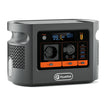
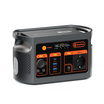
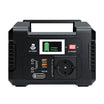
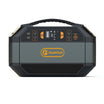
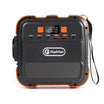
The current E106B Europe page and exact-model record document pure-sine AC output and a 600W shared maximum. That verifies the station label, not a device match.
E200
The current E200 Europe page and exact-model record document modified-sine AC output, 200W continuous output and 400W peak output. Those values still do not approve a particular load.
Step 4: rank evidence by strength
- Exact-model manual or specification for the correct market and revision.
- Current manufacturer product page matching the model code.
- Written clarification from the manufacturer naming the model and question.
- Retailer or marketplace copy, used only as a lead.
- User reports, used only to identify questions, never as a specification.
Step 5: resolve conflicts before buying
If a page says pure sine but a manual says modified sine, or if one source omits the field, stop. Save both URLs, note access dates and request written clarification. Do not average or infer the answer. A missing value remains missing until an authoritative exact-model source supplies it.
A copyable verification worksheet
| Check | Record |
|---|---|
| Station identity | Model, market, plug version, page URL, manual revision |
| Station AC | Waveform, voltage, frequency, continuous output, peak wording |
| Appliance input | Voltage, frequency, watts/amps, start-up demand, waveform rule |
| Open questions | Missing value, source conflict, grounding or neutral requirement |
| Decision | Proceed, seek written confirmation or choose another supply route |
Compare exact Europe model pages only after filling in the appliance side.
Common mistakes
- Calling a peak value continuous output.
- Assuming pure sine automatically solves voltage, surge or grounding questions.
- Assuming a small wattage means modified sine is acceptable.
- Using a review of a neighbouring model as exact-model evidence.
- Continuing when two authoritative sources conflict.
Safety and stop conditions
Follow both manufacturers' instructions, keep connectors and cables undamaged, and stop if a plug, adapter or cable is hot, damaged or behaving abnormally. Electrical Safety First reinforces compatible-equipment and damage checks, but it does not decide waveform compatibility. For medical, life-safety or professionally installed equipment, use the responsible qualified professional's requirements.
FAQ
Is pure sine always required?
No; follow the appliance maker, with extra scrutiny for sensitive or motor loads.
Does pure sine prove compatibility?
No. Voltage, frequency, sustained and start-up demand, and grounding still matter.
Can a title prove waveform?
No. Verify the exact model specification or manual.
What if page and manual disagree?
Pause and request written exact-model clarification.
Do watts and waveform answer the same question?
No. They describe different constraints and must be checked separately.
Conclusion
A credible waveform check is a document trail, not a label copied from a title. Verify the station model, separate waveform from output limits, compare the appliance manual and stop on conflicts. The E106B and E200 examples show how two exact models can have different documented waveforms without turning either record into universal compatibility advice.




Yorum yazın
Bu site hCaptcha ile korunuyor. Ayrıca bu site için hCaptcha Gizlilik Politikası ve Hizmet Şartları geçerlidir.